
 中国人文社会科学核心期刊
Journal of East China Normal University(Educationa ›› 2026, Vol. 44 ›› Issue (7): 45-60.doi: 10.16382/j.cnki.1000-5560.2026.07.004
Previous Articles Next Articles
Congbin Guo, Jiemin Sha, Zhiyuan Gao, Shoudeng Zhang
Online:2026-07-01
Published:2026-06-23
Congbin Guo, Jiemin Sha, Zhiyuan Gao, Shoudeng Zhang. “A Bad Apple” : The Impact of Peers with PE Specialty on High School Students’ Academic Performance[J]. Journal of East China Normal University(Educationa, 2026, 44(7): 45-60.
"
"
| 样本分类 | 变量 | Mean | SD | 差异检验 | 变量 | Mean | SD | 差异检验 |
| 文化生 | 入学成绩 | 502.5 | 0.13 | −15.00** (0.038) | 母亲教育水平 | 3.46 | 1.50 | −0.04 (0.396) |
| 体育生 | 487.5 | 0.18 | 3.42 | 1.38 | ||||
| 全体学生 | 500.2 | 0.14 | 3.46 | 1.50 | ||||
| 文化生 | 性别 | 0.51 | 0.50 | 0.17*** (35.590) | 父亲职业类型 | 8.05 | 3.13 | 0.13 (0.299) |
| 体育生 | 0.68 | 0.47 | 8.18 | 3.06 | ||||
| 全体学生 | 0.52 | 0.50 | 8.06 | 3.13 | ||||
| 文化生 | 年龄 | 16.16 | 0.64 | 0.09 (0.286) | 母亲职业类型 | 8.61 | 3.08 | 0.07 (0.238) |
| 体育生 | 16.25 | 0.65 | 8.68 | 2.78 | ||||
| 全体学生 | 16.16 | 0.64 | 8.62 | 2.78 | ||||
| 文化生 | 户口类型 | 0.08 | 0.27 | 0.01** (5.831) | 家庭经济状况 | 2.84 | 0.51 | −0.10*** (0.001) |
| 体育生 | 0.09 | 0.28 | 2.74 | 0.62 | ||||
| 全体学生 | 0.08 | 0.27 | 2.83 | 0.52 | ||||
| 文化生 | 体质健康 | 3.66 | 0.95 | 0.38*** (0.001) | 班级规模 | 43.07 | 11.57 | −1.99*** (0.001) |
| 体育生 | 4.04 | 0.99 | 41.08 | 12.61 | ||||
| 全体学生 | 3.69 | 0.95 | 42.95 | 11.85 | ||||
| 文化生 | 父亲教育水平 | 3.87 | 1.56 | −0.14* (0.078) | 班级成绩水平 | 0.67 | 0.09 | −0.03 (0.342) |
| 体育生 | 3.73 | 1.50 | 0.64 | 0.12 | ||||
| 全体学生 | 3.86 | 1.56 | 0.67 | 0.09 |
"
| 班级中是否有体育生 | 未匹配成功 | 匹配成功 | 总计 |
| 有 | 37 | 76 | 113 |
| 无 | 2 | 32 | 34 |
| 总计 | 39 | 108 | 147 |
"
| 变量 | 均值 | 匹配后差异 | 偏差下降(%) | T检验 | |||||
| 无体育生班级 (实验组) | 有体育生班级 (控制组) | ||||||||
| 匹配前 | 匹配后 | 匹配前 | 匹配后 | t统计量 | p值 | ||||
| 班级规模 | 41.88 | 42.03 | 43.53 | 42.58 | −5.7 | 60.2% | −1.49 | 0.137 | |
| 班级性别 | 0.48 | 0.48 | 0.53 | 0.48 | 5.0 | 79.1% | 1.17 | 0.244 | |
| 班级年龄 | 16.17 | 16.17 | 16.17 | 16.17 | −1.0 | −300.2% | −0.24 | 0.810 | |
| 班级父亲平均受教育情况 | 3.90 | 3.87 | 3.84 | 3.82 | 9.4 | −15.9% | 1.10 | 0.273 | |
| 班级经济情况 | 2.86 | 2.85 | 2.82 | 2.85 | −2.5 | 91.5% | −0.68 | 0.500 | |
| 班级平均入学成绩 | 0.82 | 0.82 | 0.82 | 0.82 | −6.5 | 13.9% | −0.37 | 0.710 | |
| 班级母亲平均受教育情况 | 3.42 | 3.41 | 3.47 | 3.37 | 5.7 | 20.1% | 1.39 | 0.166 | |
| 重点学校 | 0.24 | 0.22 | 0.13 | 0.22 | −2.7 | 90.6% | −0.62 | 0.538 | |
| 县中 | 0.55 | 0.53 | 0.53 | 0.54 | −1.3 | 49.6% | −0.31 | 0.754 | |
"
| 变量 | 样本 | 实验组 | 控制组 | 差异 | T检验 |
| 卡尺内近邻匹配 | 未匹配 | −0.009 | 0.003 | −0.012 | −0.37 |
| 匹配 | 0.010 | 0.014 | 0.004 | 0.10 | |
| 核匹配 | 未匹配 | −0.009 | 0.003 | −0.012 | −0.37 |
| 匹配 | 0.010 | 0.019 | 0.009 | 0.25 | |
| 局部线性匹配 | 未匹配 | −0.009 | 0.003 | −0.012 | −0.37 |
| 匹配 | 0.010 | 0.016 | 0.006 | 0.13 |
"
| 模型1 | 模型2 | |
| 学生成绩 | 学生成绩 | |
| 体育生比例 | −0.008 | −0.002 |
| (0.019) | (0.019) | |
| 标准化入学成绩 | 0.570*** | 0.577*** |
| (0.018) | (0.018) | |
| 性别 | 0.053* | 0.050** |
| (0.026) | (0.025) | |
| 年龄 | 0.009 | 0.005 |
| (0.021) | (0.021) | |
| 民族 | −0.206** | −0.011 |
| (0.079) | (0.078) | |
| 户口类型 | 0.072** | 0.068** |
| (0.028) | (0.028) | |
| 父亲受教育水平 | −0.004 | −0.005 |
| (0.012) | (0.011) | |
| 母亲受教育水平 | 0.017 | 0.021* |
| (0.012) | (0.011) | |
| 父亲职业类型 | 0.002 | −0.000 |
| (0.005) | (0.005) | |
| 母亲职业类型 | 0.003 | 0.002 |
| (0.004) | (0.005) | |
| 家庭经济情况 | −0.004 | −0.037 |
| (0.025) | (0.028) | |
| 班级规模 | 0.000 | 0.000 |
| (0.001) | (0.001) | |
| 班级性别 | −0.047 | −0.031 |
| (0.027) | (0.060) | |
| 班级年龄 | −0.048* | −0.029 |
| (0.020) | (0.043) | |
| 班级平均父亲受教育水平 | −0.002 | −0.010 |
| (0.146) | (0.061) | |
| 班级平均经济水平 | −0.016 | 0.026 |
| (0.036) | (0.086) | |
| 班级平均入学成绩 | − | |
| ( | ( | |
| 班级平均母亲受教育水平 | −0.011 | 0.002 |
| (0.016) | (0.021) | |
| 学校固定效应 | √ | √ |
| Constant | 0.577* | 0.332 |
| (0.187) | (0.266) | |
| Observations | 4,387 | 5,559 |
| R-squared | 0.324 | 0.334 |
"
| 模型 | F统计量 | P值 | Bootstrap次数 | 临界值 | 门槛 估计值 | ||
| 10% | 5% | 1% | |||||
| 单门槛 | 13.687* | 500 | 11.602 | 18.127 | 22.508 | ||
| 双门槛 | 5.524 | 500 | 13.551 | 19.964 | 26.452 | ||
"
| 学生成绩 | 学生成绩 | ||
| 体育生比例 | 体育生比例 | 文化生样本 | |
| <= | > | 体育生比例<= | |
| 体育生比例 | 0.310* | −0.259** | 0.370** |
| (0.193) | (0.051) | (0.123) | |
| 个体特征 | √ | √ | √ |
| 家庭特征 | √ | √ | √ |
| 班级特征 | √ | √ | √ |
| 学校固定效应 | √ | √ | √ |
| Constant | 0.531 | 0.233 | −0.024 |
| (0.289) | (0.840) | (0.454) | |
| Observations | |||
| R-squared | 0.345 | 0.320 | 0.340 |
"
| 县域高中 | 地市级高中 | |||
| <= | > | <= | > | |
| 体育生比例 | 0.462** | −0.156** | 0.430 | −0.212** |
| (0.191) | (0.063) | (0.596) | (0.094) | |
| 个体特征 | √ | √ | √ | √ |
| 家庭特征 | √ | √ | √ | √ |
| 班级特征 | √ | √ | √ | √ |
| 学校固定效应 | √ | √ | √ | √ |
| Constant | 0.698 | −1.047*** | 0.829 | 0.547 |
| (0.342) | (0.441) | (0.351) | (0.538) | |
| Observations | 506 | 1,781 | 443 | |
| R-squared | 0.337 | 0.359 | 0.364 | 0.293 |
"
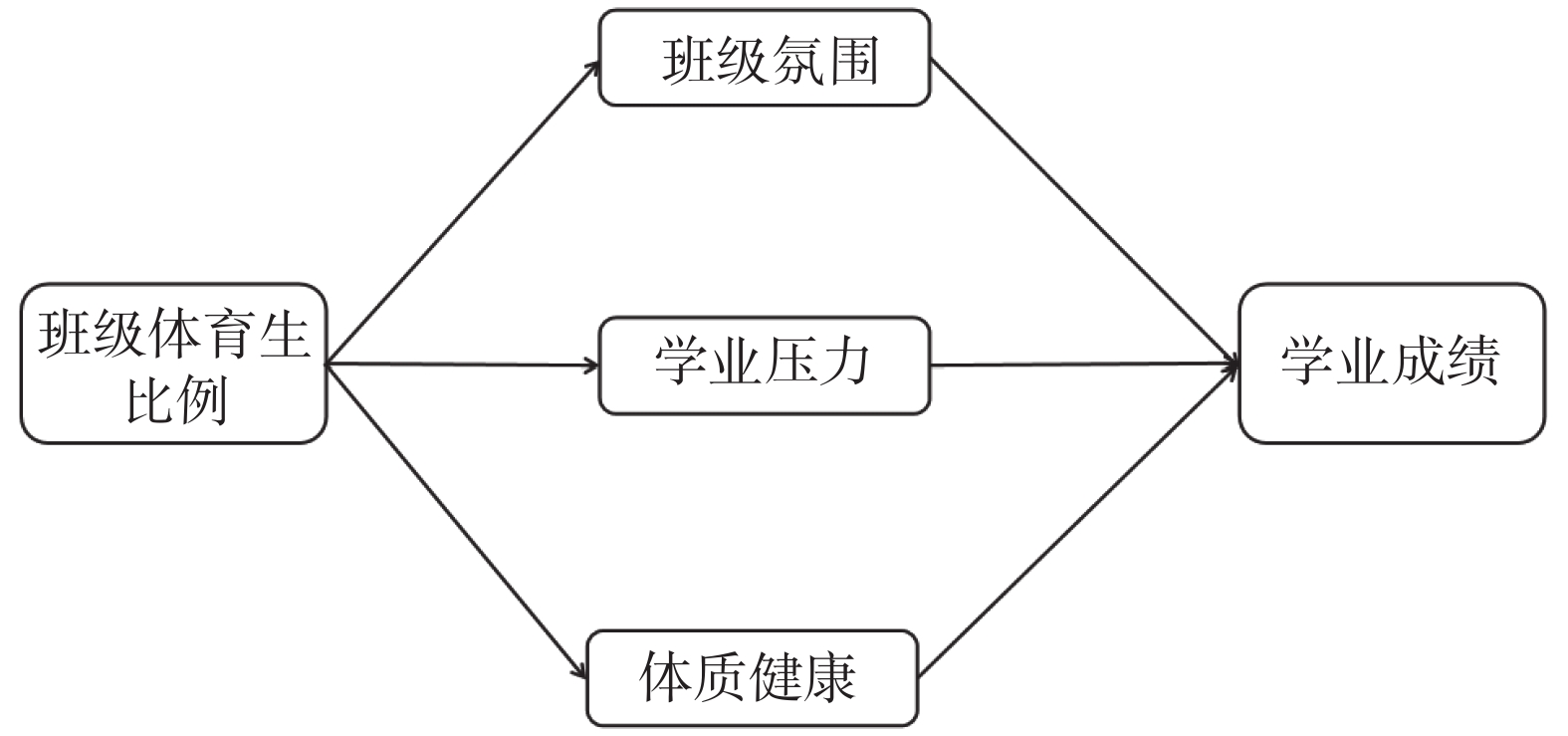
| 机制路径 | 效应类型 | 效应值 | 标准误 | 置信区间 | |
| 下限 | 上限 | ||||
| 班级体育生比例→改善班级氛围→学业表现 | 间接效应 | −0.013 | 0.006 | −0.025 | 0.001 |
| 直接效应 | 0.384 | 0.169 | 0.053 | 0.715 | |
| 班级体育生比例→舒缓学业压力→学业表现 | 间接效应 | 0.118 | 0.031 | 0.057 | 0.179 |
| 直接效应 | 0.253 | 0.085 | 0.086 | 0.420 | |
| 班级体育生比例→增强体质健康→学业表现 | 间接效应 | 0.094 | 0.017 | 0.061 | 0.127 |
| 直接效应 | 0.279 | 0.103 | 0.077 | 0.481 | |
| 曹蕊, 吴愈晓. (2019). 班级同辈群体与青少年教育期望: 社会遵从与社会比较效应. 青年研究, (05), 25- 33+94—95. | |
| 陈颉. (2023). 体教融合背景下高中体育特长生全面发展路径探析. (eds.)第十三届全国体育科学大会论文摘要集——墙报交流(学校体育分会)(八). 成都体育学院. | |
| 陈林会. (2023). 我国青少年业余体校转型发展的时代旨趣与实践策略. 首都体育学院学报, 35 (05), 512- 520. | |
| 陈媛媛, 董彩婷, 朱彬妍. (2021). 流动儿童和本地儿童之间的同伴效应: 孰轻孰重?. 经济学(季刊), 21 (02), 511- 532. | |
| 杜思慧, 成刚, 于文珊. (2023). 体重受同伴影响吗?——基于班级单位的实证考察. 华东师范大学学报(教育科学版), 41 (12), 85- 99. | |
| 方黎明. (2020). 体育锻炼对青少年认知能力和学业成绩的影响. 体育科学, 40(04), 35-41. | |
| 李佳宝. (2015). 不利的身份: 高中体育生生活体验的质性研究. 北京: 北京体育大学硕士学位论文. | |
| 李可伟, 赵子誉, 刘翔. (2025). 体教融合政策在高中体育生培养中的执行梗阻与立体化优化路径. (eds. )第六届国际体育科学大会论文集(上). 阜阳师范大学. | |
| 梁哲, 张羽. (2016). 中小学生身体形态、心肺功能与学业成绩的关系——基于新旧国家体质健康标准的分析. 体育与科学, 37 (05), 89- 97. | |
|
柳鸣毅, 但艳芳, 张毅恒. (2020). 中国体育运动学校嬗变历程、现实问题与治理策略研究. 体育学研究, 34 (03), 64- 77.
doi: 10.15877/j.cnki.nsic.20200522.001 |
|
| 芦晋汉. (2024). 自我的追寻——高校学生运动员的反叛与循规. 北京: 北京师范大学学士学位论文. | |
| 念贵, 任海巍. (2021). 中学体育特长生班级管理的现实困境及破解之策. 体育视野, (12), 57- 58. | |
| 裴丽萍. (2019). 普通高中体育“学困生”脱困解读. 西北成人教育学院学报, (06), 111- 112. | |
| 权小娟, 卢春天. (2020). 青少年体育锻炼中的同伴效应及性别差异. 上海体育学院学报, 44 (04), 41- 49. | |
|
田麦久, 徐刚, 石岩. (2024). 运动训练理论的国际发展与中国学派的建立. 北京体育大学学报, 47 (01), 1- 12.
doi: 10.19582/j.cnki.11-3785/g8.2024.01.001 |
|
| 王霄. (2016). 高中体育特长生科学训练的重要性. 当代体育科技, 6(19), 43+45. | |
| 吴愈晓, 张帆. (2020). “近朱者赤”的健康代价: 同辈影响与青少年的学业成绩和心理健康. 教育研究, 41 (07), 123- 142. | |
| 武玮, & 祁翔. (2019). 流动儿童会影响城市本地儿童的学业表现吗?——基于同伴效应的考察. 教育与经济, (03), 87- 96. | |
| 熊丙奇. (2024). 停止降分录取“体育生”“艺术生”让兴趣特长回归本源. 取自中国青年报(2024年1月17日): https://baijiahao.baidu.com/s?id=1788293222291125327&wfr=spider&for=pc. | |
| 许双成, 张立昌. (2015). 教育公平之殇——分层分班教学. 西北民族大学学报(哲学社会科学版), (04), 184- 188. | |
|
杨桦, 刘志国. (2021). 体教融合: 中国特色竞技体育后备人才培养模式转化与创新. 成都体育学院学报, 47 (03), 1- 8.
doi: 10.15942/j.jcsu.2021.03.001 |
|
| 张瀚文, 安许心. (2025). 教室与操场之间: 体育生的身体经验与道德处境. 华东师范大学学报(教育科学版), 43 (07), 86- 95. | |
| 张烁. (2021). 艺考、高水平运动队考试招生不是“升学捷径”. 取自光明网(2021年9月25日): https://m.gmw.cn/baijia/2021-09/25/1302602524. html. | |
| 宗庆庆, 李雪松. (2018). 基础教育中的同伴效应估计. 财经研究, 44 (07), 4- 15. | |
| 邹红军. (2019). 承认与抵制: 我国普通高中多样化发展的扎根理论研究. 中国教育学刊, (07), 35-41. | |
| 佐藤学, 钟启泉. (2010). "分层教学"有效吗. 全球教育展望, 39 (05), 3- 7. | |
| Aries, E., McCarthy, D., Salovey, P., & Banaji, M. R. (2004). A comparison of athletes and non-athletes at highly selective colleges: Academic performance and personal development. Research in higher education, 45 (6), 577- 602. | |
| Lavy, V., & Schlosser, A. (2011). Mechanisms and Impacts of Gender Peer Effects at School. American Economic Journal: Applied Economics, 3 (2), 1- 33. | |
| Brunello, G., & Rocco, L. (2013). The effect of immigration on the school performance of natives: Cross country evidence using PISA test scores. Economics of Education Review, 32, 234- 246. | |
| Carrell, S. E., Hoekstra, M., & Kuka, E. (2018). The Long-Run Effects of Disruptive Peers. American Economic Review, 108 (11), 3377- 3415. | |
| Carrell, S. E., Sacerdote, B. I., & West, J. E. (2013). From natural variation to optimal policy? The importance of endogenous peer group formation. Econometrica, 81 (3), 855- 882. | |
| Contini, D. (2013). Immigrant background peer effects in Italian schools. Social Science Research, 42 (4), 1122- 1142. | |
| Dee, T. S. (2014). Stereotype threat and the student‐athlete. Economic Inquiry, 52 (1), 173- 182. | |
| Engel, C. (2023). How little does it take to trigger a peer effect? An experiment on crime as conditional rule violation. Journal of Research in Crime and Delinquency, 60 (4), 455- 492. | |
| Feld, J., & Zölitz, U. (2017). Understanding peer effects: On the nature, estimation, and channels of peer effects. Journal of Labor Economics, 35 (2), 387- 428. | |
| Finnell, C. (2022). The Impact of Peer Mentoring on Freshmen Student-Athlete Retention and Experience. Lindenwood University. | |
| Frattini, T., & Meschi, E. (2019). The effect of immigrant peers in vocational schools. European Economic Review, 113, 1- 22. | |
| Geisner, I. M., Grossbard, J., Tollison, S., & Larimer, M. E. (2012). Differences between athletes and non-athletes in risk and health behaviors in graduating high school seniors. Journal of child & adolescent substance abuse, 21 (2), 156- 166. | |
| Hanushek, E. A., Kain, J. F., & Rivkin, S. G. (2009). New evidence about Brown v. Board of Education: The complex effects of school racial composition on achievement. Journal of Labor Economics, 27 (3), 349- 383. | |
| Harrison, C. K., Martin, B. E., & Fuller, R. (2015). “Eagles don’t fly with sparrows”: Self-determination theory, African American male scholar-athletes and peer group influences on motivation. The Journal of Negro Education, 84 (1), 80- 93. | |
| Heil, J. (2014). A Comparison in the Academic Achievement of High School Athletes vs. Non-athletes in the State of Kansas (Doctoral dissertation, Northwest Missouri State University). | |
| Hood, A. B., Craig, A. F., & Ferguson, B. W. (1992). The impact of athletics, part-time employment, and other activities on academic achievement. Journal of College Student Development, 33 (5), 447- 453. | |
| Hoxby, C. M., & Weingarth, G. (2005). Taking race out of the equation: School reassignment and the structure of peer effects (No. 7867). Working paper. | |
| Hu, F. (2018). Migrant peers in the classroom: Is the academic performance of local students negatively affected?. Journal of Comparative Economics, 46 (2), 582- 597. | |
| Imberman, S. A., Kugler, A. D., & Sacerdote, B. (2012). Katrina’s children: Evidence on the structure of peer effects from hurricane evacuees. American Economic Review, 102 (5), 2048- 2082. | |
| Jensen, P., & Rasmussen, A. W. (2011). The effect of immigrant concentration in schools on native and immigrant children’s reading and math skills. Economics of Education Review, 30 (6), 1503- 1515. | |
| Jõesaar, H., Hein, V., & Hagger, M. S. (2011). Peer influence on young athletes' need satisfaction, intrinsic motivation and persistence in sport: A 12-month prospective study. Psychology of Sport and Exercise, 12 (5), 500- 508. | |
| Jones, G. J., Hyun, M., Edwards, M. B., Casper, J. N., Bocarro, J. N., & Lynch, J. (2020). Is “school sport” associated with school belongingness? Testing the influence of school sport policy. Sport Management Review, 23 (5), 925- 936. | |
| Peng, Y., & Bai, X. (2024). Identifying social tipping point through perceived peer effect. Environmental Innovation and Societal Transitions, 51, 100847. | |
| Pestana, E. R., de Carvalho, W. R. G., de Menezes Nunes, L. A., Almeida Junior, F. D. A. D. S., & Salvador, E. P. (2018). Sports practice and factors associated with school performance in grade and high school: comparison between athletes and non-athletes. Sport Sciences for Health, 14 (3), 639- 644. | |
| Richard, S., & Aries, E. (1999). The Division III student-athlete: Academic performance, campus involvement and growth. Journal of College Student Development, 40 (3), 211- 218. | |
| Sacerdote, B. (2011). Peer effects in education: How might they work, how big are they and how much do we know thus far? In Handbook of the Economics of Education (Vol. 3, pp. 249-277). | |
| Seaton, M., Marsh, H. W., & Craven, R. G. (2010). Big-fish-little-pond effect: Generalizability and moderation—Two sides of the same coin. American Educational Research Journal, 47 (2), 390- 433. | |
| Shulman, J. L., & Bowen, W. G. (2001). The Game of Life: College Sports and Educational Values. Princeton: Princeton University Press. | |
| Tomon, J. E., & Ting, S. R. (2010). Effects of team climate on substance use behaviors, perceptions, and attitudes of student-athletes at a large, public university. Journal of College Student Development, 51 (2), 162- 179. | |
| Tran, A. G., Holzapfel, J., Lam, C. K., & Eustice, K. L. (2023). Race and student-athlete status: Peer appraisals of academic skills, intelligence, and favorability. Journal of Diversity in Higher Education, 16 (3), 346. | |
| Tran, C., & Zheleva, E. (2022). Heterogeneous peer effects in the linear threshold model. Proceedings of the AAAI Conference on Artificial Intelligence, 36 (4), 4175- 4183. | |
| Trogdon, J. G., Nonnemaker, J., & Pais, J. (2008). Peer effects in adolescent overweight. Journal of Health Economics, 27 (5), 1388- 1399. |
| Viewed | ||||||
|
Full text |
|
|||||
|
Abstract |
|
|||||
