
 中国人文社会科学核心期刊
Journal of East China Normal University(Educationa ›› 2026, Vol. 44 ›› Issue (8): 51-69.doi: 10.16382/j.cnki.1000-5560.2026.08.003
Previous Articles Next Articles
DeepSeek, Pei Guo1( ), JingQi Huang1, Jin Zhai1, Yue Zhou1
Accepted:2026-05-12
Online:2026-08-01
Published:2026-06-23
DeepSeek, Pei Guo, JingQi Huang, Jin Zhai, Yue Zhou. Research on the Effect of Teacher Rotation Policy Based on Multi-Agent Simulation: Simulation Evidence from an “Educational Ecosystem” Model[J]. Journal of East China Normal University(Educationa, 2026, 44(8): 51-69.
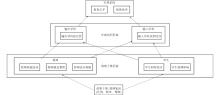
"
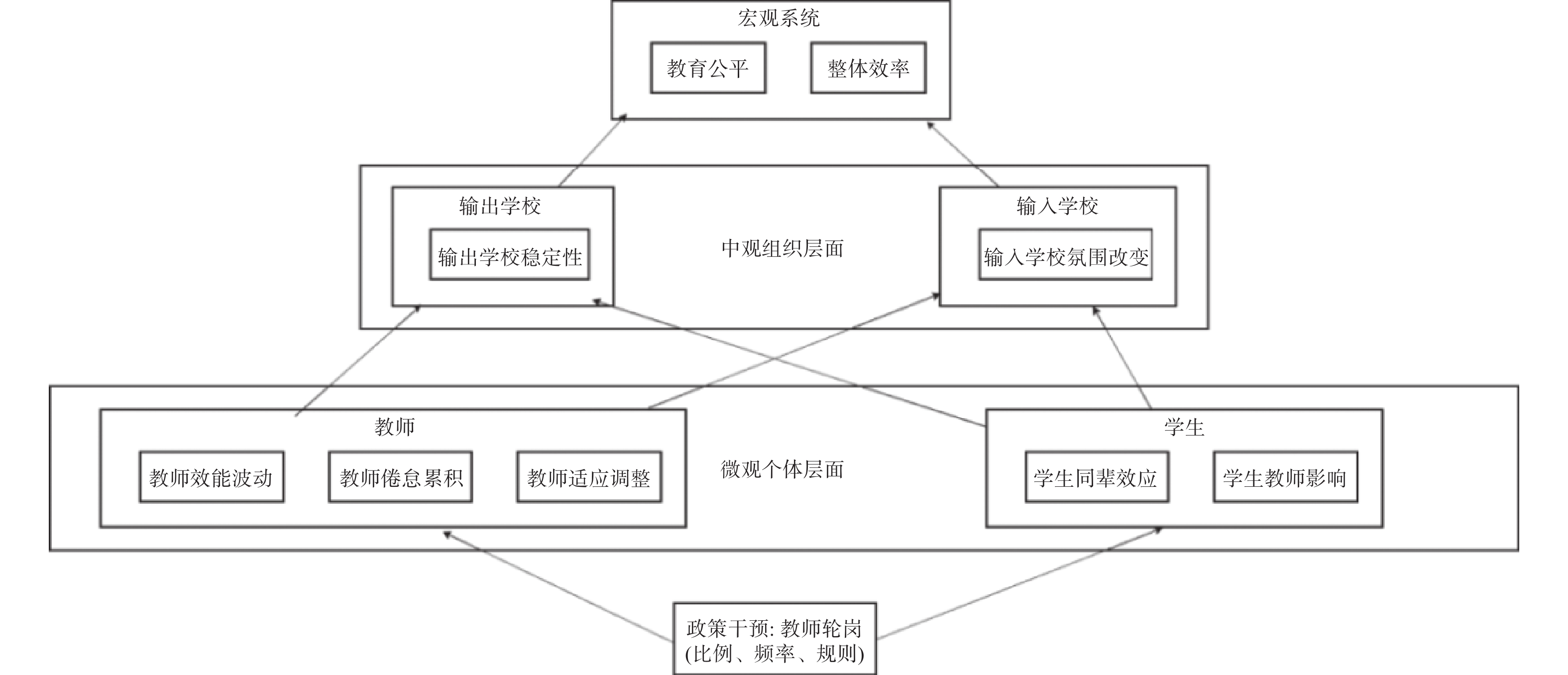
Table 1
Definition and parameter settings of student agent attributes"
| 属性名称 | 变量符号 | 分布类型/初始值 | 参数依据 |
| 基础能力 | base_ability | float:N(70,152) | 依据PISA测试成绩分布特征,标准化为均值70,标准差15,以反映学生群体的认知能力差异。 |
| 毅力 | perseverance | float:Beta(2,2) | 依据教育心理学研究,毅力通常不呈正态分布而呈偏态,故采用Beta分布模拟多数学生具有一定毅力、少数学生毅力极强或极弱的现实。 |
| 家庭资本 | family_capital | float:U(20,80) | 依据社会经济地位调查数据,设定其服从均匀分布,以模拟家庭背景的差异性及其对教育的潜在影响。 |
| 社交活跃度 | social_activity | float:Beta(1.5,1.5) | 依据社交行为研究,假设学生的社交倾向呈对称分布,采用对称参数Beta分布进行模拟。 |
| 知识水平 | knowledge | float | 动态状态变量,表示学生在时间步t所掌握的知识总量,初始值由其基础能力和家庭资本共同决定。 |
| 学习容量 | learning_capacity | float | 受基础学业能力和家庭文化资本影响的个体学习上限,体现“天花板效应”,其计算公式见下文。 |
Table 2
Behavioral rules and learning mechanisms of student agents"
| 模块 | 数学表达/伪代码 | 说明 |
| 知识增长 模块 | 学习容量计算:综合先天能力与后天环境设定个体成长极限。 | |
| 逻辑斯蒂增长模型:此为核心创新点,模拟知识增长的非线性过程。初始阶段快速提升,接近容量极限时增速放缓,有效避免传统线性模型的失真,更贴合真实学习规律。 | ||
| 社交影响 模块 | if random()<social_activity_i: j=随机选择社交网络邻居 if knowledge_j>knowledge_i: # 非线性收益:差距适中时收益最大 optimal_gap = 15 # 最佳学习差距 | 非线性社交学习:此机制体现经典的“最近发展区”理论。当学生i与同伴j的知识水平存在适度差距(设定最佳差距optimal_gap为15)时,学习收益最大;差距过小则缺乏学习动力,差距过大则超出理解范围。这精准地模拟同辈效应的复杂性与条件性。 |
Table 3
Definition and parameter settings of teacher agent attributes"
| 属性名称 | 变量符号 | 分布类型/初始值 | 参数依据 |
| 教学效能 | teaching_efficacy | float:N(75, 152) | 依据教师效能研究的分布特征,设定其服从正态分布,反映教师队伍教学能力的自然差异。 |
| 毅力 | adaptability | float:Beta(2.5,2) | 依据组织行为学理论,教师适应新环境的能力呈偏态分布,故采用Beta分布模拟多数教师具备中等以上适应能力的现实。 |
| 家庭背景 | family_capital | float:U(20,80) | 依据社会经济地位调查数据,设定其服从均匀分布,以模拟家庭背景的差异性及其对教育的潜在影响。 |
| 抗压能力 | stress_resilience | float:Beta(2, 3) | 依据职业心理学研究,个体对工作压力的复原力存在差异,采用Beta分布模拟其异质性。 |
| 恢复计数器 | recovery_counter | Int: 0 | 状态变量,记录教师轮岗后经历的恢复时间,用于计算其教学效能的恢复程度。 |
Table 4
Behavioral rules and status update mechanisms of teacher agents"
| 模块 | 数学表达/伪代码 | 说明 |
| 职业倦怠 动态(非线性累积) | teaching_pressure = (班级能力差异系数) × (班级规模/35) | 工作压力源 |
| administrative_pressure = 0.3 | 行政事务基础压力 | |
| adjustment_pressure = 0.0 | 轮岗适应压力 | |
| adjustment_pressure = 0.4 × (1 − adaptability) | 轮岗状态 | |
| 非线性倦怠累积模型 | ||
| if pressure_total < 0.4: | 恢复机制(非线性衰减) | |
| 教学效能计算 | 效能受倦怠影响的非线性衰减:采用指数函数模拟倦怠对效能的侵蚀作用,初期影响显著,后期趋于平缓,符合边际效用递减规律。 | |
| if 轮岗状态 and recovery_counter < 恢复周期: | 轮岗适应期调整:轮岗初期,教师的 教学效能会因其适应能力不足而受到 额外惩罚,该惩罚随恢复时间的推移呈指数衰减,模拟教师在新环境中的逐步适应过程。 |
Table 5
Definition and calculation basis of school agent attributes"
| 属性名称 | 变量符号 | 计算与更新方式 | 参数与理论依据 |
| 平均文化资本 | avg_family_capital | 每学期初计算 | 反映学校的生源社会经济背景,是衡量校际差异和教育起点的关键指标。 |
| 组织氛围 | organizational_climate | 动态合成计算,详见下方规则。 | 综合反映学校的教学环境质量,是影响师生效能的关键组织变量。 |
| 教师凝聚力 | teacher_cohesion | (可选)可基于教师流失率与校龄结构反向估算。 | 表征教师队伍的稳定性与协作程度,是组织氛围的组成部分。 |
Table 6
Dynamic calculation model of the school's organizational climate"
| 计算要素 | 数学表达/伪代码 | 说明与理论内涵 |
| 教师稳定性效应 | stability_effect = 1 − (当期离职教师数 / 教师总数) / 0.2 | 该计算将教师离职率归一化。假设当年离职率超过20%时,稳定性效应降为0,体现高频教师流动对组织氛围的毁灭性打击。 |
| 学生多样性效应 | diversity_index = 1 − 2 × |0.5 − 学生能力基尼系数| | 此为核心创新点,模拟学生能力构成的“倒U型”影响。当学生能力分布极度均质或极度差异时,多样性效应均不佳;而在适度差异时效应最强,符合组织多样性研究的经典理论。 |
| 资源饱和效应 | 采用饱和函数模拟资源的影响。当平均文化资本达到一定阈值(60)后,其带来的边际效益递减,反映资源投入的饱和现象。 | |
| 组织氛围合成 | 组织氛围是三大要素的加权综合。其中教师稳定性被赋予最高权重(0.4),强调教师队伍稳定是学校组织健康的基石。 |
Table 7
Configuration of core experimental parameters"
| 属性名称 | 变量符号 | 计算与更新方式 | 参数与理论依据 |
| 政策参数 | 轮岗频率 | 10时间步/次 | 模拟常见的学年制轮岗周期 |
| 轮岗比例 | 20% | 平衡政策强度与系统稳定性,属于中等干预强度 | |
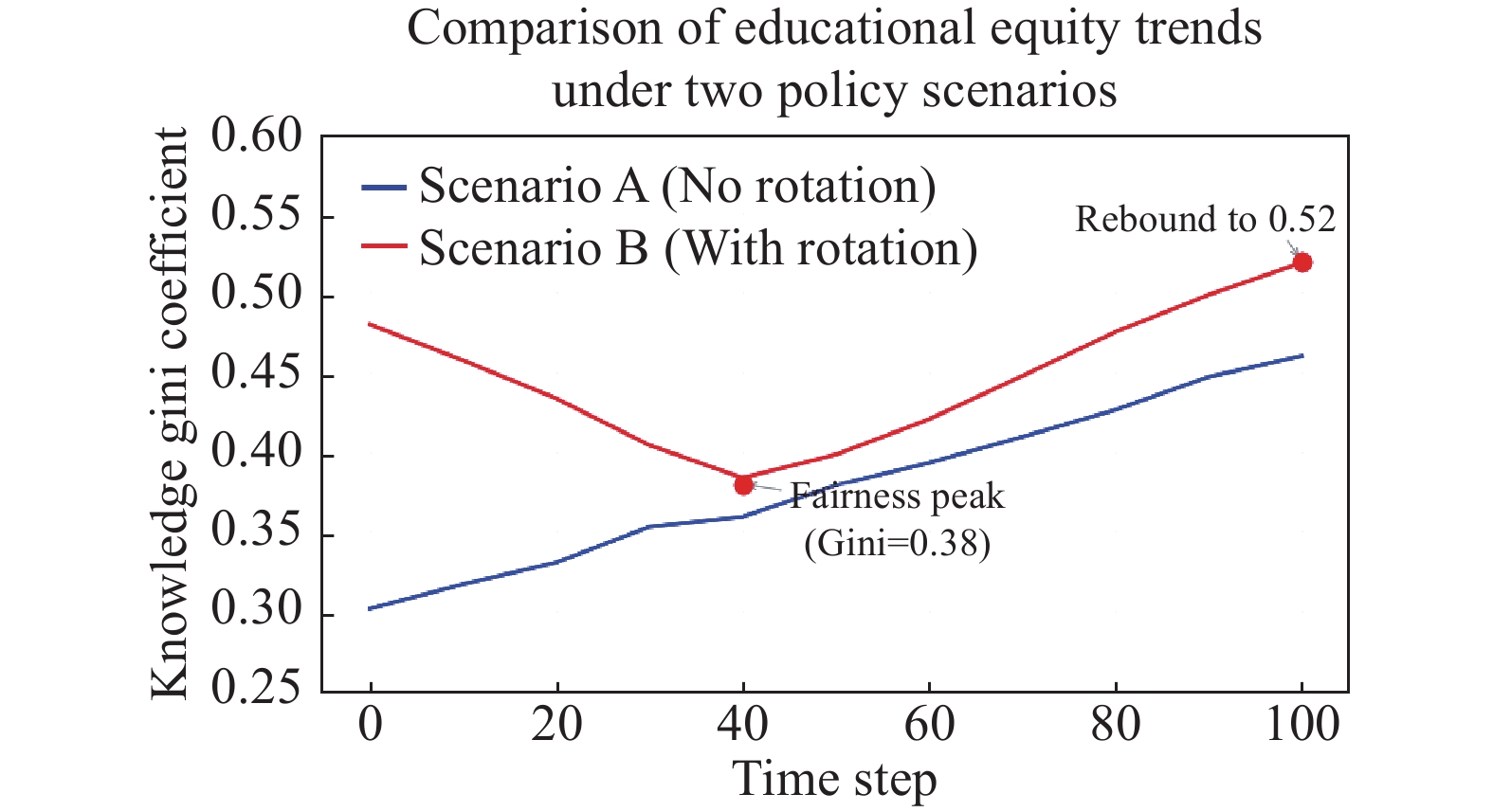
| 运行参数 | 模拟时长 | 100时间步 | 覆盖政策的中长期效应,足以观测到“公平性反弹” |
| 独立重复数 | 50次 | 满足统计显著性要求,确保结果非偶然 | |
| 系统参数 | 学校数量 | 10所 | 在计算复杂性与系统代表性间取得平衡 |
| 教师/学校 | 20名 | 模拟典型学校规模 | |
| 学生/学校 | 200名 | 保证学生群体的异质性 |
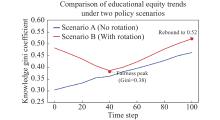
"
"
"
| 何文萱, 柯政. (2022). 教育政策仿真: 推进教育决策科学化的方法基础. 现代远程教育研究, 34 (04), 65- 72+90. | |
| 胡金艳, 杨霞, 高兴启, 满其峰, 张义兵. (2024). 知识建构社区中多主体模拟支持的观点涌现模型构建: 复杂性科学的视角. 电化教育研究, 45 (01), 100- 107. | |
| 李永梅, 谭维智. (2025). 智能机器驱动的教育学知识生产及其中国化. 现代远程教育研究, 37 (01), 63- 72. | |
| 刘石奇, 刘智, 段会敏, 粟柱, 彭晛. (2025). 大模型驱动的教育多智能体系统应用研究——技术架构、发展现状、实践路径与未来展望. 远程教育杂志, 43 (01), 33- 45. | |
| 苏福根. (2025). 复杂系统视域生成式人工智能促进高等教育发展的风险及治理. 高等工程教育研究, (04), 112- 117. | |
| 孙建文, 冯锦天, 万仟. (2025). 多智能体驱动的虚拟学生模拟助力教师答疑能力提升. 华中师范大学学报(自然科学版), 59 (05), 721- 729. | |
| 王骁汉, 江哲涵, 廖珺, 陈运香, 高燕. (2025). 基于多智能体的PBL模拟教学系统的构建. 护理研究, 39 (13), 2191- 2197. | |
| 谢林, T. C. (2005). 微观动机与宏观行为(谢静, 邓子梁, 李天有, 译). 北京: 中国人民大学出版社. | |
| 杨满福, 桑新民. (2025). 从Deep-Learning到DeepSeek: 人工智能赋能大学功能范式重构的挑战、转型与新生态. 现代教育技术, 35 (04), 5- 13. | |
| 袁磊, 徐济远, 刘沃奇. (2025). 数智教育生态下人机协同教学范式转型. 开放教育研究, 31 (02), 108- 117. | |
| 张佳, 刘智慧, 夏美茹. (2023). 教师交流轮岗政策实施现状及优化对策——利益相关者视角下的混合研究. 教育发展研究, 43 (20), 37- 46. | |
| Axelrod, R., & Hamilton, W. D. (1981). The evolution of cooperation. Science, 211 (4489), 1390- 1396. | |
| Arnejo, Z., Gaudou, B., Saqalli, M., & Bantayan, N. (2025). Communicating agent-based models to stakeholders: a scoping review. Journal of Artificial Societies and Social Simulation, 28 (2), 2. | |
| Belfrage, M., Lorig, F., & Davidsson, P. (2024). Simulating change: a systematic literature review of agent-based models for policy-making. Simulation Series, 56 (1), 512- 524. | |
| Matthew A. Kraft, William H. Marinell, & Darrick Shen-Wei Yee. (2016). School organizational contexts, teacher turnover, and student achievement: Evidence from panel data. American Educational Research Journal, 53(5), 1411-1449. | |
| Adnot, M., Dee, T., Katz, V., & Wyckoff, J. (2017). Teacher turnover, teacher quality, and student achievement in DCPS. Educational Evaluation and Policy Analysis, 39(1), 54-76. | |
| Nguyen, T. D., Pham, L., Crouch, M., & Springer, M. G. (2020). The correlates of teacher turnover: An updated and expanded Meta-analysis of the literature. Educational Research Review, 31, 100355. | |
| Nespeca, V., Comes, T., & Brazier, F. (2023). A methodology to develop agent-based models for policy support via qualitative inquiry. Journal of Artificial Societies and Social Simulation, 26(1). | |
| Pensiero, N., & Brede, M. (2024). An agent-based model of school tracking, accountability, and segregation. Journal of Simulation, 18 (4), 524- 538. |
| [1] | DeepseekV3.2, Jiangshan Sun, Shanshan Chen. The “Optimal Learning Style” Does Not Exist: Large-Scale Learning Analytics Evidence That AI-Driven Personalized Instruction Cannot Outperform Universal High-Quality Teaching (Including the Organizing Committee’s Recommendation and Transparency Statement for the Research and Manuscript Preparation Process) [J]. Journal of East China Normal University(Educationa, 2026, 44(8): 117-136. |
| [2] | Wen Xiong. Physical Education Entrance Exam for High School and College:Scientific Inquiry and Ethical Dilemma [J]. Journal of East China Normal University(Educationa, 2025, 43(3): 78-94. |
| [3] | Wenwang Jin, Xilang Liu. Was the “Noble Son of A Poor Family” Compensated or Selected Out? A Follow-up Study on the Enrollment of Two Elite Universities under the Special Program from 2018 to 2023 [J]. Journal of East China Normal University(Educational Sciences), 2025, 43(1): 113-126. |
| [4] | Yiling Hu, Zihong Zhao, Fang Wen. Research on the Co-evolution Model of AI Education Ecosystem: The Perspective of Complex System [J]. Journal of East China Normal University(Educational Sciences), 2022, 40(9): 118-126. |
| [5] | Lei Zheng, Yu Sun. Where there is a Will, there is a Way: Heterogeneous Effects of Students’ Willpower on Cognitive Abilities [J]. Journal of East China Normal University(Educational Sciences), 2022, 40(8): 83-95. |
| [6] | Xiaoyu Wei, Na Su. Can School Education Balance Equity and Quality? [J]. Journal of East China Normal University(Educational Sciences), 2021, 39(8): 116-126. |
| [7] | Chen Xie, Hongbiao Yin. The Provincial Comparison on Quality and Equity of Teaching-Research Work from Teachers’ Perspective [J]. Journal of East China Normal University(Educational Sciences), 2021, 39(5): 55-67. |
| [8] | Huang Zhongjing, Sun Xiaoxue, Wang Qian. From Philosophical Research to Empirical Research: Paradigm Shift in Education Equity Research [J]. Journal of East China Normal University(Educational Sciences), 2020, 38(9): 119-136. |
| [9] | XIANG Xianming. Equity Transition of Educational Purpose [J]. Journal of East China Normal University(Educationa, 2017, 35(2): 24-32+116. |
| [10] | HUANG Xue-Jun. Choice and Equity:Educational Reform in Era of Interest Differentiation [J]. Journal of East China Normal University(Educationa, 2011, 29(2): 33-38. |
| Viewed | ||||||
|
Full text |
|
|||||
|
Abstract |
|
|||||
