
 中国人文社会科学核心期刊
Journal of East China Normal University(Educationa ›› 2026, Vol. 44 ›› Issue (9): 36-47.doi: 10.16382/j.cnki.1000-5560.2026.09.004
Previous Articles Next Articles
Liping Ma1, Xiangrui Zheng2
Accepted:2026-05-29
Online:2026-09-01
Published:2026-08-29
Liping Ma, Xiangrui Zheng. Win with Mathematics? Expected Selection Effects of the Exceptional Admission Policy in Mathematics under China’s Strengthening Basic Disciplines Plan[J]. Journal of East China Normal University(Educationa, 2026, 44(9): 36-47.
"
"
| 变量 | (1) | (2) | (3) |
| 是否优秀学生 | 是否优秀学生 中的长青学生 | 是否优秀学生 中的拔尖学生 | |
| 高考数学成绩 | 0.015*** | 0.017*** | 0.001 |
| (0.003) | (0.005) | (0.007) | |
| 院系固定效应 | 是 | 是 | 是 |
| 届别固定效应 | 是 | 是 | 是 |
| 样本量 | 11,116 | 2,835 | 2,835 |
"
| 变量 | 是否优秀学生 | 是否优秀学生 中的长青学生 | 是否优秀学生 中的拔尖学生 | ||||||||
| (1) | (2) | (3) | (4) | (5) | (6) | (7) | (8) | (9) | |||
| 理学 | 工学 | 人文 | 理学 | 工学 | 人文 | 理学 | 工学 | 人文 | |||
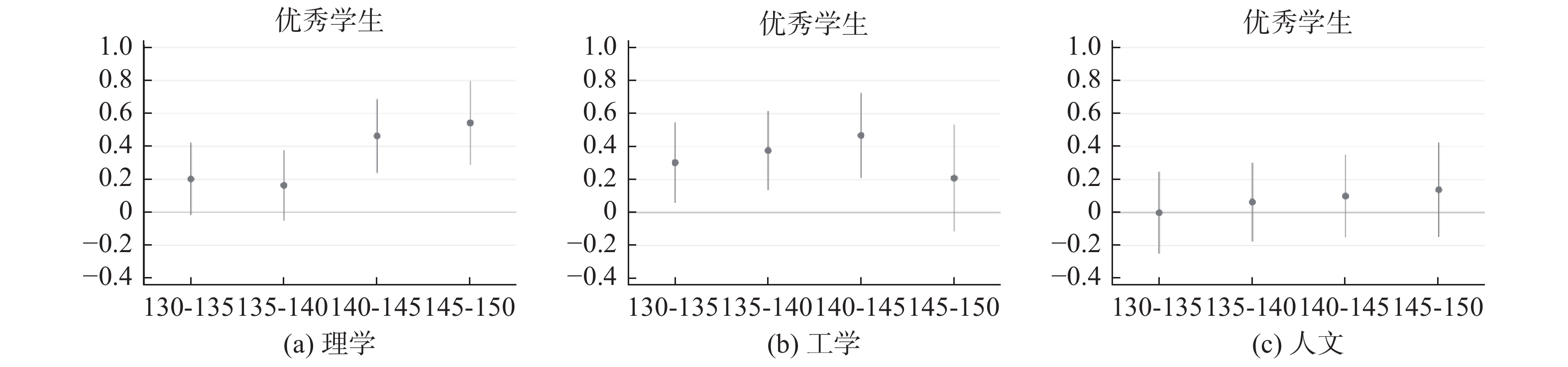
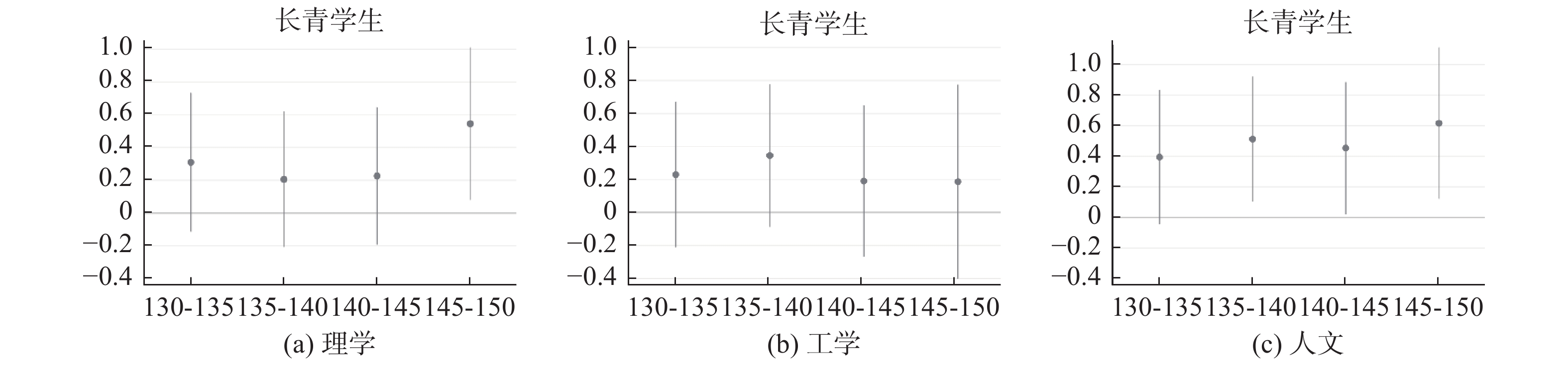
| 高考数学成绩 | 0.024*** | 0.016*** | 0.006 | 0.017** | 0.013 | 0.020*** | -0.008 | 0.011 | 0.004 | ||
| (0.004) | (0.005) | (0.004) | (0.008) | (0.009) | (0.007) | (0.013) | (0.013) | (0.010) | |||
| 院系固定效应 | 是 | 是 | 是 | 是 | 是 | 是 | 是 | 是 | 是 | ||
| 届别固定效应 | 是 | 是 | 是 | 是 | 是 | 是 | 是 | 是 | 是 | ||
| 样本量 | 4,619 | 3,324 | 3,173 | 1,058 | 853 | 924 | 1,058 | 853 | 924 | ||
"
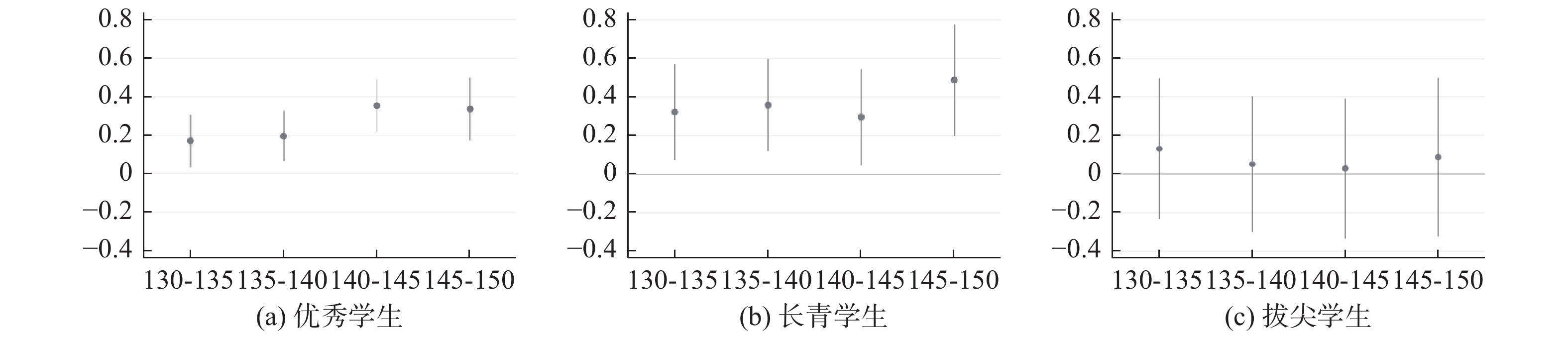
"
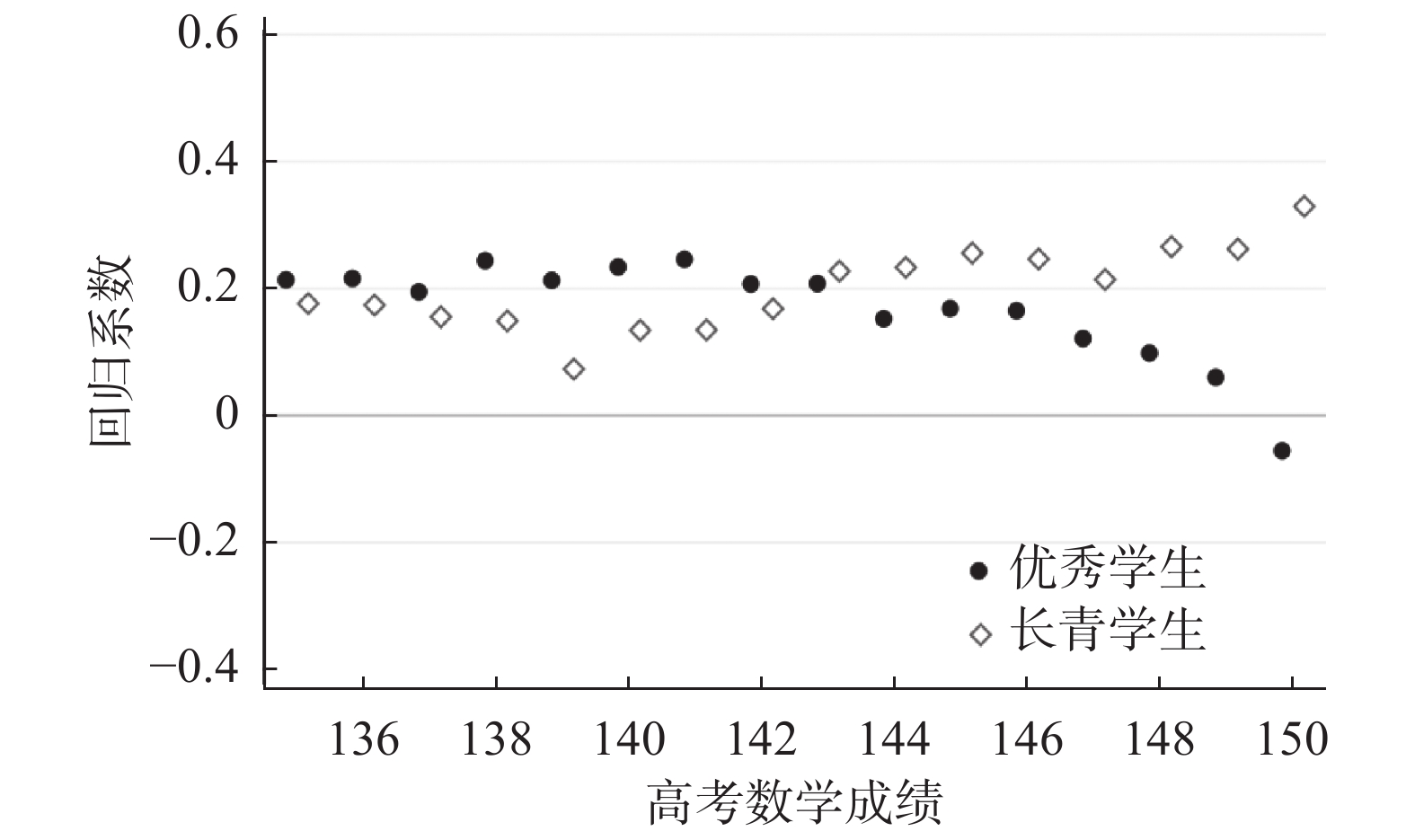
"
"
| 戴耘, 雷维娜, 朱琳. (2026). 走向科学的和多用途的“创新人才识别/培养测评体系”: 理论架构与策略分析. 华东师范大学学报(教育科学版), 44 (2), 1- 31. | |
| 傅维利. (2009). 我国高考改革的困境、出路及新方案设计. 教育研究, 30 (7), 8- 13. | |
|
刘进, 林松月, 王艺蒙, 马丽娜. (2019). 西部生源大学生学业表现的多维对比分析——基于B大学N学院学生的实证研究. 重庆高教研究, 7 (4), 12- 29.
doi: 10.15998/j.cnki.issn1673-8012.2019.04.002 |
|
| 王新凤. (2023). 我国高校拔尖创新人才选拔政策变迁与机制优化. 北京师范大学学报(社会科学版), (4), 29- 39. | |
|
Ackerman, P. L., & Heggestad, E. D. (1997). Intelligence, personality, and interests: Evidence for overlapping traits. Psychological Bulletin, 121 (2), 219- 245.
doi: 10.1037/0033-2909.121.2.219 |
|
|
Ayebo, A., Ukkelberg, S., & Assuah, C. (2016). Success in Introductory Calculus: the role of high school and pre-calculus preparation. International Journal of Research in Education and Science, 3 (25311), 11- 19.
doi: 10.21890/ijres.267359 |
|
|
Ballard, C. L., & Johnson, M. F. (2004). Basic math skills and performance in an introductory economics class. The Journal of Economic Education, 35 (1), 3- 23.
doi: 10.3200/JECE.35.1.3-23 |
|
|
Barr, D., Clifton, R., Renaud, R., & Wang, X. (2023). An analysis of the relationship between high-school pre-calculus and university calculus grades. International Journal of Mathematical Education in Science and Technology, 54 (7), 1229- 1256.
doi: 10.1080/0020739X.2022.2117656 |
|
|
Benbow, C. P. (2012). Identifying and nurturing future innovators in science, technology, engineering, and mathematics: a review of findings from the study of mathematically precocious youth. Peabody Journal of Education, 87 (1), 16- 25.
doi: 10.1080/0161956X.2012.642236 |
|
|
Brown, J. L., Halpin, Glennelle, & Halpin, Gerald. (2015). Relationship between high school mathematical achievement and quantitative GPA. Higher Education Studies, 5 (6), 1.
doi: 10.5539/hes.v5n6p1 |
|
| Chalmers, A. (2013). What Is This Thing Called Science? (4th ed.). Hachett Publishing Company, Inc. | |
| Cohn, E., Cohn, S., Balch, D. C., & Bradley, J. (2004). Determinants of undergraduate GPAs: SAT scores, high-school GPA and high-school rank. Economics of Education Review, Special Issue in Honor of B. F. Kiker, 23(6), 577—586. https://doi.org/10.1016/j.econedurev.2004.01.001. | |
| Dai, D. Y., & Chen, F. (2021). Paradigms of Gifted Education: A Guide for Theory-Based, Practice-Focused Research. Routledge. https://doi.org/10.4324/9781003236986. | |
| English, L. D., & Gainsburg, J. (2015). Problem Solving in a 21st-Century Mathematics Curriculum. in Handbook of International Research in Mathematics Education (3rd edtion). Routledge. | |
|
Fonteyne, L., De Fruyt, F., Dewulf, N., Duyck, W., Erauw, K., Goeminne, K., Lammertyn, J., Marchant, T., Moerkerke, B., Oosterlinck, T., & Rosseel, Y. (2015). Basic mathematics test predicts statistics achievement and overall first year academic success. European Journal of Psychology of Education, 30 (1), 95- 118.
doi: 10.1007/s10212-014-0230-9 |
|
|
Forrest, R. L., Stokes, D. W., Burridge, A. B., & Voight, C. D. (2017). Math remediation intervention for student success in the algebra-based introductory physics course. Physical Review Physics Education Research, 13 (2), 020137.
doi: 10.1103/PhysRevPhysEducRes.13.020137 |
|
|
Gambini, A., Desimoni, M., & Ferretti, F. (2024). Predictive tools for university performance: An explorative study. International Journal of Mathematical Education in Science and Technology, 55 (3), 691- 717.
doi: 10.1080/0020739X.2021.2022794 |
|
|
Gray, E. M., & Tall, D. O. (1994). Duality, ambiguity, and flexibility: A “proceptual” view of simple arithmetic. Journal for Research in Mathematics Education, 25 (2), 116- 140.
doi: 10.5951/jresematheduc.25.2.0116 |
|
| Hu, W., Li, F., & Gan, L. (2014). Does China’s National College Entrance Exam effectively evaluate applicants? Frontiers of Economics in China, 9(2), 174—182. https://doi.org/10.3868/s060-003-014-0010-7. | |
| Islam, M. M., & Al-Ghassani, A. (2015). Predicting college math success: Do high school performance and gender matter? Evidence from Sultan Qaboos University in Oman. International Journal of Higher Education, 4 (2), 67- 80. | |
| Lubinski, D. (2010). Spatial ability and STEM: A sleeping giant for talent identification and development. Personality and Individual Differences, Collected works from the Festschrift for Tom Bouchard, June 2009: A tribute to a vibrant scientific career, 49(4), 344—351. https://doi.org/10.1016/j.paid.2010.03.022. | |
|
Lubinski, D., & Benbow, C. P. (2006). Study of mathematically precocious youth after 35 years: Uncovering antecedents for the development of math-science expertise. Perspectives on Psychological Science, 1 (4), 316- 345.
doi: 10.1111/j.1745-6916.2006.00019.x |
|
|
Meltzer, D. E. (2002). The relationship between mathematics preparation and conceptual learning gains in physics: A possible “hidden variable” in diagnostic pretest scores. American Journal of Physics, 70 (12), 1259- 1268.
doi: 10.1119/1.1514215 |
|
|
Orlov, G., McKee, D., Foster, I. R., Bottan, D., & Thomas, S. R. (2021). Identifying students at risk using a new math skills assessment. AEA Papers and Proceedings, 111, 97- 101.
doi: 10.1257/pandp.20211044 |
|
| Robertson, K. F., Smeets, S., Lubinski, D., & Benbow, C. P. (2010). Beyond the threshold hypothesis: Even among the gifted and top math/science graduate students, cognitive abilities, vocational interests, and lifestyle preferences matter for career choice, performance, and persistence. Current Directions in Psychological Science, 19 (6), 346- 351. | |
|
Rosa, V., & Lewis, S. E. (2019). An explanative basis for the differential performance of students with low math aptitude in general chemistry. Chemistry Education Research and Practice, 20 (3), 570- 593.
doi: 10.1039/C9RP00068B |
|
| Rothstein, J. M. (2004). College performance predictions and the SAT. Journal of Econometrics, Higher Education (Annals Issue), 121(1), 297—317. https://doi.org/10.1016/j.jeconom.2003.10.003. | |
|
Sengupta-Irving, T., & Agarwal, P. (2017). Conceptualizing perseverance in problem solving as collective enterprise. Mathematical Thinking and Learning, 19 (2), 115- 138.
doi: 10.1080/10986065.2017.1295417 |
|
|
Subotnik, R. F., Olszewski-Kubilius, P., & Worrell, F. C. (2011). Rethinking giftedness and gifted education: A proposed direction forward based on psychological science. Psychological Science in the Public Interest, 12 (1), 3- 54.
doi: 10.1177/1529100611418056 |
|
| Terman, J. (1926). Genetic Studies of Genius: Vol. I. Mental and Physical Traits of a Thousand Gifted Children. Stanford University Press. | |
|
Thompson, E. D., Bowling, B. V., & Markle, R. E. (2018). Predicting student success in a major’s introductory biology course via logistic regression analysis of scientific reasoning ability and mathematics scores. Research in Science Education, 48 (1), 151- 163.
doi: 10.1007/s11165-016-9563-5 |
|
| Trusty, J., & Niles, S. G. (2003). High-school math courses and completion of the bachelor’s degree. Professional School Counseling, 7 (2), 99- 107. | |
| Wang, M. -T., Degol, J., & Ye, F. (2015). Math achievement is important, but task values are critical, too: Examining the intellectual and motivational factors leading to gender disparities in STEM careers. Frontiers in Psychology, 6. https://doi.org/10.3389/fpsyg.2015.00036. | |
|
Wei, D., Zhuang, K., Ai, L., Chen, Q., Yang, W., Liu, W., Wang, K., Sun, J., & Qiu, J. (2018). Structural and functional brain scans from the cross-sectional Southwest University adult lifespan dataset. Scientific Data, 5 (1), 180134.
doi: 10.1038/sdata.2018.134 |
|
|
Williamson, V. M., Walker, D. R., Chuu, E., Broadway, S., Mamiya, B., Powell, C. B., Shelton, G. R., Weber, R., Dabney, A. R., & Mason, D. (2020). Impact of basic arithmetic skills on success in first-semester general chemistry. Chemistry Education Research and Practice, 21 (1), 51- 61.
doi: 10.1039/C9RP00077A |
| [1] | Haitao Zhou, Yuanjia Zhu. Typological Logic and Path Optimization for the Identification, Training, and Evaluation of Top Innovative Talents [J]. Journal of East China Normal University(Educationa, 2026, 44(9): 27-35. |
| [2] | Yuanhao He, Wei Bao. The Validity of China’s College Entrance Examination for Early Identification of Top Innovative Talents [J]. Journal of East China Normal University(Educationa, 2026, 44(9): 14-26. |
| [3] | Jia Qian, Xiaonan Cui. What Shapes the Innovative Ability of Primary and Secondary School Students: An Empirical Study Based on Machine Learning [J]. Journal of East China Normal University(Educationa, 2026, 44(7): 61-75. |
| [4] | Shixin Fang, Yi Lu, Yusen Sheng. The Impact of Cognitive Challenge and Gaokao Difficulty:A Theoretical Analysis for Selection and Development of Well-Rounded Talents [J]. Journal of East China Normal University(Educationa, 2025, 43(9): 54-68. |
| Viewed | ||||||
|
Full text |
|
|||||
|
Abstract |
|
|||||
