
 中国人文社会科学核心期刊
Journal of East China Normal University(Educationa ›› 2026, Vol. 44 ›› Issue (3): 85-102.doi: 10.16382/j.cnki.1000-5560.2026.03.007
Previous Articles Next Articles
Huibin Gao
Accepted:2025-11-14
Online:2026-03-01
Published:2026-03-02
Huibin Gao. The Implementation Effect, Challenges and Strategies of the Policy of Professional Tilting Senior Towards Rural Teachers[J]. Journal of East China Normal University(Educationa, 2026, 44(3): 85-102.
"
| 出台时间 | 政策名称 | 政策要求 | 政策变迁 |
| 2012年9月 | 《国务院关于深入推进义务教育均衡发展的意见》 | 在核准岗位结构比例时高级教师岗位向农村学校和薄弱学校倾斜。 | 确定应然结构比例目标 |
| 2013年12月 | 《教育部 国家发展改革委 财政部关于全面改善贫困地区义务教育薄弱学校基本办学条件的意见》 | 农村学校教师职称晋升比例应不低于当地城区学校教师。 | |
| 2015年6月 | 《国务院办公厅关于印发乡村教师支持计划(2015—2020年)的通知》 | 实现县域内城乡学校教师岗位结构比例总体平衡,切实向乡村教师倾斜。 | |
| 2016年7年 | 《国务院关于统筹推进县域内城乡义务教育一体化改革发展的若干意见》 | 到2020年,城乡师资配置基本均衡,确定县域统一的义务教育学校岗位结构比例。 | |
| 2018年4月 | 《国务院办公厅关于全面加强乡村小规模学校和乡镇寄宿制学校建设的指导意见》 | 努力使乡村学校中高级教师岗位比例不低于城镇同学段学校。 | 切实推进,实然行动,扶持弱势,推进公平 |
| 2020年7月 | 《教育部等六部门关于加强新时代乡村教师队伍建设的意见》 | 适当提高中小学中高级岗位结构比例,向乡村教师倾斜,乡村学校中高级专业技术岗位设置比例不低于当地城镇同类学校标准。对长期在乡村学校任教的教师……中高级岗位实行总量控制、比例单列,可不受所在学校岗位结构比例限制。 | |
| 2021年2月 | 中共中央办公厅 国务院办公厅印发《关于加快推进乡村人才振兴的意见》 | 对长期在乡村学校任教的教师,职称评审可按规定“定向评价、定向使用”,高级岗位实行总量控制、 比例单列,可不受所在学校岗位结构比例限制。 | |
| 2022年4月 | 教育部等八部门关于印发《新时代基础教育强师计划》 | 对长期在乡村学校任教的教师,职称评审可按规定“定向评价、定向使用”,高级岗位实行总量控制、 比例单列,可不受所在学校岗位结构比例限制。对长期在乡村学校工作的中小学教师,职称评聘可按规定“定向评价、定向使用”,中高级岗位实行总量控制、比例单列,不受各地岗位结构比例限制。 | |
| 2022年9月 | 人力资源社会保障部 教育部关于印发《关于进一步完善中小学岗位设置管理的指导意见》的通知 | 努力使乡村学校中高级教师岗位比例不低于当地城镇同学段学校。义务教育学校要逐步实行县域统一的岗位结构比例。支持乡村中小学设置“定向评价、定向使用”教师中高级岗位,实行总量控制、比例单列、专岗专用。 | |
| 2024年8月 | 《中共中央 国务院关于弘扬教育家精神 加强新时代高素质专业化教师队伍建设的意见》 | 深化职称制度改革,优化教师岗位结构比例。 职称评聘向乡村教师倾斜。 | 深化改革,并保持公平 |
"
| 类别 | 项目 | 人数 | 比例(%) | 类别 | 项目 | 人数 | 比例(%) | |
| 性别 | 男 | 39.8 | 年龄 | 35岁以下 | 42.4 | |||
| 女 | 60.2 | 35-49岁 | 38.9 | |||||
| 学历 | 高中阶段 | 43 | 0.7 | 50岁以上 | 18.7 | |||
| 专科 | 24.5 | 职称 | 正高级 | 21 | 0.4 | |||
| 本科 | 73.4 | 副高级 | 18.5 | |||||
| 硕士研究生 | 79 | 1.1 | 中级职称 | 36.2 | ||||
| 教龄 | 3年以内 | 853 | 14.9 | 初级职称 | 30.7 | |||
| 3-10年 | 29.0 | 未评职称 | 817 | 14.2 | ||||
| 11-20年 | 924 | 16.1 | 区域 | 东部 | 25.6 | |||
| 21-30年 | 24.9 | 中部 | 27.1 | |||||
| 30年以上 | 864 | 15.1 | 西部 | 47.3 | ||||
| 学段 | 小学 | 75.8 | 学校 | 乡中心区 | 44.6 | |||
| 初中 | 1988 | 24.2 | 位置 | 村小 | 51.1 | |||
| 教学点 | 249 | 4.3 |
"
| 潜变量 | 测量变量 | 因子载荷 | Cronbach’a |
| 职业认知 | 奉献精神 | 0.891 | 0.888 |
| 高尚品格 | 0.929 | ||
| 爱生 | 0.901 | ||
| 工作量变量 | 授课时数 | 0.725 | 0.675 |
| 跨学科授课 | 0.760 | ||
| 跨年级授课 | 0.609 | ||
| 工资待遇 | 工资收入 | 0.833 | 0.793 |
| 工会福利 | 0.869 | ||
| 医疗保险 | 0.821 | ||
| 专业培训 | 学科培训 | 0.852 | 0.891 |
| 通识培训 | 0.944 | ||
| 培训效果 | 0.920 | ||
| 职称变量 | 职称结构 | 0.932 | 0.909 |
| 结构比例 | 0.937 | ||
| 职称晋升 | 0.891 |
"
| 变量 | 类别 | 专业培训 | 工作量 | 工资待遇 | 职称晋升 | 职业吸引力 |
| 性别 | 男 | 0.915 | 0.772 | 0.811 | 1.138 | 0.906 |
| 女 | 0.875 | 0.765 | 0.759 | 1.011 | 0.852 | |
| T | 1.376 | −1.077 | 4.139*** | −0.478 | −0.067 | |
| 年龄 | 35岁以下-35至50岁 | −.105* | 0.027 | −.164* | .137* | −.096* |
| 35岁以下-50岁以上 | −.105* | .136* | −.299* | .082* | −.143* | |
| 年龄 | 35至50岁-50岁以上 | 0.000 | .110* | −.135* | −0.005 | −0.047 |
| F | 9.786*** | 11.950*** | 61.646*** | 9.777*** | 12.471*** | |
| 学历 | 专科-本科 | 0.043 | .302* | −.138* | 0.057 | .132* |
| 专科-研究生 | 0.054 | .585* | −0.201* | 0.006 | 0.159 | |
| 本科-研究生 | 0.011 | .284* | 0.088 | 0.063 | 0.027 | |
| F | 0.791 | 46.299*** | 8.600*** | 1.180 | 6.184*** | |
| 教龄 | 3年内-3至10年 | 0.060 | −.082* | 0.053 | .268* | 0.005 |
| 3年内-11至20年 | 0.043 | −0.053 | 0.009 | .389* | −0.031 | |
| 3年内-21至30年 | −.119* | 0.056 | −.188* | .291* | −0.062 | |
| 3至10年-11至20年 | −0.017 | 0.028 | −0.045 | .122* | −0.037 | |
| 3至10年-30年以上 | −.162* | .109* | −.197* | −.099* | −.094* | |
| F | 9.534** | 8.827** | 34.242*** | 16.588*** | 3.878** | |
| 区域 | 东部-中部 | .156* | −.297* | .209* | 0.064 | .178* |
| 东部-西部 | .157* | −.498* | .070* | −.186* | .069* | |
| 中部-西部 | 0.001 | −.201* | −.139* | −.250* | −.109* | |
| F | 17.834 *** | 228.139*** | 28.184*** | 31.326*** | 15.866*** | |
| 学校位置 | 乡中心区-村小 | −.054* | −.338* | −0.041 | −.103* | −.100* |
| 乡中心区-教学点 | 0.033 | −.666* | −0.024 | −0.082 | −0.039 | |
| 村小-教学点 | 0.087 | −.328* | 0.017 | 0.020 | 0.061 | |
| F | 3.107* | 191.212*** | 1.846 | 6.462*** | 9.008*** | |
| 学段 | 小学 | 0.892 | 0.787 | 0.782 | 1.089 | 0.881 |
| 初中 | 0.883 | 0.778 | 0.769 | 1.080 | 0.841 | |
| T | 3.635*** | 18.674*** | 6.531*** | 4.327*** | 5.010*** |
"
"
| 省份 | 2013年 | 2018年 | 2023年 | |||||
| 小学 | 初中 | 小学 | 初中 | 小学 | 初中 | |||
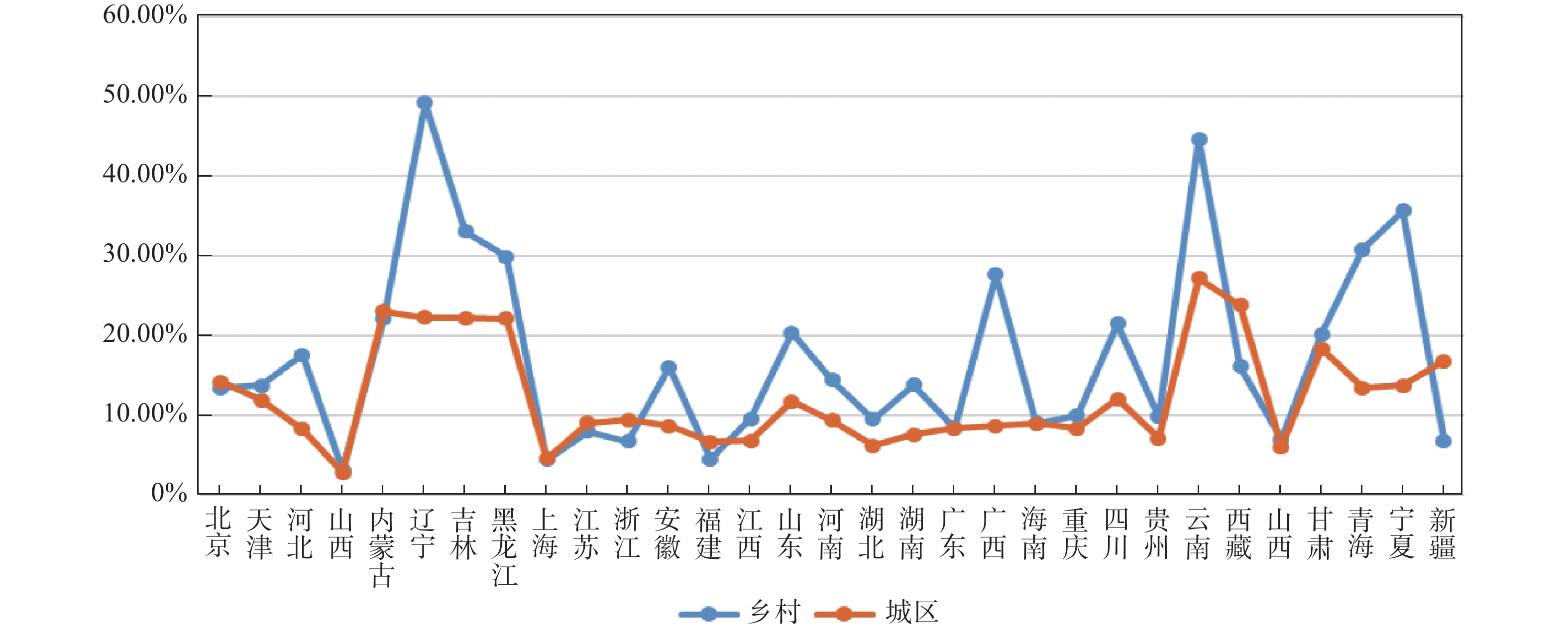
| 总体平均 | 1.47% | 12.43% | 5.39% | 19.33% | 18.13% | 27.18% | ||
| 北京 | 0.23% | 17.14% | 5.06% | 25.94% | 13.39% | 28.18% | ||
| 天津 | 3.25% | 28.02% | 8.85% | 32.92% | 13.72% | 35.97% | ||
| 河北 | 1.41% | 12.21% | 3.66% | 19.89% | 17.55% | 26.15% | ||
| 山西 | 0.66% | 4.11% | 0.85% | 8.30% | 3.13% | 12.85% | ||
| 内蒙古 | 22.03% | 26.54% | 22.98% | 28.73% | 22.19% | 27.18% | ||
| 辽宁 | 6.12% | 40.65% | 15.58% | 48.12% | 49.21% | 59.20% | ||
| 吉林 | 1.01% | 8.50% | 9.91% | 25.34% | 33.05% | 34.37% | ||
| 黑龙江 | 3.83% | 15.07% | 10.45% | 21.50% | 29.92% | 30.70% | ||
| 上海 | 3.03% | 10.03% | 1.77% | 11.13% | 4.44% | 11.59% | ||
| 江苏 | 1.62% | 15.00% | 3.77% | 22.78% | 8.00% | 27.32% | ||
| 浙江 | 1.01% | 13.62% | 2.33% | 19.87% | 6.76% | 24.93% | ||
| 安徽 | 0.91% | 15.11% | 3.10% | 19.89% | 16.01% | 27.91% | ||
| 福建 | 0.56% | 15.99% | 1.25% | 22.34% | 4.48% | 28.44% | ||
| 江西 | 1.35% | 23.25% | 2.25% | 30.05% | 9.56% | 27.07% | ||
| 山东 | 1.90% | 13.35% | 3.65% | 13.72% | 20.38% | 35.76% | ||
| 河南 | 1.53% | 14.86% | 3.20% | 18.05% | 14.44% | 27.79% | ||
| 湖北 | 1.48% | 13.26% | 2.35% | 17.69% | 9.52% | 21.24% | ||
| 湖南 | 1.21% | 8.11% | 4.40% | 15.71% | 13.82% | 21.20% | ||
| 广东 | 0.48% | 4.98% | 0.74% | 9.33% | 8.39% | 18.76% | ||
| 广西 | 0.56% | 6.96% | 1.46% | 12.12% | 27.69% | 29.47% | ||
| 海南 | 0.36% | 13.83% | 0.64% | 17.31% | 9.01% | 19.43% | ||
| 重庆 | 0.43% | 7.91% | 5.28% | 12.93% | 9.98% | 15.09% | ||
| 四川 | 1.18% | 11.31% | 7.52% | 18.63% | 21.52% | 26.50% | ||
| 贵州 | 0.29% | 5.09% | 1.56% | 14.36% | 9.85% | 19.90% | ||
| 云南 | 0.29% | 13.66% | 23.30% | 32.24% | 44.56% | 42.35% | ||
| 西藏 | 0.54% | 2.21% | 4.34% | 8.31% | 16.14% | 13.50% | ||
| 陕西 | 0.69% | 7.81% | 1.44% | 12.48% | 6.93% | 17.89% | ||
| 甘肃 | 0.72% | 4.93% | 1.78% | 9.48% | 20.20% | 26.98% | ||
| 青海 | 3.76% | 21.77% | 15.61% | 25.23% | 30.83% | 26.08% | ||
| 宁夏 | 1.60% | 13.20% | 14.30% | 19.81% | 35.67% | 28.78% | ||
| 新疆 | 0.98% | 12.89% | 5.23% | 15.97% | 6.84% | 13.10% | ||
"
| 模型1 | 模型2 | 模型3 | |
| 背景变量 | |||
| 性别(以男教师为参照) | |||
| 女教师 | 0.012 | 0.008 | 0.007 |
| 学历(以本科为参照) | |||
| 高中阶段 | −0.008 | −0.009 | −0.003 |
| 专科 | −0.013 | −0.011 | −0.021* |
| 研究生 | 0.021 | 0.018 | 0.026** |
| 教龄(以3年以下为参照) | |||
| 3-10年教龄 | 0.009 | 0.017 | 0.016 |
| 11-20年教龄 | 0.043*** | 0.038*** | 0.016 |
| 20年以上教龄 | 0.014 | 0.002 | 0.021* |
| 学段(以小学为参照) | |||
| 初中 | 0.010 | 0.002 | 0.005 |
| 区域(以东部地区为参照) | |||
| 中部 | −0.011 | 0.013 | −0.009 |
| 西部 | 0.030 | 0.060*** | 0.008 |
| 学校位置(以乡中心区为参照) | |||
| 村小 | 0.009 | 0.000 | −0.009 |
| 教学点 | 0.001 | 0.001 | −0.005 |
| 学校硬件环境(以“非常差”为参照) | |||
| 比较差 | 0.169*** | 0.069*** | 0.059*** |
| 一般 | 0.452*** | 0.195*** | 0.119*** |
| 比较好 | 0.735*** | 0.322*** | 0.191*** |
| 非常好 | 0.769*** | 0.327*** | 0.192*** |
| 培训变量 | |||
| 学科培训 | 0.160*** | 0.137*** | |
| 通识培训 | 0.154*** | 0.069*** | |
| 培训效果 | 0.255*** | 0.127*** | |
| 职称变量 | |||
| 职称结构 | 0.105*** | ||
| 结构比例 | 0.096*** | ||
| 职称晋升 | 0.298*** | ||
| F | 188.698*** | 317.769*** | 441.900*** |
| Adjusted R2 | 0.344 | 0.512 | 0.628 |
"
| 模型1 | 模型2 | 模型3 | |
| 背景变量 | |||
| 性别(以男教师为参照) | |||
| 女教师 | −0.004 | −0.002 | 0.001 |
| 学历(以本科为参照) | |||
| 高中阶段 | −0.003 | −0.005 | −0.003 |
| 专科 | −0.023 | −0.035* | −0.035** |
| 研究生 | 0.015 | 0.018 | 0.030** |
| 教龄(以3年以下为参照) | |||
| 3-10年教龄 | 0.080*** | 0.080*** | 0.033*** |
| 11-20年教龄 | 0.073*** | 0.070*** | 0.013 |
| 20年以上教龄 | 0.006 | 0.001 | 0.030** |
| 学段(以小学为参照) | |||
| 初中 | −0.041** | −0.067*** | −0.002 |
| 区域(以东部为参照) | |||
| 中部 | −0.046** | −0.032* | −0.038* |
| 西部 | −0.008 | −0.032 | −0.032** |
| 位置(以乡中心区为参照) | |||
| 村小 | 0.010 | 0.021 | −0.011 |
| 教学点 | −0.006 | 0.008 | −0.010 |
| 工作量变量 | |||
| 授课时数 | 0.093*** | 0.016 | |
| 跨学科授课 | −0.031* | 0.009 | |
| 跨年级授课 | 0.019 | 0.007 | |
| 职称变量 | |||
| 职称结构 | 0.245*** | ||
| 结构比例 | 0.109*** | ||
| 职称晋升 | 0.435*** | ||
| F | 7.735*** | 9.746*** | 372.455*** |
| Adjusted R2 | 0.014 | 0.022 | 0.539 |
"
| 模型1 | 模型2 | 模型3 | |
| 背景变量 | |||
| 学段(以小学为参照) | |||
| 初中 | −0.056*** | −0.002 | 0.000 |
| 区域(以东部为参照) | |||
| 中部 | −0.073*** | −0.015 | −0.017 |
| 西部 | −0.032* | −0.006 | −0.013 |
| 位置(以乡中心区为参照) | |||
| 村小 | 0.026 | 0.023 | 0.022 |
| 教学点 | 0.000 | −0.007 | −0.003 |
| 家庭收入(以低收入为参照) | |||
| 中收入 | −0.020 | 0.013 | 0.011 |
| 高收入 | −0.043** | −0.016 | −0.010 |
| 综合变量 | |||
| 职业认知 | 0.279*** | 0.120*** | |
| 工作环境 | 0.163*** | 0.042** | |
| 工作压力 | 0.046** | 0.076*** | |
| 工作量 | 0.084*** | 0.012 | |
| 工资待遇 | 0.052*** | 0.044*** | |
| 成长发展 | 0.050*** | 0.085*** | |
| 村庄融入 | 0.106*** | 0.063*** | |
| 社会地位 | 0.162*** | 0.258*** | |
| 职称变量 | |||
| 职称结构 | 0.092*** | ||
| 结构比例 | 0.073*** | ||
| 职称晋升 | 0.192*** | ||
| F | 9.392*** | 324.195*** | 362.173*** |
| Adjusted R2 | 0.010 | 0.459 | 0.532 |
"
| 安雪慧. (2015). 从资历到能力与业绩: 义务教育学校教师工资等级和结构决定因素. 教育研究, 36 (12), 26- 35. | |
| 陈寒, 王凤琴. (2023). 教师职业吸引力及其影响因素的国际比较研究. 上海教育科研, (7), 27- 34. | |
| 程天君. (2024). 高质量教育公平——新时代教育公平国家战略引论. 教育研究, 45 (4), 4- 16. | |
| 丁瑞常, 顾明远, 彼得·圣吉等. (2017). 面向未来的教育如何定位教师角色与价值——顾明远与彼得·圣吉凝聚东西方智慧的再次跨界对话. 比较教育研究, 39 (2), 3- 8. | |
| 高慧斌. (2017). 乡村教师职称(职务)评聘制度演变及改革策略. 当代教育科学, (1), 17- 21+61. | |
| 高慧斌. (2025). 中小学教师职称结构改革进程及优化策略. 教育研究, 46 (2), 140- 150. | |
| 郝文武. (2021). 进一步加大缩小东西部及其城乡教育现代化差距的力度. 西北师大学报 (社会科学版), 58 (6), 29- 36. | |
| 何东昌. (1998). 中华人民共和国重要教育文献(1796—1990). 海口: 海南出版社. | |
| 胡娜丽, 徐瑾劼. (2023). TALIS透视下教师职业吸引力及其提升策略. 教育国际交流, (05), 37- 40. | |
| 教育部等六部门. (2020). 关于加强新时代乡村教师队伍建设的意见. 教育部网站(2020年9月4日). 取自https://www.gov.cn/zhengce/zhengceku/2020-09/04/content_5540386.htm. | |
| 李娟, 杨晶晶, 赖明勇. (2023). 教师激励、基础教育发展与人力资本积累——基于中小学教师职称制度改革的实证研究. 经济学(季刊), 23 (3), 1185- 1201. | |
| 李涛, 黄嘉欣. (2025). 学龄人口减少对乡村小规模学校发展的影响及其疏解. 教育研究, 46 (2), 1- 8. | |
| 李涛, 黄少澜. (2023). 乡村教师职业吸引力的多维测算与分解. 东北师范大学学报(哲学社会科学版), 321 (1), 32- 46. | |
| 李廷洲, 金晨, 金志峰. (2018). 中小学教师职称改革成效如何?——基于多元评估理论的政策评估研究. 教育发展研究, 38 (18), 17- 23. | |
| 李廷洲, 陆莎, 金志峰. (2017). 我国中小学教师职称改革: 发展 历程、关键问题与政策建议. 中国教育学刊, (12), 66- 72+78. | |
| 李志辉, 罗平. (2010). SPSS Stastistics中文版统计分析教程(第三版). 北京: 电子工业出版社. | |
| 梁红梅, 高梦解. (2020). 中小学教师职业荣誉感的现实困境与涵育路径. 华南师范大学学报(社会科学版), (6), 83- 94+190. | |
| 刘善槐, 王爽, 朱秀红. (2022). 乡村振兴背景下农村教师工资收入决定机制研究. 华东师范大学学报教育科学版, (6), 1- 15. | |
| 刘同舫. (2024). 大历史观视域下教育综合改革的内在动力与文明意蕴. 教育研究, 45 (10), 17- 25. | |
| 牟晓伟, 范子怡, 仝鑫. (2025). 东北地区人口流失对经济的影响及对策研究. 海南师范大学学报(社会科学版), 38 (1), 113- 120. | |
| 庞丽娟, 杨小敏, 金志峰. (2019). 乡村教师职称评聘的困境、影响与政策应对. 教师教育研究, 31 (1), 31- 36. | |
| 祁占勇, 王君妍, 司晓宏. (2017). 我国西北地区义务教育均衡发展的现实困境与政策选择——基于国家教育督导《反馈意见》的研究. 中国教育学刊, (10): 53—58. | |
| 人力资源社会保障部, 教育部. (2015). 关于深化中小学教师职称制度改革的指导意见的通知. 中华人民共和国中央人民政府网站(2015年8月28日). 取自https://www.gov.cn/gongbao/content/2016/content_5033907.htm. | |
| 人力资源社会保障部, 教育部. (2022). 关于进一步完善中小学岗位设置管理的指导意见的通知. 中华人民共和国中央人民政府网站(2022年9月10日). 取自https://www.gov.cn/zhengce/zhengceku/2022-09/10/content_5709280.htm. | |
| 王晓生, 邬志辉. (2019). 乡村教师职称评聘的结构矛盾与改革方略. 中国教育学刊, (9), 70- 74. | |
| 韦敬楠. (2022). 中小学教师职称评聘向乡村倾斜的适度性及其矫正. 西北成人教育学院学报, (3), 28- 33. | |
| 邬志辉, 秦玉友. (2015). 中国农村教育发展报告2013—2014. 北京: 北京师范大学出版社. | |
| 吴世瑾, 刘涵, 常芳, 樊鑫. (2023). 教师职称越高, 学生学业表现越好?——基于晋升锦标赛激励的分析. 经济学(季刊), 23 (1), 228- 245. | |
| 袁振国. (2019). 教育公平的中国模式. 中国教育学刊, (09), 1- 5. | |
| 张茂聪, 李琰. (2024). 以高质量教师教育赋能教育强国战略: 逻辑、挑战与现实进路. 天津师范大学学报(社会科学版), (1), 97- 105. | |
| 赵德成, 曹宗清, 张颖怡, 李乾锋. (2022). 教师活力表现及影响因素: 基于区域性大规模样本的多水平分析. 教育学报, 18 (6), 101- 116. | |
| 周晔, 彭宇. (2024). 乡村教育高质量发展助力教育强国建设——结构—功能的理论视域. 教育研究, 45 (3), 100- 110. |
| No related articles found! |
| Viewed | ||||||
|
Full text |
|
|||||
|
Abstract |
|
|||||
