
 中国人文社会科学核心期刊
Journal of East China Normal University(Educationa ›› 2026, Vol. 44 ›› Issue (4): 22-39.doi: 10.16382/j.cnki.1000-5560.2026.04.003
Previous Articles Next Articles
Yuan Cui1, Kit-tai Hau2, Qian Zhao1
Online:2026-04-01
Published:2026-03-31
Yuan Cui, Kit-tai Hau, Qian Zhao. Does High-Stakes Testing Hinder the Cultivation of Creative Thinking? An International Comparison from the Perspective of Institutional Logics[J]. Journal of East China Normal University(Educationa, 2026, 44(4): 22-39.
"
"
| 模型1 | 模型2 | 模型3 | 模型4 | 模型5 | 模型6 | 模型7 | |
| 水平-1 (学生层) | |||||||
| 性别 | –0.221*** | –0.221*** | –0.219*** | –0.221*** | –0.222*** | –0.222*** | |
| (0.002) | (0.002) | (0.002) | (0.002) | (0.002) | (0.002) | ||
| 家庭社会经济地位 | 0.039*** | 0.039*** | 0.040*** | 0.039*** | 0.039*** | 0.039*** | |
| (0.001) | (0.001) | (0.001) | (0.001) | (0.001) | (0.001) | ||
| 移民背景 | –0.018*** | –0.017*** | –0.027*** | –0.019*** | –0.023*** | –0.020*** | |
| (0.004) | (0.004) | (0.004) | (0.004) | (0.004) | (0.004) | ||
| 数学成绩 | 0.422*** | 0.422*** | 0.422*** | 0.423*** | 0.422*** | 0.422*** | |
| (0.001) | (0.001) | (0.001) | (0.001) | (0.001) | (0.001) | ||
| 水平-2(学校层) | |||||||
| 学校社会经济地位 | 0.049*** | 0.051*** | 0.050*** | 0.050*** | 0.054*** | 0.046*** | |
| (0.003) | (0.003) | (0.003) | (0.003) | (0.003) | (0.003) | ||
| 生师比 | 0.003 | 0.002 | 0.002 | 0.002 | 0.003 | 0.003 | |
| (0.002) | (0.002) | (0.002) | (0.002) | (0.002) | (0.002) | ||
| 学校类型 | –0.033*** | –0.034*** | –0.035*** | –0.034*** | –0.023*** | –0.033*** | |
| (0.006) | (0.006) | (0.006) | (0.006) | (0.006) | (0.006) | ||
| 学校教育质量 | 0.376*** | 0.375*** | 0.375*** | 0.375*** | 0.374*** | 0.380*** | |
| (0.003) | (0.003) | (0.003) | (0.003) | (0.003) | (0.003) | ||
| 水平-3(国家/地区层) | |||||||
| 高利害考试 | –0.106* | –0.106* | –0.106* | –0.103* | –0.104* | ||
| (0.044) | (0.044) | (0.044) | (0.044) | (0.044) | |||
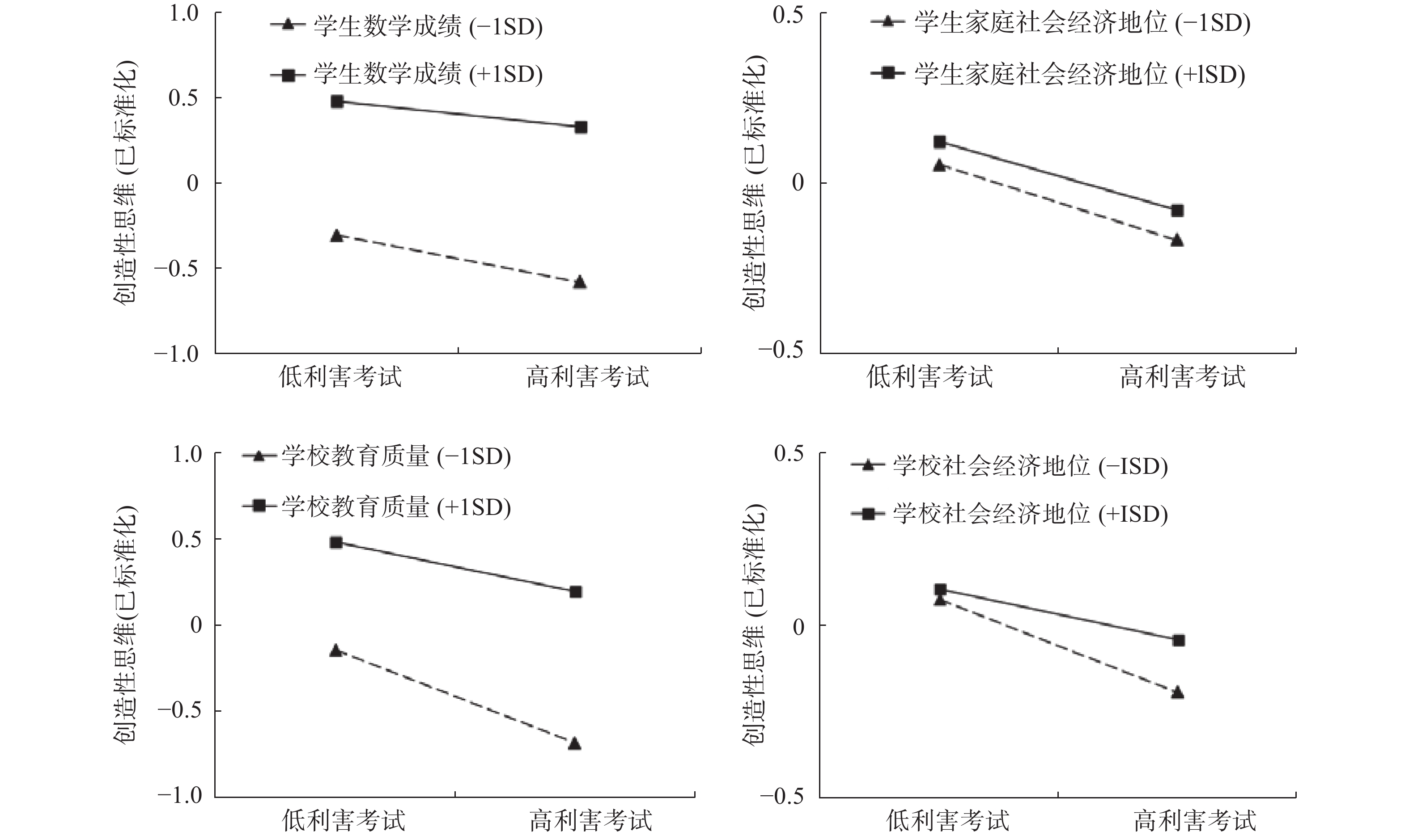
| 高利害考试×学生数学成绩 | 0.033*** | ||||||
| (0.001) | |||||||
| 高利害考试×学生家庭社会经济地位 | 0.006*** | ||||||
| (0.001) | |||||||
| 高利害考试×学校教育质量 | 0.032*** | ||||||
| (0.002) | |||||||
| 高利害考试×学校社会经济地位 | 0.030*** | ||||||
| (0.002) | |||||||
| ln GDP | 0.386*** | 0.366*** | 0.367*** | 0.366*** | 0.368*** | 0.367*** | |
| (0.041) | (0.041) | (0.041) | (0.041) | (0.041) | (0.041) | ||
| 常数项 | 0.144*** | 0.139*** | 0.139*** | 0.139*** | 0.131** | 0.138*** | |
| (0.042) | (0.040) | (0.040) | (0.040) | (0.040) | (0.040) | ||
| 学生层方差 | 0.547 | 0.357 | 0.359 | 0.357 | 0.359 | 0.359 | 0.359 |
| 学校层方差 | 0.215 | 0.036 | 0.036 | 0.036 | 0.036 | 0.035 | 0.036 |
| 国家(地区)层方差 | 0.243 | 0.100 | 0.091 | 0.091 | 0.091 | 0.091 | 0.091 |
| 学生样本量 | |||||||
| 学校样本量 | |||||||
| 国家(地区)样本量 | 58 | 58 | 58 | 58 | 58 | 58 | 58 |
| ICC(学校层) | 0.456 | 0.276 | 0.262 | 0.263 | 0.262 | 0.261 | 0.262 |
| ICC(国家或地区层) | 0.242 | 0.203 | 0.188 | 0.188 | 0.188 | 0.188 | 0.188 |
"
| 解释变量的分位数 | 0.1 | 0.2 | 0.3 | 0.4 | 0.5 | 0.6 | 0.7 | 0.8 | 0.9 |
| 控制变量 | 已控制 | 已控制 | 已控制 | 已控制 | 已控制 | 已控制 | 已控制 | 已控制 | 已控制 |
| 高利害考试 | –0.172*** | –0.155*** | –0.139*** | –0.126*** | –0.114*** | –0.102** | –0.090** | –0.075** | –0.052* |
| (0.032) | (0.037) | (0.043) | (0.042) | (0.043) | (0.041) | (0.039) | (0.038) | (0.033) | |
| Pseudo R2 | 0.523 | 0.526 | 0.527 | 0.528 | 0.528 | 0.527 | 0.527 | 0.526 | 0.524 |
| N |
"
"
| 路径 | 估计值 | 标准误 | 95%的置信区间 |
| 高利害考试→学校创造性活动 | 0.539*** | 0.121 | [0.302, 0.777] |
| 学校创造性活动→创造性思维 | |||
| 组内层面(Within-level) | –0.110*** | 0.015 | [–0.139, –0.081] |
| 组间层面(Between-level) | –0.533*** | 0.075 | [–0.679, –0.387] |
| 高利害考试→学校创造性活动→创造性思维 | |||
| 间接效应 | –0.288*** | 0.077 | [–0.439, –0.136] |
| 直接效应(控制中介后) | 0.001 | 0.080 | [–0.156, 0.157] |
"
| 当学校社会经济地位在高、低两种水平时,高利害考试→学校创造性活动→创造性思维的间接效应 | |||
| 路径 | 估计值 | 标准误 | 95%的置信区间 |
| 学校社会经济地位差异 | |||
| 高(M+1SD) | –0.138** | 0.056 | [–0.249, –0.027] |
| 低(M–1SD) | –0.195*** | 0.069 | [–0.330, –0.060] |
| 差异 | –0.057 | 0.089 | [–0.231, 0.117] |
| 当学校教育质量在高、低两种水平时,高利害考试→学校创造性活动→创造性思维的间接效应 | |||
| 学校教育质量差异 | |||
| 高(M+1SD) | –0.066* | 0.033 | [–0.131, –0.001] |
| 低(M–1SD) | –0.116*** | 0.045 | [–0.203, –0.028] |
| 差异 | –0.050 | 0.056 | [–0.159, 0.059] |
| 蔡瑜琢, 姜琳丽. (2024). 高等教育管理与领导: 制度逻辑理论的视角. 北京大学教育评论, 22 (03), 49- 75+188. | |
| 褚宏启. (2024). 拔尖创新人才培养要警惕“掐尖”乱象. 中小学管理, (03), 63. | |
| 方杰, 张敏强, 邱皓政. (2010). 基于阶层线性理论的多层级中介效应. 心理科学进展, 18 (08), 1329- 1338. | |
| 顾秀林, 丁念金. (2017). 核心素养导向的课程改革——新加坡基础教育课程改革刍议. 外国中小学教育, (04), 68- 75. | |
| 柯政, 李恬. (2023). 拔尖创新人才培养的重点与方向. 全球教育展望, 52 (04), 3- 13. | |
| 柯政, 梁灿. (2023). 论应试教育与学生创造力培养之间的关系. 华东师范大学学报(教育科学版), 41 (04), 72- 82. | |
| 李杨, 许庆瑞. (2025). 不同制度理论流派对企业创新能力发展的解释差异与观点弥合——一个整合性综述框架. 科技进步与对策, 42 (06), 151- 160. | |
| 林崇德. (2024). 教育促进创新人才发展的理论思考和实践探索. 中国教育科学(中英文), 7 (05), 6- 19. | |
| 刘华杰, 崔岐恩. (2010). 我们的教育有利于创造力的培养吗——对创造力阻滞因素的审视. 教育发展研究, 30 (06), 8- 11. | |
| 钱佳, 李青青. (2024). “应试”教学如何影响学生创造力发展——基于SSES2019调查数据的实证分析. 基础教育, 21 (04), 59- 74. | |
| 朱德全, 刘璐璐. (2024). 新时代教育评价改革的“兼容-中心”识别: 分析框架与制度逻辑. 教育研究与实验, (03), 111- 121. | |
| Amabile, T. M., Conti, R., Coon, H., Lazenby, J., & Herron, M. (1996). Assessing the work environment for creativity. Academy of Management Journal, 39 (5), 1154- 1184. | |
| Au, W. (2007). High-stakes testing and curricular control: A qualitative metasynthesis. Educational Researcher, 36 (5), 258- 267. | |
| Besharov, M. L., & Smith, W. K. (2014). Multiple institutional logics in organizations: Explaining their varied nature and implications. Academy of Management Review, 39 (3), 364- 381. | |
| Bicer, A., Aldemir, T., Krall, G., Quiroz, F., Chamberlin, S., Nelson, J. L., Lee, Y., & Kwon, H. (2024). Exploring creativity in mathematics assessment: An analysis of standardized tests. Thinking Skills and Creativity, 54, 1- 19. | |
| Cai, Y., & Mountford, N. (2022). Institutional logics analysis in higher education research. Studies in Higher Education, 47 (8), 1627- 1651. | |
| Dai, Y., Chen, S., Mao, F., & Xu, J. (2024). Determinants of Creativity in Migrant versus Urban Children: A Case Study in China. Children, 11 (7), 802. | |
| Diamond, J. B., & Spillane, J. P. (2004). High-stakes accountability in urban elementary schools: Challenging or reproducing inequality?. Teachers College Record, 106 (6), 1145- 1176. | |
| Drake, S. M., & Savage, M. J. (2016). Negotiating accountability and integrated curriculum from a global perspective. International Journal of Learning, Teaching and Educational Research, 15(6), 127—144. | |
| Fan, H., Ma, Y., Xu, J., Chang, Y., & Guo, S. (2022). Effects of homework creativity on academic achievement and creativity disposition: Evidence from comparisons with homework time and completion based on two independent Chinese samples. Frontiers in Psychology, 13, 923882. | |
| Greenwood, R., Raynard, M., Kodeih, F., Micelotta, E. R., & Lounsbury, M. (2011). Institutional complexity and organizational responses. Academy of Management Annals, 5 (1), 317- 371. | |
| Guliban, C. B., & Tagadiad, C. L. (2024). School Culture Triage and School Quality as Predictors of Organizational Resilience. International Journal of Research and Innovation in Social Science, 8 (12), 3496- 3511. | |
| Kandler, C., Riemann, R., Angleitner, A., Spinath, F. M., Borkenau, P., & Penke, L. (2016). The nature of creativity: The roles of genetic factors, personality traits, cognitive abilities, and environmental sources. Journal of Personality and Social Psychology, 111 (2), 230. | |
| Kirkpatrick, R., & Zang, Y. (2011). The negative influences of exam-oriented education on Chinese high school students: Backwash from classroom to child. Language Testing in Asia, 1 (3), 36. | |
| Liu, J., Sun, X., Sun, M., Zhou, Y., Li, X., Cao, J., . . & Xu, F. (2021). Factors influencing the creativity of chinese upper-secondary-school students participating in programming education. Frontiers in Psychology, 12, 732605. | |
| Murphy, K., Murphy, S., & Swain, N. (2025). Australian teachers’ adoption of critical and creative thinking as curriculum. The Australian Educational Researcher, 52 (1), 275- 294. | |
| Nagengast, B., & Marsh, H. W. (2012). Big fish in little ponds aspire more: mediation and cross-cultural generalizability of school-average ability effects on self-concept and career aspirations in science. Journal of Educational Psychology, 104 (4), 1033. | |
| Ocasio, W. (1997). Towards an attention-based view of the firm. Strategic Management Journal, 18 (S1), 187- 206. | |
| OECD (2019), PISA 2021 Creative Thinking Framework (Third Draft)., Paris: OECD Publishing. | |
| OECD (2024), PISA 2022 Technical Report, Paris: OECD Publishing. | |
| Oliver, C. (1991). Strategic responses to institutional processes. Academy of Management Review, 16 (1), 145- 179. | |
| Pache, A. C., & Santos, F. (2013). Inside the hybrid organization: Selective coupling as a response to competing institutional logics. Academy of Management Journal, 56 (4), 972- 1001. | |
| Pasarin-Lavin, T., Abin, A., Garcia, T., & Rodriguez, C. (2023). Relationship between executive functions and creativity in children and adolescents: A systematic review. Children, 10 (6), 1002. | |
| Polesel, J., Rice, S., & Dulfer, N. (2014). The impact of high-stakes testing on curriculum and pedagogy: a teacher perspective from Australia. Journal of Education Policy, 29, 640- 657. | |
| Posso, C., Saravia, E., & Uribe, P. (2023). Acing the test: Educational effects of the SaberEs test preparation program in Colombia. Economics of Education Review, 97, 102459. | |
| Tan, J. P. L., Koh, E., Chan, M., Costes-Onishi, P., & Hung, D. (2017). Advancing 21st century competencies in Singapore. Asia Society: Centre for Global Education, 1—28. | |
| Thornton, P. H., Ocasio, W., & Lounsbury, M. (2012). The institutional logics perspective: A new approach to culture, structure, and process. England: Oxford University Press. | |
| Ugarte, C., Urpí, C., & Costa-Paris, A. (2020). The need of autonomy for flexible management in the fostering of school quality. International Journal of Leadership in Education, 25, 124- 146. | |
| Verger, A., Parcerisa, L., Pagès, M., & Camphuijsen, M. (2024). School autonomy with accountability as a cross-national policy model: diverse adoptions, practices and impacts. Nordic journal of studies in educational policy, 10 (3), 167- 179. | |
| Williams, N. J., Preacher, K. J., Allison, P. D., Mandell, D. S., & Marcus, S. C. (2022). Required sample size to detect mediation in 3-level implementation studies. Implementation Science, 17 (1), 66. | |
| Wong, H. M., Kwek, D., & Tan, K. (2020). Changing assessments and the examination culture in Singapore: A review and analysis of Singapore’s assessment policies. Asia Pacific Journal of Education, 40 (4), 433- 457. | |
| Xu, S., & Lu, C. (2022). Hybridization of curriculum integration and high-stakes testing: Chinese teachers’ experiences and struggles in handling competing institutional logics. Teaching and Teacher Education, 119, 103845. | |
| Yonwong, P., Thongsuk, T., & Hemtasin, C. (2024). Creativity development of secondary school students using four thinking activities blended inquiry-based learning. International Journal of Instruction, 17 (1), 579- 598. |
| [1] | Ji Liu, Jin Zhang. PISA Derivatives: A Utilitarian Challenge to Global Education Governance [J]. Journal of East China Normal University(Educational Sciences), 2023, 41(2): 53-62. |
| [2] | Baocun Liu, Qinhui Huang. Global Competence of Students in PISA High-Performing Regions: The Impact of Individual and School Factors [J]. Journal of East China Normal University(Educational Sciences), 2023, 41(2): 38-52. |
| [3] | Shenghua Huang, Hongbiao Yin, Yule Jin. The Types of Parental Involvement and Secondary School Students’ Subject Literacy: A Latent Class Analysis Based on the Data of Hong Kong and Macao in PISA 2018 [J]. Journal of East China Normal University(Educational Sciences), 2023, 41(1): 50-59. |
| [4] | Xiaohong Li, shan Wang, Chen Chen, Jie Yang, Xiangli Tang. The Impact of Family Cultural Capital on Students’ Reading Literacy: An Empirical Study Based on Multilevel Logistic Model [J]. Journal of East China Normal University(Educational Sciences), 2022, 40(8): 57-66. |
| [5] | Andreas Schleicher. Educating Students for Their Future, Rather than Our Past [J]. Journal of East China Normal University(Educational Sciences), 2020, 38(5): 1-21. |
| [6] | Gan Qiuling, Bai Xinwen, Liu Jian, Wei Rui, Ma Lihong, Xu Guanxing, Liu Yan, Kang Cuiping. Creativity Competence: Part III of the 5Cs Framework for Twenty-first Century Key Competences [J]. Journal of East China Normal University(Educational Sciences), 2020, 38(2): 57-70. |
| [7] | Wu Yuanyue, Guo Yuanxiang. Gender Difference in Science Learning and Curriculum Response: the Data Analysis of Four Provinces in China Based on PISA 2015 [J]. Journal of East China Normal University(Educationa, 2019, 37(5): 115-127. |
| [8] | WANG Fuwei, YAN Fengqiao. The Origin of Independent Colleges as a Unique Organizational Form of Higher Education [J]. Journal of East China Normal University(Educationa, 2018, 36(6): 118-134+159. |
| [9] | CHEN Chunjin, GU Xiaoqing. Extended Compulsory Education and Reforms in Basic Education: Evidence from PISA 2015 Survey [J]. Journal of East China Normal University(Educationa, 2018, 36(5): 71-82+167+168. |
| [10] | LOU Lian-Di, PANG Wei-Guo. Research on the Role of Knowledge Base in University Students’ Creative Thinking [J]. Journal of East China Normal University(Educationa, 2014, 32(4): 90-98. |
| Viewed | ||||||
|
Full text |
|
|||||
|
Abstract |
|
|||||
