
 中国人文社会科学核心期刊
Journal of East China Normal University(Educationa ›› 2025, Vol. 43 ›› Issue (8): 30-50.doi: 10.16382/j.cnki.1000-5560.2025.08.003
Previous Articles Next Articles
Marek Kwiek1, Lukasz Szymula2
Accepted:2025-04-25
Online:2025-08-01
Published:2025-07-31
Marek Kwiek, Lukasz Szymula. Patterns of Scientific Attrition: A Quantitative Analysis of Research Landscapes in OECD Countries with Methodological Considerations[J]. Journal of East China Normal University(Educationa, 2025, 43(8): 30-50.
"
"
"
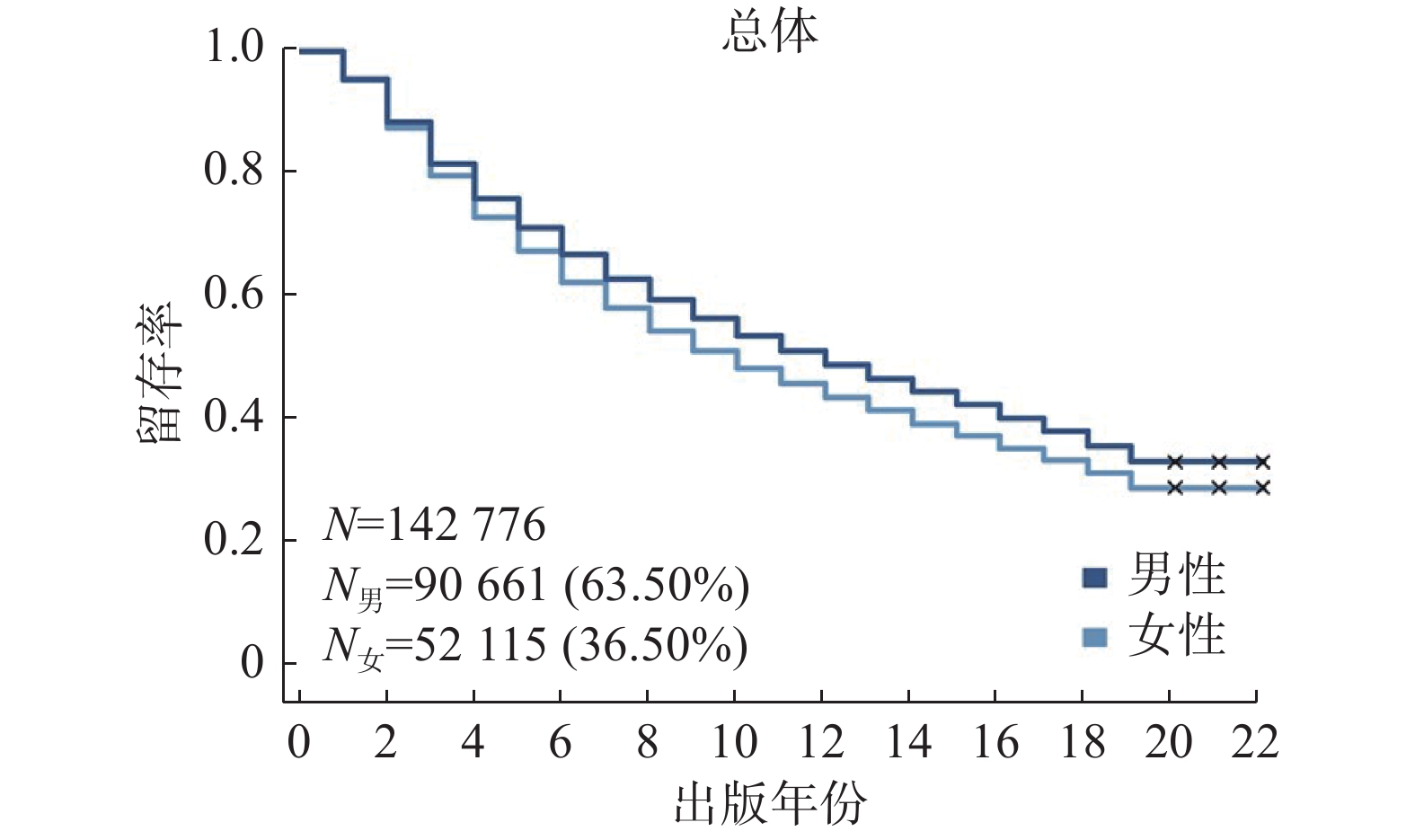
| 时间 (年) | 女性(2000 年队列) | 男性(2000 年队列) | 总计(2000 年队列) | ||||||||
| N | N (离开 科学界) | KM 概率(停留) 及 95% CI 和 SE | N | N (离开 科学界) | KM 概率(停留) 及 95% CI 和 SE | N | N (离开 科学界) | KM 概率(停留) 及 95% CI 和 SE | |||
| 1 | 52,115 | 2,530 | 0.951 (0.950-0.953)1 | 90,661 | 4,151 | 0.954 (0.953-0.956)1 | 142,776 | 6,681 | 0.953 (0.951-0.954)1 | ||
| 2 | 49,585 | 3,985 | 0.875 (0.872-0.878)1 | 86,510 | 6,302 | 0.885 (0.883-0.887)1 | 136,095 | 10,287 | 0.880 (0.877-0.882)1 | ||
| 3 | 45,600 | 3,948 | 0.799 (0.796-0.803)2 | 80,208 | 6,114 | 0.817 (0.815-0.820)1 | 125,808 | 10,062 | 0.811 (0.809-0.812)1 | ||
| 4 | 41,652 | 3,553 | 0.731 (0.727-0.735)2 | 74,094 | 5,062 | 0.761 (0.759-0.764)1 | 115,746 | 8,615 | 0.749 (0.746-0.751)1 | ||
| 5 | 38,099 | 2,838 | 0.677 (0.673-0.681)2 | 69,032 | 4,356 | 0.713 (0.710-0.716)2 | 107,131 | 7,194 | 0.695 (0.691-0.698)2 | ||
| 6 | 35,261 | 2,602 | 0.627 (0.623-0.631)2 | 64,676 | 3,934 | 0.670 (0.667-0.673)2 | 99,937 | 6,536 | 0.655 (0.651-0.658)2 | ||
| 7 | 32,659 | 2,183 | 0.585 (0.581-0.589)2 | 60,742 | 3,458 | 0.632 (0.629-0.635)2 | 93,401 | 5,641 | 0.613 (0.610-0.616)2 | ||
| 8 | 30,476 | 1,961 | 0.547 (0.543-0.551)2 | 57,284 | 3,110 | 0.598 (0.594-0.601)2 | 87,760 | 5,071 | 0.577 (0.574-0.580) 2 | ||
| 9 | 28,515 | 1,665 | 0.515 (0.511-0.520) 2 | 54,174 | 2,774 | 0.567 (0.564-0.570)2 | 82,689 | 4,439 | 0.548 (0.545-0.551)2 | ||
| 10 | 26,850 | 1,472 | 0.487 (0.483-0.491)2 | 51,400 | 2,465 | 0.540 (0.537-0.543)2 | 78,250 | 3,937 | 0.517 (0.514-0.520) 2 | ||
| 11 | 25,378 | 1,264 | 0.463 (0.458-0.467)2 | 48,935 | 2,225 | 0.515 (0.512-0.518) 2 | 74,313 | 3,489 | 0.492 (0.489-0.495)2 | ||
| 12 | 24,114 | 1,158 | 0.440 (0.436-0.445)2 | 46,710 | 2,055 | 0.493 (0.489-0.496)2 | 70,824 | 3,213 | 0.466 (0.463-0.469)2 | ||
| 13 | 22,956 | 1,151 | 0.418 (0.414-0.423)2 | 44,655 | 2,032 | 0.470 (0.467-0.473)2 | 67,611 | 3,183 | 0.444 (0.441-0.447)2 | ||
| 14 | 21,805 | 1,089 | 0.398 (0.393-0.402)2 | 42,623 | 1,889 | 0.449 (0.446-0.453)2 | 64,428 | 2,978 | 0.426 (0.423-0.429)2 | ||
| 15 | 20,716 | 1,048 | 0.377 (0.373-0.382)2 | 40,734 | 1,884 | 0.429 (0.425-0.432)2 | 61,450 | 2,932 | 0.405 (0.402-0.408)2 | ||
| 16 | 19,668 | 1,033 | 0.358 (0.353-0.362)2 | 38,850 | 1,959 | 0.407 (0.404-0.410)2 | 58,518 | 2,992 | 0.384 (0.381-0.387)2 | ||
| 17 | 18,635 | 1,002 | 0.338 (0.334-0.342)2 | 36,891 | 2,020 | 0.385 (0.381-0.388)2 | 55,526 | 3,022 | 0.363 (0.360-0.366)2 | ||
| 18 | 17,633 | 1,064 | 0.318 (0.314-0.322)2 | 34,871 | 2,070 | 0.362 (0.359-0.365)2 | 52,504 | 3,134 | 0.342 (0.339-0.345)2 | ||
| 19 | 16,569 | 1,228 | 0.294 (0.290-0.298) 2 | 32,801 | 2,350 | 0.336 (0.333-0.339)2 | 49,370 | 3,578 | 0.315 (0.312-0.318)2 | ||
"
"
| 时间 (年) | 女性(2010 年队列) | 男性(2010 年队列) | |||||
| N | N(离开科学界) | KM 概率(停留) 及 95% CI 和 SE | N | N(离开科学界) | KM 概率(停留) 及 95% CI 和 SE | ||
| 1 | 97,145 | 5,030 | 0.948 (0.947-0.950)1 | 135,698 | 7,375 | 0.946 (0.944-0.947)1 | |
| 2 | 92,115 | 8,686 | 0.859 (0.857-0.861)1 | 128,323 | 12,183 | 0.856 (0.854-0.858)1 | |
| 3 | 83,429 | 8,090 | 0.776 (0.773-0.778)1 | 116,140 | 11,164 | 0.774 (0.771-0.776)1 | |
| 4 | 75,339 | 7,369 | 0.700 (0.697-0.703)1 | 104,976 | 9,869 | 0.701 (0.698-0.703)1 | |
| 5 | 67,970 | 6,470 | 0.633 (0.630-0.636)2 | 95,107 | 8,552 | 0.638 (0.635-0.640)1 | |
| 6 | 61,500 | 5,904 | 0.572 (0.569-0.575)2 | 86,555 | 7,851 | 0.580 (0.577-0.583)1 | |
| 7 | 55,596 | 5,499 | 0.516 (0.513-0.519)2 | 78,704 | 7,322 | 0.526 (0.523-0.529)1 | |
| 8 | 50,097 | 4,984 | 0.464 (0.461-0.468)2 | 71,382 | 7,078 | 0.474 (0.471-0.477)1 | |
| 9 | 45,113 | 4,929 | 0.414 (0.411-0.417)2 | 64,304 | 6,745 | 0.424 (0.422-0.427)1 | |
"
"
"
"
| Alexopoulos, M., Lyons, K., Mahetaji, K., Barnes, M. E., & Gutwillinger, R. (2023). Gender inference: can chatGPT outperform common commercial tools?. arXiv preprint arXiv:2312.00805. | |
| Allison, P. D. (2014). Event history and survival analysis. Sage. | |
|
Baas, J., Schotten, M., Plume, A., Côté, G., & Karimi, R. (2020). Scopus as a curated, high-quality bibliometric data source for academic research in quantitative science studies. Quantitative Science Studies, 1 (1), 377- 386.
doi: 10.1162/qss_a_00019 |
|
| Blickenstaff, J. C. (2005). Women and science careers: Leaky pipeline or gender filter? Gender and Education, 17(4), 369—386. | |
| Branch, E. H. ed. (2016). Pathways, Potholes, and the Persistence of Women in Science. Reconsidering the Pipeline. Lexington Books. | |
| Branch, E. H. , & Alegria, S. (2016). Gendered Responses to Failure in Undergraduate Computing. Evidence, Contradictions, and New Directions. In: E. H. Branch (ed. ), Pathways, Potholes, and the Persistence of Women in Science. Reconsidering the Pipeline (p. 17-31). Lexington Books. | |
| Cornelius, R. , Constantinople, A. , & Gray, J. (1988). The chilly climate: Fact or artifact? The Journal of Higher Education, 59(5), 527—55. | |
| Deutsch, F. M. , & Yao, B. (2014). Gender differences in faculty attrition in the USA. Community, Work & Family, 17(4), 392—408. | |
| Ehrenberg, R. G., Kasper, H., & Rees, D. I. (1991). Faculty turnover in American colleges and universities. Economics of Education Review, 10 (2), 99- 110. | |
| Elsevier (2018). Gender in the global research landscape. Elsevier. | |
| Elsevier. (2020). The researcher journey through a gender lens. Elsevier. | |
| Fox, M. F. (2010). Women and Men Faculty in Academic Science and Engineering: Social-Organizational Indicators and Implications. American Behavioral Scientist, 53, 997- 1012. | |
| Fox, M. F., & Mohapatra, S. (2007). Social-organizational characteristics of work and publication productivity among academic scientists in doctoral-granting departments. The Journal of Higher Education, 78 (5), 542- 571. | |
| Fox, M. F. (2020). Gender, science, and academic rank: Key issues and approaches. Quantitative Science Studies, 1 (3), 1001- 1006. | |
| Fox, M. F. , & Xiao, W. (2013). Perceived Chances for Promotion Among Women Associate Professors in Computing: Individual, Departmental, and Entrepreneurial Factors. Journal of Technology Transfer 38: 135—152. | |
| Fox, M. F. , & Kline, K. (2016). Women Faculty in Computing. A Key Case of Women in Science. In: E. H. Branch (ed. ), Pathways, Potholes, and the Persistence of Women in Science. Reconsidering the Pipeline (p. 54-69). Lexington Books. | |
| Geuna, A. , & Shibayama, S. (2015). Moving out of academic research: Why do scientists stop doing research? In A. Geuna (Ed. ), Global mobility of research scientists (pp. 271–297). Elsevier. | |
| Glenn, Norval D. 2005. Cohort analysis. Thousand Oaks, CA: Sage | |
| Goulden, M., Mason, M. A., & Frasch, K. (2011). Keeping women in the science pipeline. The ANNALS of the American Academy of Political and Social Science, 638, 141- 162. | |
| Hammarfelt, B. (2017). Recognition and reward in the academy: Valuing publication oeuvres in biomedicine, economics and history. Aslib Journal of Information Management, 69 (5), 607- 623. | |
| Hu, Y., Hu, C., Tran, T., Kasturi, T., Joseph, E., & Gillingham, M. (2021). What’s in a name?–gender classification of names with character based machine learning models. Data Mining and Knowledge Discovery, 35(4), 1537—1563. | |
| Kaminski, D., & Geisler, C. (2012). Survival analysis of faculty retention in science and engineering by gender. Science, 335, 864- 866. | |
| Kanter, R. M. (1977). Some effects of proportions on group life: Skewed sex ratios and responses to token women. American Journal of Sociology, 82 (5), 965- 990. | |
| Karimi, F., Wagner, C., Lemmerich, F., Jadidi, M., & Strohmaier, M. (2016). Inferring gender from names on the web: A comparative evaluation of gender detection methods. In Proceedings of the 25th International conference companion on World Wide Web (pp. 53-54). | |
| Kashyap, R. , Rinderknecht, R. G. , Akbaritabar, A. , Alburez-Gutierrez, D. , Gil-Clavel, S. , Grow, A. , Zhao, X. (2023). Digital and computational demography. In: Research handbook on digital sociology, 48–86. Cheltenham: Edward Elgar Publishing. | |
| King, M. M. , Bergstrom, C. T. , Correll, S. J. , Jacquet, J. , & West, J. D. (2017). Men set their own cites high: Gender and self-citation across fields and over time. Socius, 3. | |
| Kwiek, M. (2016). The European research elite: A cross-national study of highly productive academics across 11 European systems. Higher Education, 71 (3), 379- 397. | |
| Kwiek, M. (2018). High research productivity in vertically undifferentiated higher education systems: Who are the top performers? Scientometrics. Vol. 115(1). 415—462. | |
| Kwiek, M., & Roszka, W. (2021a). Gender disparities in international research collaboration: A large-scale bibliometric study of 25, 000 university professors. Journal of Economic Surveys, 35 (5), 1344- 1388. | |
| Kwiek, M., & Roszka, W. (2021b). Gender-based homophily in research: A large-scale study of man-woman collaboration. Journal of Informetrics, 15 (3), 1- 38. | |
| Kwiek, M., & Roszka, W. (2022). Are female scientists less inclined to publish alone? The gender solo research gap. Scientometrics, 127, 1697- 1735. | |
| Kwiek, M. , & Szymula, L. (2024). Quantifying attrition in science: A cohort-based, longitudinal study of scientists in 38 OECD countries. Higher Education, 1–29. Online first: https://doi.org/10.1007/s10734-024-01284-0. | |
| Kyvik, S. (1990). Age and scientific productivity. Differences between fields of learning. Higher Education, 19(1), 37—55. | |
| Larivière, V., Ni, C., Gingras, Y., Cronin, B., & Sugimoto, C. R. (2013). Bibliometrics: Global gender disparities in science. Nature, 504 (7479), 211- 213. | |
| Liu, L., Jones, B. F., Uzzi, B., et al. (2023). Data, measurement, and empirical methods in the science of science. Nature Human Behaviour, 7, 1046- 1058. | |
| Loannidis, J. P. A., Boyack, K. W., & Klavans, R. (2014). Estimates of the continuously publishing core in the scientific workforce. PLOS One, 9 (7), e101698. | |
| Maranto, C. L., & Griffin, A. E. (2011). The antecedents of a “chilly climate” for women faculty in higher education. Human Relations, 64 (2), 139- 159. | |
| Mills, M. (2011). Introducing survival and event history analysis. Sage. | |
| Milojevic, S., Radicchi, F., & Walsh, J. P. (2018). Changing demographics of scientific careers: The rise of the temporary workforce. Proceedings of the National Academy of Sciences, 115, 12616- 12623. | |
| NamSor (2024). NamSor API documentation available from https://namsor.app/api-documentation/. | |
| Nane, G. F., Larivière, V., & Costas, R. (2017). Predicting the age of researchers using bibliometric data. Journal of informetrics, 11(3), 713—729. | |
| Nielsen, M. W., & Andersen, J. P. (2021). Global citation inequality is on the rise. Proceedings of the National Academy of Sciences, 118 (7), e2012208118. | |
| Nygaard, L. P., Piro, F., & Aksnes, D. (2022). Gendering excellence through research productivity indicators. Gender and Education, 34 (6), 690- 704. | |
| Pelz, D. C., & Andrews, F. M. (1976). Scientists in organizations: Productive climates for research and development. New York: Wiley. | |
| Peters, S. A., & Norton, R. (2018). Sex and gender reporting in global health: new editorial policies. BMJ global health, 3(4). | |
| Preston, A. E. (2004). Leaving science. Occupational exit from scientific careers. Russell Sage Foundation. | |
| Priem, J., Piwowar, H., & Orr, R. (2022). OpenAlex: A fully-open index of scholarly works, authors, venues, institutions, and concepts. arXiv preprint arXiv:2205.01833. | |
| Radicchi, F., & Castellano, C. (2013). Analysis of bibliometric indicators for individual scholars in a large data set. Scientometrics, 97, 627—637. | |
| Robinson-Garcia, N., Costas, R., Sugimoto, C. R., Larivière, V., & Nane, G. F. (2020). Task specialization across research careers. Elife, 9, e60586. | |
| Rosser, V. J. (2004). Faculty members’ intentions to leave: A national study on their work-life and satisfaction. Research in Higher Education, 45 (3), 285- 309. | |
| Santos, J. M. , Horta, H. , & Amâncio, L. (2020). Research agendas of female and male academics: A new perspective on gender disparities in academia. Gender and Education, 1—19. | |
| Santamaría, L., & Mihaljević, H. (2018). Comparison and benchmark of name-to-gender inference services. PeerJ Computer Science, 4, e156. | |
| Salganik, M. J. (2018). Bit by bit: Social research in the digital age. Princeton University Press. | |
| Savage, W. E., & Olejniczak, A. J. (2021). Do senior faculty members produce fewer research publications than their younger colleagues? Evidence from Ph. D. granting institutions in the United States. Scientometrics, 126(6), 4659—4686. | |
| Science-Metrix (2018). Analytical Support for Bibliometrics Indicators. Development of bibliometric indicators to measure women’s contribution to scientific publications. Final Report. Science-Metrix. | |
| Shaw, A. K., & Stanton, D. E. (2012). Leaks in the pipeline: Separating demographic inertia from ongoing gender differences in academia. Proceedings of the Royal Society B. Biological Sciences, 279 (1743), 3736- 3741. | |
| Shibayama, S., & Baba, Y. (2015). Impact-oriented science policies and scientific publication practices: The case of life sciences in Japan. Research Policy, 44 (4), 936- 950. | |
| Singer, J. D. , & Willett, J. B. (2003). Applied Longitudinal Data Analysis. Modeling Change and Event Occurrence. Oxford: Oxford University Press. | |
| Smart, J. C. (1990). A causal model of faculty turnover intentions. Research in Higher Education, 31 (5), 405- 424. | |
|
Spoon K., LaBerge N., Wapman K. H., Zhang S., Morgan A. C., Galesic M., Fosdick B. K., Larremore D. B., Clauset A. (2023). Gender and retention patterns among U. S. faculty. Science Advances, 9, eadi2205.
doi: 10.1126/sciadv.adi2205 |
|
| Stephan, P. E., & Levin, S. G. (1992). Striking the mother lode in science: The importance of age, place, and time. New York: Oxford University Press. | |
| Stephan, P. E. (2012). How economics shapes science. Harvard University Press. | |
| Sugimoto, C. , & Larivière, V. (2023). Equity for women in science: Dismantling systemic barriers to advancement. Harvard University Press. | |
| Tang, L. , & Horta, H. (2023). Supporting academic women’s careers: Male and female academics’ perspectives at a Chinese research university. Minerva. https://doi.org/10.1007/s11024-023-09506-y. | |
| Van den Besselaar, P., & Sandström, U. (2016). Gender differences in research performance and its impact on careers: a longitudinal case study. Scientometrics, 106, 143—162. | |
| Wang, D. , & Barabási, A. -L. (2021). The science of science. Cambridge University Press. | |
| Wais, K. (2016). Gender prediction methods based on first names with genderizeR. The R Journal 8(1): 17—37. | |
| West, J. D., Jacquet, J., King, M. M., Correll, S. J., & Bergstrom, C. T. (2013). The role of gender in scholarly authorship. PloS one, 8(7), e66212. | |
| White-Lewis, D. K., O’Meara, K., Mathews, K., et al. (2023). Leaving the institution or leaving the academy? Analyzing the factors that faculty weigh in actual departure decisions. Research in Higher Education, 64, 473- 494. | |
| Wohrer, V. (2014). To stay or to go? Narratives of early-stage sociologists about persisting in academia. Higher Education Policy, 27, 469- 487. | |
| Xie, Y. , & Shauman, K. A. (2003). Women in Science: Career Processes and Outcomes. Harvard University Press. | |
| Xu, Y. J. (2008). Gender disparity in STEM disciplines: A study of faculty attrition and turnover intentions. Research in Higher Education, 49, 607- 624. | |
| Zhou, Y., & Volkwein, J. F. (2004). Examining the influence on faculty departure intentions: A comparison of tenured versus nontenured faculty at research universities using NSOPF-99. Research in Higher Education, 45 (2), 139- 176. |
| [1] | Yonghe Zheng, Danhua Zhou, Yonghe Zhang, Xuewei Tian, Jingying Wang, Yi Zheng. ChatGPT from the Perspective of Computational Education: Connotation, Theme, Reflection, and Challenge [J]. Journal of East China Normal University(Educational Sciences), 2023, 41(7): 91-102. |
| [2] | Guangbin Zhang, Kexun Xue. The Underlying Logic and Construction Path of Digital Pedagogy: On the Construction of Chinese Digital Pedagogy [J]. Journal of East China Normal University(Educational Sciences), 2023, 41(11): 67-84. |
| [3] | Haiping Xue, Huanhuan Shi. Starting Line Competition: An Analysis of the First Time for Primary and Secondary School Students to Participate in Extracurricular Tutoring—— An Empirical Study Supporting the Implementation of the “Double Reduction” Policy [J]. Journal of East China Normal University(Educational Sciences), 2022, 40(2): 71-89. |
| [4] | Xin Yang. Trace on Calculation Method of Evaluation Reform of Education [J]. Journal of East China Normal University(Educational Sciences), 2022, 40(1): 19-29. |
| [5] | Tang Hanwei, Zhang Jiangkun. Limits of Big Data Application in Education [J]. Journal of East China Normal University(Educational Sciences), 2020, 38(10): 60-68. |
| [6] | ZHAO Lingli. The Quality Assessment of Aesthetic Education Supported by Objectives and Curriculum [J]. Journal of East China Normal University(Educationa, 2017, 35(5): 87-99+161. |
| [7] | JIANG Yong, DAI Nai'en. Limitation of Evidence-Based Educational Research:Perspective of Cultural Existentialism Pedagogy [J]. Journal of East China Normal University(Educationa, 2017, 35(3): 72-79+170. |
| Viewed | ||||||
|
Full text |
|
|||||
|
Abstract |
|
|||||
