
 中国人文社会科学核心期刊
Journal of East China Normal University(Educational Sciences) ›› 2025, Vol. 43 ›› Issue (1): 81-95.doi: 10.16382/j.cnki.1000-5560.2025.01.006
Previous Articles Next Articles
Wenyan Liang1,2, Qian He1
Online:2025-01-01
Published:2024-12-24
Wenyan Liang, Qian He. How Siblings Influence Adolescents’ Cognitive Abilities and Subjective Well-being?[J]. Journal of East China Normal University(Educational Sciences), 2025, 43(1): 81-95.
"

"

"
| 变量 | 观测样本 | 均值 | 标准差 | 最小值 | 最大值 | |
| 认知能力 | 字词测试得分 | 68.83 | 20.32 | 0 | 100 | |
| 数学测试得分 | 65.31 | 21.45 | 0 | 100 | ||
| 主观幸福感 | 总体生活满意度 | 78.93 | 20.23 | 0 | 100 | |
| 人际关系满意度 | 67.98 | 21.10 | 0 | 100 | ||
| 积极情绪 | 84.40 | 13.34 | 0 | 100 | ||
| 兄弟姐妹状况 | 兄弟姐妹数量 | 0.93 | 0.65 | 0 | 2 | |
| 有1个兄弟姐妹(1=是, 0=否) | 0.56 | 0.49 | 0 | 1 | ||
| 有2个兄弟姐妹(1=是, 0=否) | 0.18 | 0.38 | 0 | 1 | ||
| 个人特征 控制变量 | 男孩(1=男孩, 0=女孩) | 0.52 | − | − | − | |
| 年龄 | 15.29 | 1.99 | 10 | 18 | ||
| 非农户口(1=非农, 0=农业) | 0.22 | − | − | − | ||
| 民族(1=汉族, 0=其他) | 0.90 | − | − | − | ||
| 学段(1=小学, 2=初中, 3=高中) | 2.16 | − | − | − | ||
| 滞后期字词测试得分 | 62.37 | 21.13 | 0 | 100 | ||
| 滞后期数学测试得分 | 59.97 | 23.05 | 0 | 100 | ||
| 滞后期总体生活满意度 | 79.67 | 21.82 | 0 | 100 | ||
| 滞后期人际关系满意度 | 70.30 | 21.56 | 0 | 100 | ||
| 滞后期积极情绪 | 85.45 | 13.85 | 0 | 100 | ||
| 家庭特征 控制变量 | 父母最高受教育年限 | 8.42 | 3.92 | 0 | 22 | |
| 父母最高职业威望 | 35.18 | 14.53 | 12 | 90 | ||
| 家庭总收入(万元/年) | 6.20 | 7.02 | 0.4 | 93.5 | ||
"
| 认知能力 | 主观幸福感 | |||||
| 字词测试得分 | 数学测试得分 | 总体生活满意度 | 人际关系满意度 | 积极情绪 | ||
| 兄弟姐妹数量 | −0.371 | −1.293** | 0.781 | 0.922 | −0.004 | |
| (0.55) | (0.65) | (1.03) | (1.07) | (0.40) | ||
| 男孩 | −2.761*** | −0.314 | −1.246 | 0.862 | 1.841*** | |
| (0.56) | (0.66) | (1.02) | (1.04) | (0.41) | ||
| 年龄 | −0.556* | 1.141*** | −0.497 | −2.739*** | −0.268 | |
| (0.29) | (0.33) | (0.55) | (0.60) | (0.20) | ||
| 户籍类型 | 1.111 | 3.373*** | −0.172 | 1.696 | 0.017 | |
| (0.92) | (1.06) | (1.56) | (1.71) | (0.66) | ||
| 民族 | −2.819* | 1.319 | −2.379 | 6.536** | −0.101 | |
| (1.45) | (1.92) | (2.52) | (2.73) | (1.07) | ||
| 学段 | 6.326*** | 3.563*** | −1.548 | 0.795 | −0.250 | |
| (0.81) | (0.93) | (1.31) | (1.42) | (0.56) | ||
| 父母最高受教育年限 | 0.271*** | 0.513*** | 0.187 | −0.082 | 0.123* | |
| (0.09) | (0.11) | (0.17) | (0.18) | (0.07) | ||
| 父母最高职业威望 | 0.047** | 0.059** | 0.040 | 0.065 | −0.014 | |
| (0.02) | (0.03) | (0.04) | (0.05) | (0.02) | ||
| 家庭总收入(万元/年) | 0.053 | 0.118*** | 0.054 | 0.119 | −0.029 | |
| (0.04) | (0.04) | (0.09) | (0.08) | (0.03) | ||
| 常数项 | 54.239*** | 24.576*** | 67.166*** | 90.072*** | 67.479*** | |
| (7.84) | (7.96) | (11.58) | (10.82) | (4.40) | ||
| 滞后一期结果变量 | YES | YES | YES | YES | YES | |
| 年份固定效应 | YES | YES | YES | YES | YES | |
| 区县固定效应 | YES | YES | YES | YES | YES | |
| 样本量 | ||||||
| 拟合优度 | 0.38 | 0.26 | 0.21 | 0.21 | 0.16 | |
"
| 认知能力 | 主观幸福感 | |||||
| 字词测试得分 | 数学测试得分 | 总体生活满意度 | 人际关系满意度 | 积极情绪 | ||
| 拥有1个兄弟姐妹 | −0.653 | −1.720* | 3.653** | 3.918** | −0.190 | |
| (β1) | (0.75) | (0.96) | (1.56) | (1.62) | (0.56) | |
| 拥有2个兄弟姐妹 | −0.750 | −2.590** | 1.966 | 2.259 | −0.010 | |
| (β2) | (1.10) | (1.30) | (2.06) | (2.14) | (0.79) | |
| 控制变量 | YES | YES | YES | YES | YES | |
| 滞后一期被解释变量 | YES | YES | YES | YES | YES | |
| 固定效应 | YES | YES | YES | YES | YES | |
| 常数项 | YES | YES | YES | YES | YES | |
| 样本量 | ||||||
| 拟合优度 | 0.383 | 0.262 | 0.209 | 0.208 | 0.164 | |
"
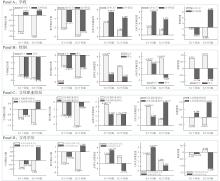
| 认知能力 | 主观幸福感 | |||||
| 字词测试 | 数学测试 | 总体生活满意度 | 人际关系满意度 | 积极情绪 | ||
| Panel A:学段(对照组:高中以下) | ||||||
| 兄弟姐妹数量( | −0.912 | −1.371* | 0.426 | 0.502 | −0.280 | |
| (0.64) | (0.76) | (1.04) | (1.08) | (0.46) | ||
| 兄弟姐妹数量 | 1.167 | 0.195 | 1.909 | 2.825 | 0.663 | |
| (0.86) | (1.02) | (1.99) | (2.07) | (0.62) | ||
| 0.255 | −1.175 | 2.335* | 3.326* | 0.383 | ||
| (0.72) | (0.85) | (1.90) | (1.98) | (0.52) | ||
| Panel B:性别(对照组:女生) | ||||||
| 兄弟姐妹数量( | −0.320 | −1.586* | 1.110 | 2.334* | 0.491 | |
| (0.69) | (0.82) | (1.27) | (1.33) | (0.50) | ||
| 兄弟姐妹数量 | −0.096 | 0.551 | −0.624 | −2.675 | −0.933 | |
| (0.83) | (0.99) | (1.56) | (1.63) | (0.60) | ||
| −0.416 | −1.035 | 0.486 | −0.341 | −0.443 | ||
| (0.52) | (0.19) | (0.69) | (0.79) | (0.35) | ||
| Panel C:家庭社会阶层(对照组:父母低职业威望) | ||||||
| 兄弟姐妹数量( | −0.582 | −1.531** | 0.879 | 0.596 | −0.243 | |
| (0.57) | (0.69) | (1.07) | (1.12) | (0.42) | ||
| 兄弟姐妹数量 | 0.666 | 0.736 | −0.285 | 0.945 | 0.731 | |
| (0.72) | (0.86) | (1.30) | (1.35) | (0.52) | ||
| 0.084 | −0.795 | 0.594 | 1.541 | 0.488 | ||
| (0.72) | (0.86) | (1.30) | (1.35) | (0.52) | ||
| Panel D:父母学历(对照组:父母学历均在高中以下) | ||||||
| 兄弟姐妹数量( | −0.558 | −1.672** | 0.772 | 0.709 | 0.082 | |
| (0.55) | (0.66) | (1.01) | (1.06) | (0.40) | ||
| 兄弟姐妹数量 | 0.856 | 1.710* | 0.051 | 1.086 | −0.382 | |
| (0.77) | (0.92) | (1.41) | (1.48) | (0.56) | ||
| 0.298 | 0.038 | 0.822 | 1.795 | −0.300 | ||
| (0.80) | (0.95) | (1.50) | (1.57) | (0.58) | ||
"
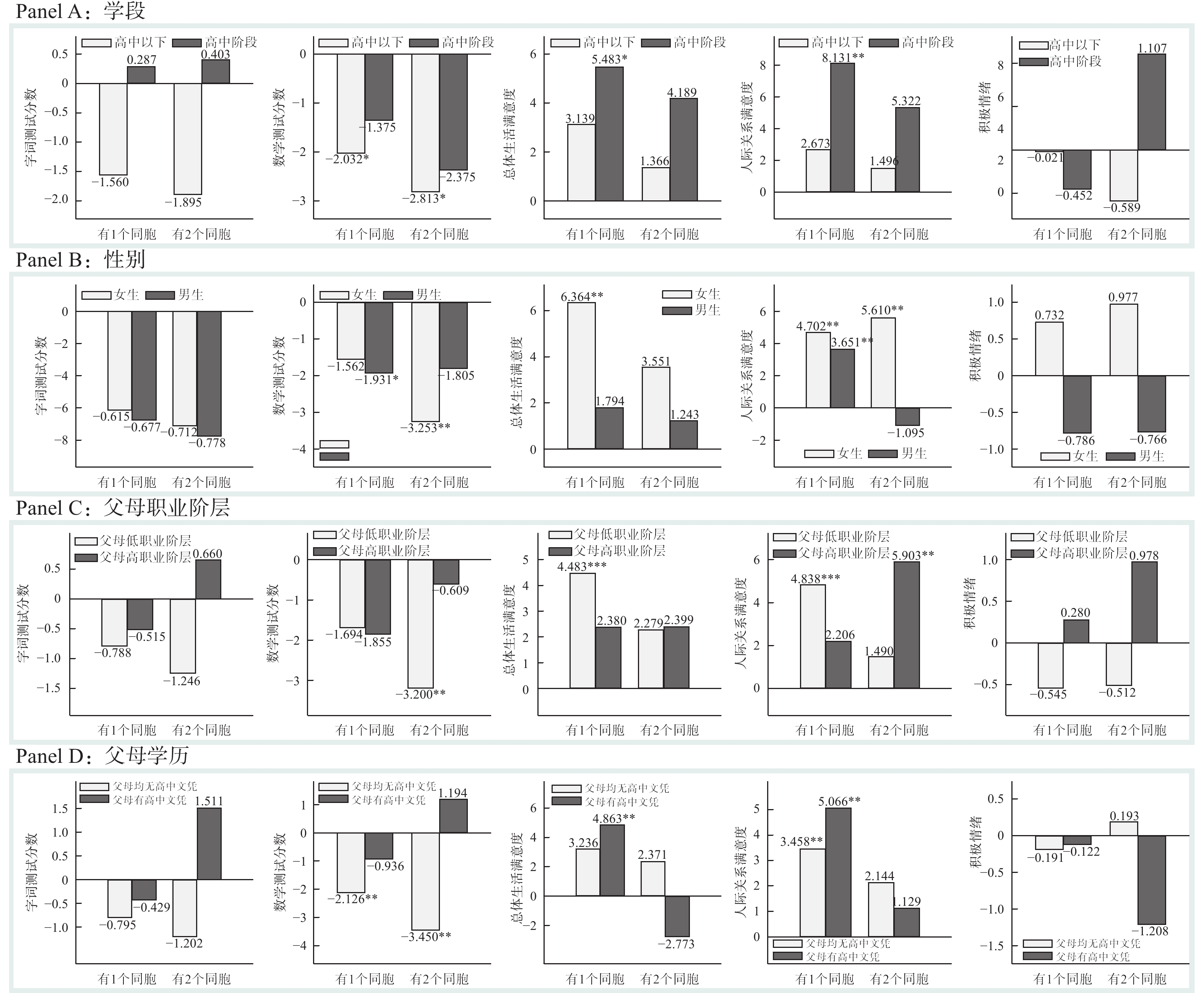
"
| 认知能力 | 主观幸福感 | |||||
| 字词测试得分 | 数学测试得分 | 总体生活满意度 | 人际关系满意度 | 积极情绪 | ||
| 保留多子女样本家庭中年龄最大子女: | ||||||
| 连续同胞变量 | ||||||
| 兄弟姐妹数量 | −0.680 | −1.194* | 1.364 | 1.550 | −0.265 | |
| (0.58) | (0.69) | (1.1) | (1.14) | (0.42) | ||
| 离散同胞变量 | ||||||
| 拥有1个兄弟姐妹 | −0.587 | −1.417 | 3.667** | 3.955** | −0.203 | |
| (0.76) | (0.97) | (1.61) | (1.66) | (0.58) | ||
| 拥有2个兄弟姐妹 | −1.370 | −2.359* | 2.727 | 3.091 | −0.536 | |
| (1.17) | (1.39) | (2.20) | (2.27) | (0.85) | ||
| 保留多子女样本家庭中年龄最小子女: | ||||||
| 连续同胞变量 | ||||||
| 兄弟姐妹数量 | −0.109 | −1.411** | 0.521 | 0.666 | −0.173 | |
| (0.57) | (0.68) | (1.11) | (1.17) | (0.42) | ||
| 离散同胞变量 | ||||||
| 拥有1个兄弟姐妹 | −0.656 | −1.805* | 3.124* | 3.674** | −0.207 | |
| (0.76) | (0.97) | (1.62) | (1.66) | (0.58) | ||
| 拥有2个兄弟姐妹 | −0.166 | −2.776** | 1.128 | 1.422 | −0.343 | |
| (1.19) | (1.37) | (2.21) | (2.29) | (0.84) | ||
"
| 认知能力 | 主观幸福感 | |||||
| 字词测试分数 | 数学测试分数 | 总体生活满意度 | 人际关系满意度 | 积极情绪 | ||
| 兄弟姐妹数量(IV) | 0.351* | 0.250 | 0.496** | 0.561** | 0.195 | |
| (0.19) | (0.17) | (0.23) | (0.23) | (0.21) | ||
| 一阶段回归结果 | 0.094*** | 0.094*** | 0.093*** | 0.094*** | 0.093*** | |
| (0.01) | (0.01) | (0.01) | (0.01) | (0.01) | ||
| 一阶段F值 | 53.53 | 53.53 | 52.91 | 53.39 | 53.53 | |
"
| 认知能力 | 主观幸福感 | |||||
| 字词测试得分 | 数学测试得分 | 总体生活满意度 | 人际关系满意度 | 积极情绪 | ||
| Panel A:2010—2018年期间,同胞数量从0变为1 | ||||||
| 拥有1个兄弟姐妹 | 4.581** | −0.287 | 2.027 | 2.146 | −1.475 | |
| (2.02) | (2.06) | (2.10) | (2.06) | (1.26) | ||
| Panel B:2010—2018年期间,同胞数量从1变为2 | ||||||
| 拥有2个兄弟姐妹 | 0.997 | −7.965** | −5.402** | −0.535 | 1.698 | |
| (3.54) | (3.74) | (2.59) | (4.36) | (2.24) | ||
| 程猛, 康永久. (2018). 从农家走进精英大学的年轻人: “懂事”及其命运. 中国青年研究, (05), 68- 75. | |
| 卡尼曼. (2012). 思考, 快与慢(胡晓姣, 等译). 北京: 中信出版社. | |
| 黎煦, 陶政宇. (2018). 生育二胎对孩子教育水平的影响研究. 人口学刊, 40 (06), 20- 30. | |
| 刘冬冬, 姚昊. (2018). 课外补习对初中学生不同学科成绩的影响研究——基于CEPS(2013-2014)实证分析. 教育学术月刊, (10), 57- 63. | |
| 刘晶波. (1999). 独生子女家庭教育的特点及其对儿童社会性发展的影响. 南京师大学报(社会科学版), (05), 64- 68. | |
| 刘小峰, 刘庆, 徐欢腾. (2020). 教育成长过程中的家庭同胞关系. 青年研究, (04), 32- 42+95. | |
| 陆方文, 刘国恩, 李辉文. (2017). 子女性别与父母幸福感. 经济研究, 52 (10), 173- 188. | |
| 穆光宗. (2023). 低生育危机与生育友好型社会构建. 人民论坛, (15), 17- 21. | |
| 聂景春, 庞晓鹏, 曾俊霞, 龙文进. (2016). 农村儿童兄弟姐妹的影响研究: 交流互动或资源稀释?. 人口学刊, 38 (06), 5- 16. | |
| 谭之博, 张晓波. (2016). 独生子女政策的精神健康成本. 经济研究, 51 (02), 168- 180. | |
| 陶东杰. (2019). 同胞数量与青少年认知能力: 资源稀释还是生育选择?. 教育与经济, 2019 (03), 29- 39. | |
| 王军, 王广州. (2022). 中国三孩政策下的低生育意愿研究及其政策意涵. 清华大学学报(哲学社会科学版), 37 (02), 201- 212+217. | |
| 魏钦恭, 张佳楠. (2021). 来自兄弟的“让渡”和母亲的“馈赠”: 校外教育投入中的女孩占优现象与家庭偏好逻辑. 社会, 41 (05), 208- 242. | |
| 谢宇, 胡婧炜, 张春泥. (2014). 中国家庭追踪调查: 理念与实践. 社会, 34 (02), 1- 32. | |
| 席强敏, 黄明慧, 张可云. (2023). 同胞数量与个体教育获得——基于公共教育投入的调节作用. 社会科学, (06), 145- 158. | |
| 杨娟. (2016). 代际流动性的经济学分析. 北京: 经济科学出版社. | |
| 翟振武, 李姝婧. (2022). 把握生育新态势建立整体性生育支持政策体系. 人口研究, 46 (06), 10- 16. | |
| 张月云, 谢宇. (2015). 低生育率背景下儿童的兄弟姐妹数、教育资源获得与学业成绩. 人口研究, 39 (04), 19- 34. | |
| 郑磊, 侯玉娜, 刘叶. (2014). 家庭规模与儿童教育发展的关系研究. 教育研究, 35 (04), 59- 69. | |
| 朱文婷, 张明珠, 洪秀敏. (2020). 一孩家庭与二孩家庭幼儿人际交往能力的差异分析. 中国临床心理学杂志, 28 (04), 793- 798. | |
| Attane, I. (2002). China’s Family Planning Policy: An Overview of Its Past and Future. Studies in Family Planning, 33 (1), 103- 113. | |
| Becker, G. S., & Lewis H. G. (1973). On the Interaction between the Quantity and Quality of Children. Journal of Political Economy, 81 (2), S279- S288. | |
| Blake, J. (1981). The Only Child in America: Prejudice versus Performance. Population and Development Review, 7 (1), 43. | |
| Borgonovi, F., & Pál, J. (2016). A Framework for the Analysis of Student Well-Being in the PISA 2015 Study. OECD. | |
| Chen, S. (2020). Parental Investment After the Birth of a Sibling: The Effect of Family Size in Low-Fertility China. Demography, 57 (6), 2085- 2111. | |
| Cutting, A. L., & Dunn, J. (2006). Conversations with siblings and with friends: Links between relationship quality and social Understanding. British Journal of Developmental Psychology, 24 (1), 73- 87. | |
| Diener, E., Suh, E., Lucas, R., & Smith, H. (1999). Subjective Well-Being: Three Decades of Progress. Psychological Bulletin, 125, 276- 302. | |
| Downey, D. B. (2001). Number of siblings and intellectual development: The resource dilution explanation - ProQuest. American Psychologist, 56 (6), 497- 504. | |
| Feinberg, M. E., Solmeyer, A. R., Hostetler, M. L., Sakuma, K. L., Jones, D., & McHale, S. M. (2013). Siblings Are Special: Initial Test of a New Approach for Preventing Youth Behavior Problems. The Journal of Adolescent Health: Official Publication of the Society for Adolescent Medicine, 53 (2), 166- 173. | |
| Furnham, A., & Cheng, H. (2000). Perceived parental behaviour, self-esteem and Happiness. Social Psychiatry and Psychiatric Epidemiology, 35 (10), 463- 470. | |
| Heckman, J. J., Stixrud, J., & Urzua, S. (2006). The Effects of Cognitive and Noncognitive Abilities on Labor Market Outcomes and Social Behavior. Journal of Labor Economics, 24 (3), 411- 482. | |
| Jiao, S., Ji, G., & Jing, Q. (1986). Comparative Study of Behavioral Qualities of Only Children and Sibling Children. Child Development, 57 (2), 357- 361. | |
| Joseph, D. L., & Newman, D. A. (2010). Emotional intelligence: An integrative meta-analysis and cascading model. Journal of Applied Psychology, 95 (1), 54- 78. | |
| Li, M., Cai, M., Zhong, H., & Liu, H. (2021). Comparisons of academic achievements of One-only children vs. children with siblings in China. Current Psychology, 40 (11), 5658- 5671. | |
| Li, X., & Qiu, Y. (2021). Are more children better than one? Evidence from a lab experiment of decision Making. China Economic Review, 69, 101653. | |
| Li, H., Zhang, J., & Zhu, Y. (2008). The Quantity-Quality Trade-Off of Children in a Developing Country: Identification Using Chinese Twins. Demography, 45 (1), 223- 243. | |
| Liu, C., Munakata, T., & Onuoha, F. N. (2005). Mental Health Condition of the Only-Child: A Study of Urban and Rural High School Students in China. Adolescence, 40 (160), 831- 45. | |
| McHale, S. M., Updegraff, K. A., & Whiteman S. D. (2012). Sibling Relationships and Influences in Childhood and Adolescence. Journal of Marriage and Family, 74 (5), 913- 930. | |
| OECD (2019). PISA 2018 Results (Volume II): Where All Students Can Succeed. Paris: OECD Publishing. | |
| Papavassiliou, I. Th. (1954). Intelligence and Family Size. Population Studies, 7 (3), 222- 226. | |
| Qian, N. (2009). Quantity-Quality and the One Child Policy: The Only-Child Disadvantage in School Enrollment in Rural China. NBER Working Paper No. 14973. | |
| Sorensen, L. C., Cook, P. J., & Dodge, K. A. (2017). From Parents to Peers: Trajectories in Sources of Academic Influence Grades 4 to 8. Educational Evaluation and Policy Analysis, 39 (4), 697- 711. | |
| Wu, L. (2014). Are only children worse off on subjective Well-being? : Evidence from China’s one-child Policy. Woking paper. Corpus ID: 157995872. | |
| Yang, B., Ollendick, T. H., Dong, Q., Xia, Y., & Lin, L. (1995). Only Children and Children with Siblings in the People’s Republic of China: Levels of Fear, Anxiety, and Depression. Child Development, 66 (5), 1301- 1311. | |
| Zajonc, R. B. (1976). Family Configuration and Intelligence. Science, 192 (4236), 227- 236. |
| [1] | Xiaomei Ye, Xiaojie Cao. The Influence of Teacher Care on the Development of Rural Children’s Non-cognitive Ability: Analysis of the Mechanism of Co-education in Home and Schools [J]. Journal of East China Normal University(Educational Sciences), 2023, 41(5): 98-112. |
| [2] | Fati Wu, Hao Tian, Yu Wang, Minsheng Fan. Research on Analysis of Knowledge Acquisition and Cognitive Ability Based on Rasch Model in Smart Education [J]. Journal of East China Normal University(Educational Sciences), 2021, 39(8): 57-69. |
| [3] | Chao Fang, Bin Huang. Can Physical Exercise Promote the Development of Teenagers’ Cognitive Ability? An Empirical Study Based on CEPS [J]. Journal of East China Normal University(Educational Sciences), 2021, 39(3): 84-98. |
| Viewed | ||||||
|
Full text |
|
|||||
|
Abstract |
|
|||||
