
 中国人文社会科学核心期刊
华东师范大学学报(教育科学版) ›› 2025, Vol. 43 ›› Issue (10): 10-32.doi: 10.16382/j.cnki.1000-5560.2025.10.002
• 专题:教育研究方法 • 上一篇
云如先, 黄斌, 祝雅汶
接受日期:2025-05-08
出版日期:2025-10-01
发布日期:2025-10-09
基金资助:Ruxian Yun, Bin Huang, Yawen Zhu
Accepted:2025-05-08
Online:2025-10-01
Published:2025-10-09
摘要:
人力资本是宏观教育与经济政策研究中经常使用的核心概念。要完成一项宏观教育政策计量研究,必须先要实现对一国人力资本的精确测量。通过一定的测量方法与数据转换技术形成国际可比的教育人力资本数据库,是学者开展宏观教育政策研究的基础性工作。本文沿着教育人力资本测量的“演变史”,系统介绍受教育年限、学生认知技能、经质量调整后的受教育年限和成人认知技能四种常用的教育人力资本测量指标,包括它们的基本原理、测算步骤、转换技术与常用国际数据库等,并依据人力资本理论与教育生产函数理论,对这四个测量指标的优缺点进行比较分析,提出评判教育人力资本测量指标优劣的四个基本原则,即“直接测量优于间接测量”、“存量测量优于流量测量”、“产出测量优于投入测量”和“质量测量优于数量测量”,最后对未来国家教育人力资本研究的发展方向进行了讨论。
云如先, 黄斌, 祝雅汶. 一国教育人力资本究竟应如何测量?——一个相关前沿测量方法与转换技术的系统评述[J]. 华东师范大学学报(教育科学版), 2025, 43(10): 10-32.
Ruxian Yun, Bin Huang, Yawen Zhu. How to Measure the Educational Human Capital of A Country: A Systematic Review on Frontier Measurement Methods and International Data Conversion Technology[J]. Journal of East China Normal University(Educationa, 2025, 43(10): 10-32.

图 1
受教育年限数据的三种插补方法对比"

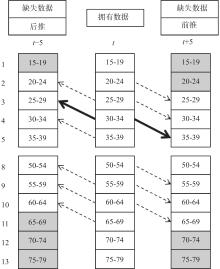
图 2
趋势外推法示意图"
图 3
一次完整迭代示意图"
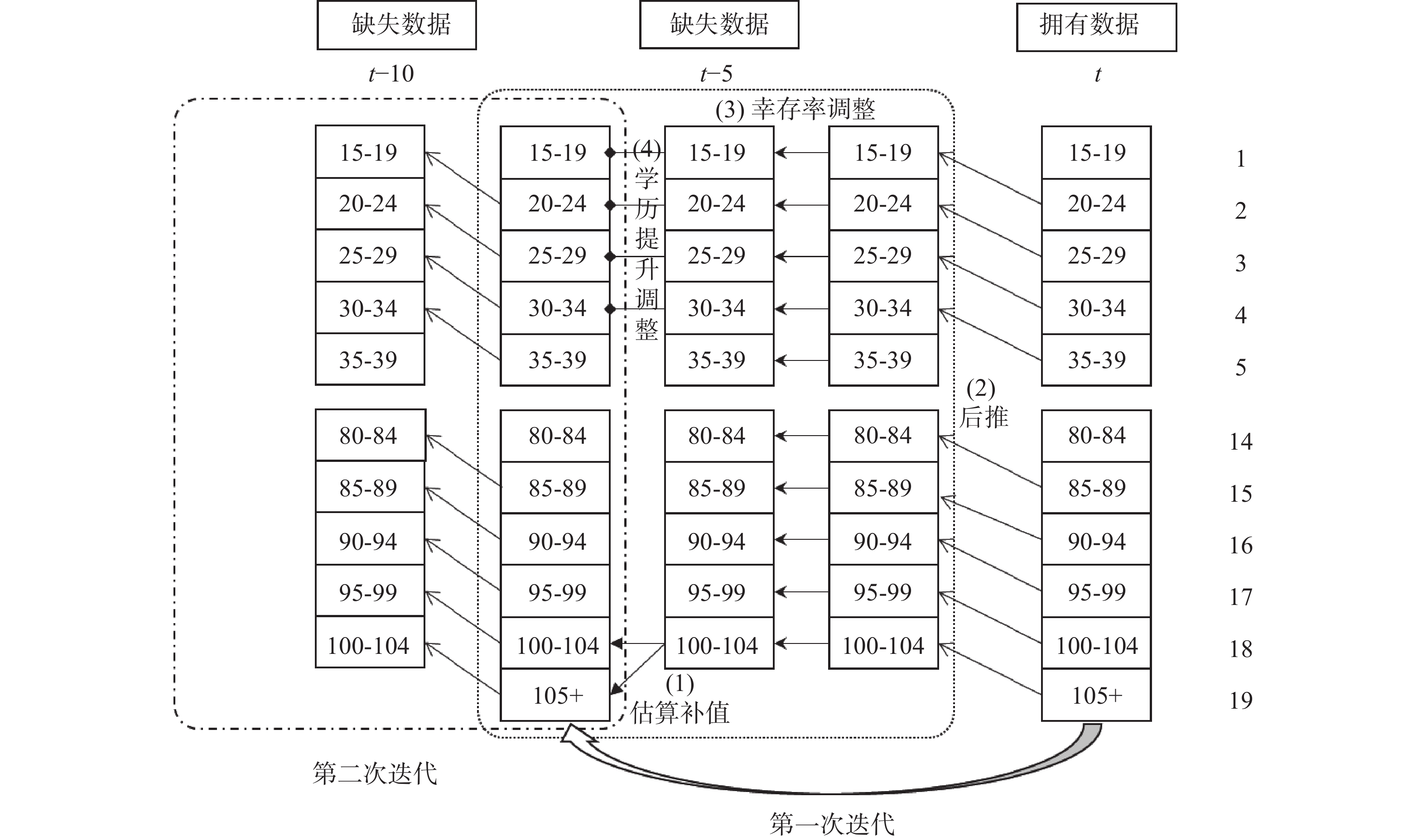
表 1
平均受教育年限数据库"
| Barro-Lee 教育成就数据库 | 维特根斯坦中心人力资本数据 | |
| 使用方法 | 趋势外推法(前推+后推) | 迭代后推法 |
| 主要文献 | Barro & Lee ( | Speringer et al. ( |
| 覆盖国家和地区数量 | 146个 | 185个 |
| 覆盖年份 | 1950–2015年 | 1950–2015年 |
| 最近更新年份 | 2021年 | 2024年 |
| 包含内容 | 平均受教育年限 | 教育获得分布、平均受教育年限 |
| 人口年龄跨度 | 15-24、25-34、…55-64岁 | 15-24、25-34、…100+岁 |
| 人口队列分类 | 15-64岁;25-64岁 | 15+;25+等 |
| 获取网址 | http://barrolee.com/ | https://dataexplorer.wittgensteincentre.org |
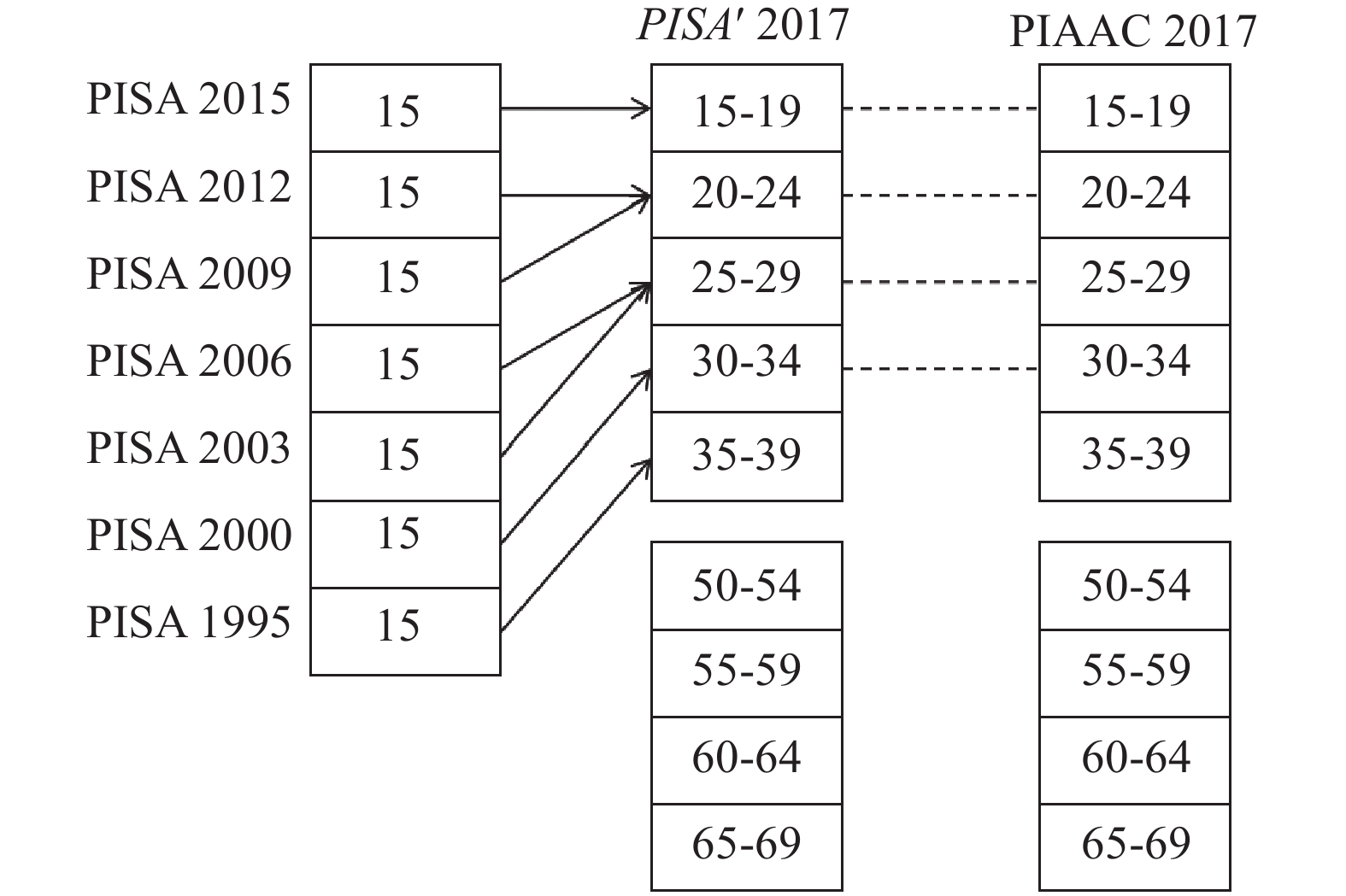
图 4
以不同类型锚点进行数据转换的方法对比"
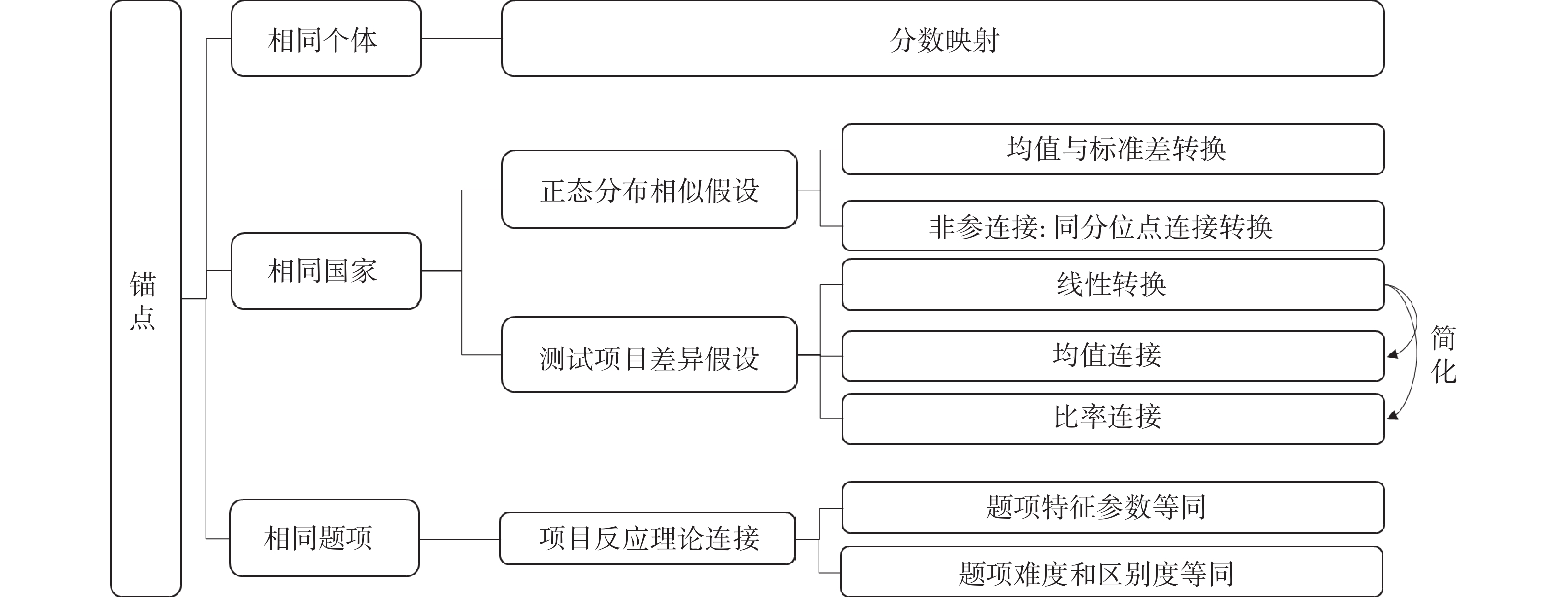
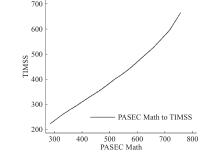
图 5
两种测试项目得分之间的映射关系 注:来源于Patel & Sandefur (2020)。"
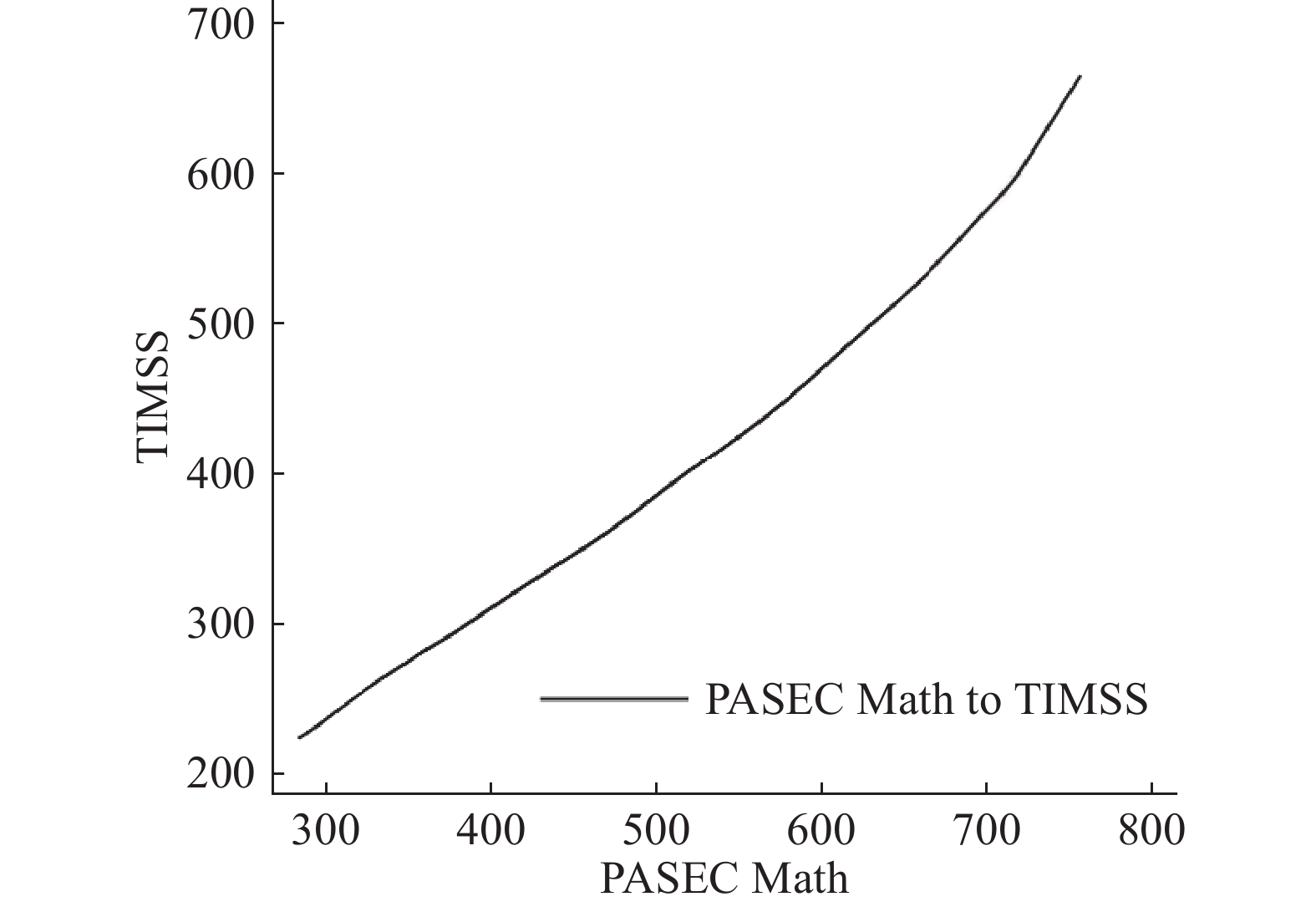
图 6
同分位点连接示意图"
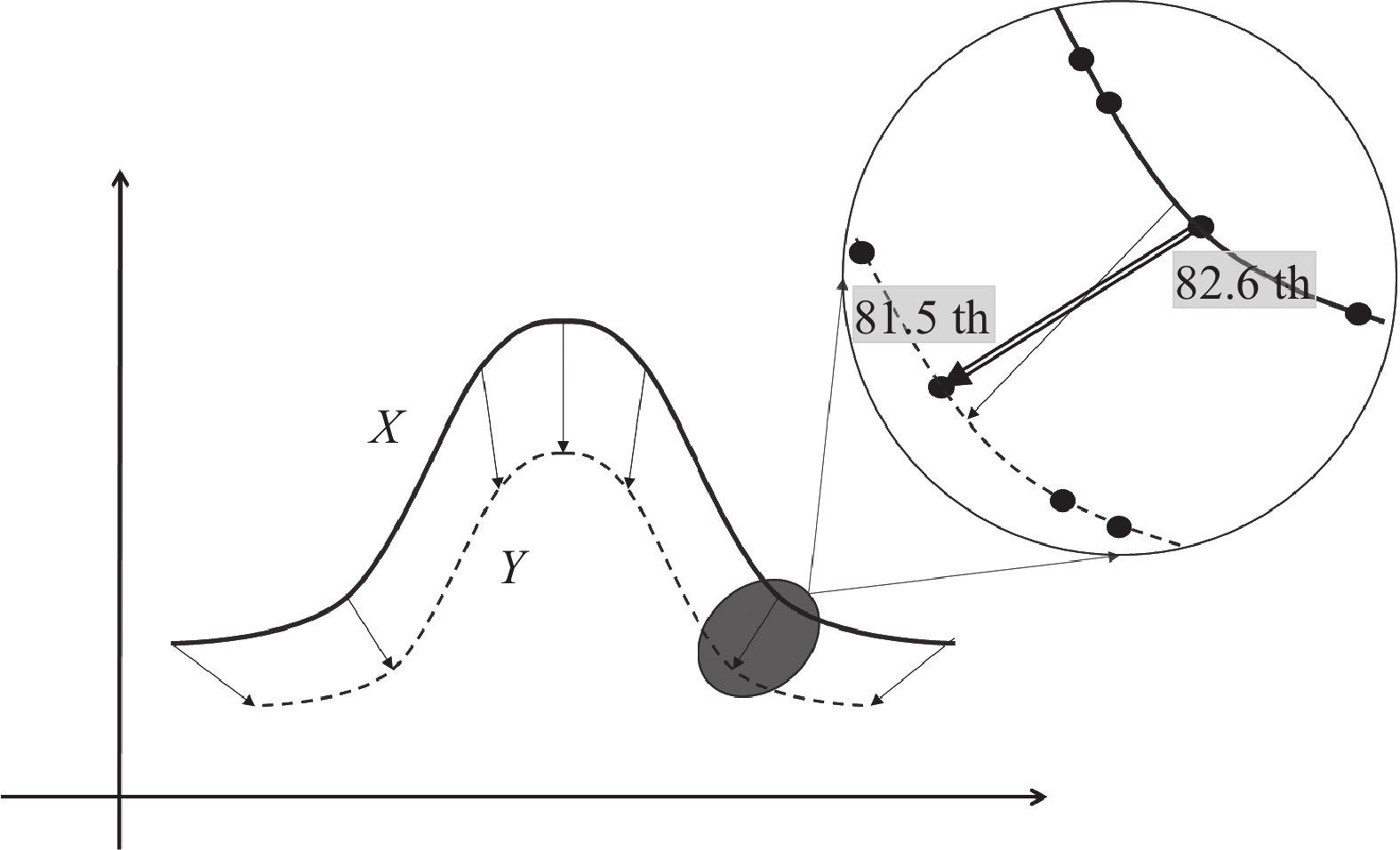
表 2
公开的学生认知技能数据库"
| HLO数据库(新版) | 全球人力资本估计(Global Human Capital Estimates) | 统一尺度下的学生获得数据 | |
| 方法文献 | Angrist et al. ( | Lim et al. ( | Gust et al. ( |
| 转换方法 | 线性转换辅以均值标准差转换 | 线性转换辅以高拟合补值 | 均值标准差转换辅以高拟合补值 |
| 元数据来源 | TIMSS、PIRLS、PISA、SACMEQ、PASEC、SERCE、TERCE、EGRA | TIMSS、PIRLS、PISA、SACMEQ、PASEC、PERCE、SERCE、TERCE、NAEP、NAS、智商(Intelligence Quotient,IQ)、 Barro–Lee数据 | TIMSS、PISA、SACMEQ、PASEC、SERCE、TERCE |
| 学段 | 小学和初中学生 | 5-9岁,10-14岁和15-19岁学生 | 以初中学生为主 |
| 测试科目 | 数学、科学、阅读 | 学习指数 | 数学和科学的得分均值 |
| 数据类型 | 国家均值 | 国家均值 | 国家均值 |
| 数据跨期与结构 | 2000-2017年非平衡面板 | 1990-2016年平衡面板 | 2018/2019年横截面 |
| 国家和地区数量 | 164 | 195 | 159 |
| 数据获取 | Gust et al.( |
表 3
QAYS数据库"
| 方法文献 | Filmer et al. ( | Altinok & Diebolt ( | |
| 采用的函数形式 | 公式(27) | 公式(27) | |
| 元数据来源 | 学生认知技能 | 文章中:TIMSS或PISA 后续更新:教育质量全球数据库(Global Dataset on Education Quality (2020 Update)) | TIMSS、PIRLS、PISA、SACMEQ、PASEC、PERCE、SERCE、TERCE、EGRA、ASER |
| 受教育年限 | Barro–Lee 数据(25-29岁) | Barro–Lee 数据(15-64岁) | |
| 时间跨度 | 2010、2017、2018、2020年的非平衡面板数据 | 1970-2020年的平衡面板数据(5年间隔) | |
| 覆盖国家和地区数目 | 174个 | 120个 | |
| 数据获取 | |||
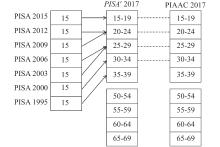
图 7
学生与成人认知技能得分转换原理"
| 黄斌, 何沛芸, 朱宇, 魏易. (2022). 基于父母教育背景的中国家庭校外教育支出分化. 中国教育学刊, (04), 19- 28. | |
| 黄斌, 云如先. (2023). 教育发展何以强国——基于1960—2020年认知技能国际可比数据的实证分析. 教育研究, 44 (10), 125- 136. | |
| 黄斌, 云如先, 吴凯霖. (2024). 认知技能分布对国民经济增长的影响: 教育强国的新证据. 华东师范大学学报(教育科学版), 42 (9), 13- 32. | |
| 魏易. (2020). 校内还是校外: 中国基础教育阶段家庭教育支出现状研究. 华东师范大学学报(教育科学版), 38 (05), 103- 116. | |
| 周金燕. (2024). 探索非认知能力的投资规律: 跨学科的理论和证据. 教育经济评论, 9 (01), 21- 43. | |
| Altinok, N., Angrist, N., & Patrinos, H. A. (2018). Global Data Set on Education Quality (1965–2015). Policy Research working paper, Washington, D. C. : World Bank Group. | |
| Altinok, N., & Diebolt, C. (2024). Cliometrics of Learning-Adjusted Years of Schooling: Evidence from a New Dataset. Cliometrica, 18 (3), 691- 764. | |
| Altinok, N., Diebolt, C., & Demeulemeester, J. L. (2014). A New International Database on Education Quality: 1965–2010. Applied Economics, 46 (11), 1212- 1247. | |
| Altinok, N., & Murseli, H. (2007). International Database on Human Capital Quality. Economics Letters, 96 (2), 237- 244. | |
| Angrist, N., Djankov, S., Goldberg, P. K., & Patrinos, H. A. (2021). Measuring Human Capital Using Global Learning Data. Nature, 592 (7854), 403- 408. | |
| Angrist, N., Evans, D., Filmer, D. P., Glennerster, R., Rogers, F. H., & Sabarwal, S. (2020). How to Improve Education Outcomes Most Efficiently? A Comparison of 150 Interventions Using the New Learning-Adjusted Years of Schooling Metric. CDG Working Paper. | |
| Balaj, M., Henson, C. A., Aronsson, A., et al. (2024). Effects of Education on Adult Mortality: A Global Systematic Review and Meta-Analysis. The Lancet Public Health, 9 (3), e155- e165. | |
| Barro, R. J., & Lee, J. W.(1993). International Comparisons of Educational Attainment, Journal of Monetary Economics, 32(3), 363—394. | |
| Barro, R. J., & Lee, J.W. (2001). International Data on Educational Attainment: Updates and Implications. Oxford Economic Papers, 53 (3), 541- 563. | |
| Barro, R. J., & Lee, J.W. (2013). A New Data Set of Educational Attainment in the World, 1950–2010. Journal of Development Economics, 104 (September), 184- 198. | |
| Barro, R. J., & Lee, J. W.(2015). Education Matters: Global Schooling Gains from the 19th to the 21st Century. Oxford, UK: Oxford University Press. | |
| Bauer, R., Potančoková, M., Goujon, A., & K. C., S. (2012). Populations for 171 Countries by Age, Sex, and Level of Education around 2010: Harmonized Estimates of the Baseline Data for the Wittgenstein Centre Projections. IIASA Interim Report IR-12-016. | |
| Braun, H. I., & Holland, P. W. (1982). Observed-score Test Equating: A Mathematical Analysis of Some ETS Equating Procedures. In P. W. Holland & D. B. Rubin (Eds. ), Test equating (pp. 9-49). New York: Academic. | |
| Cohen, D., & Soto, M. (2007). Growth and Human Capital: Good Data, Good Results. Journal of Economic Growth, 12 (1), 51- 76. | |
| Das, J., & Zajonc, T. (2010). India Shining and Bharat Drowning: Comparing Two Indian States to the Worldwide Distribution in Mathematics Achievement. Journal of Development Economics, 92 (2), 175- 187. | |
| De La Fuente, Á., & Doménech, R. (2006). Human Capital in Growth Regressions: How Much Difference Does Data Quality Make? Journal of the European Economic Association, 4(1), 1—36. | |
| De La Fuente, Á., & Doménech, R. (2015). Educational Attainment in the OECD, 1960–2010. Updated Series and a Comparison with Other Sources. Economics of Education Review, 48 (October), 56- 74. | |
| De La Fuente, Á., & Doménech, R. (2024). Cross-Country Data on Skills and the Quality of Schooling: A Selective Survey. Journal of Economic Surveys, 38 (1), 3- 26. | |
| Égert, B., De La Maisonneuve, C. & Turner, D. (2024). A New Macroeconomic Measure of Human Capital Exploiting PISA and PIAAC: Linking Education Policies to Productivity. Education Economics, 32(6),7451—761. | |
| Filmer, D., Rogers, H., Angrist, N., & Sabarwal, S. (2020). Learning-Adjusted Years of Schooling (LAYS): Defining a New Macro Measure of Education. Economics of Education Review, 77 (August), 101971. | |
| Gethin. (2023). Distributional Growth Accounting: Education and the Reduction of Global Poverty, 1980-2022. Job Market Paper. | |
| Glawe, L., & Wagner, H. (2022). Is Schooling the Same as Learning? – The Impact of the Learning-Adjusted Years of Schooling on Growth in a Dynamic Panel Data Framework. World Development, 151 (March), 105773. | |
| Goujon, A., K. C., S., Speringer, M., et al. (2016). A Harmonized Dataset on Global Educational Attainment Between 1970 and 2060 – an Analytical Window into Recent Trends and Future Prospects in Human Capital Development. Journal of Demographic Economics, 82 (3), 315- 363. | |
| Gust, S., Hanushek, E. A., & Woessmann, L. (2024). Global Universal Basic Skills: Current Deficits and Implications for World Development. Journal of Development Economics, 166 (January), 103205. | |
| Hanushek, E. A. (2003). The Failure of Input-Based Schooling Policies. Economic Journal, 113 (485), 64- 98. | |
| Hanushek, E. A., & Kimko, D. D. (2000). Schooling, Labor-Force Quality, and the Growth of Nations. American Economic Review, 90 (5), 1184- 1208. | |
| Hanushek, E. A., & Woessmann, L. (2008). The Role of Cognitive Skills in Economic Development. Journal of Economic Literature, 46 (3), 607- 668. | |
| Hanushek, E. A., & Woessmann, L. (2012a). Do Better Schools Lead to More Growth? Cognitive Skills, Economic Outcomes, and Causation. Journal of Economic Growth, 17 (4), 267- 321. | |
| Hanushek, E. A., & Woessmann, L. (2012b). Schooling, Educational Achievement, and the Latin American Growth Puzzle. Journal of Development Economics, 99 (2), 497- 512. | |
| Hanushek, E. A., & Woessmann, L. (2015). Universal Basic Skills: What Countries Stand to Gain. Organisation for Economic Co-operation and Development, Paris. | |
| Hanushek, E. A., & Zhang, L. (2009). Quality‐Consistent Estimates of International Schooling and Skill Gradients. Journal of Human Capital, 3 (2), 107- 143. | |
| Hastedt, D., & Desa, D. (2015). Linking Errors Between Two Populations and Tests: A Case Study in International Surveys in Education. Practical Assessment, Research, and Evaluation, 20(1), 14. | |
| Holland, P. W., & Thayer, D. T. (2000). Univariate and Bivariate Loglinear Models for Discrete Test Score Distributions. Journal of Educational and Behavioral Statistics, 25 (2), 133- 183. | |
| Kaarsen, N. (2014). Cross-Country Differences in the Quality of Schooling. Journal of Development Economics, 107 (March), 215- 224. | |
| Kolen, M. J. (1984). Effectiveness of Analytic Smoothing in Equipercentile Equating. Journal of Educational Statistics, 9 (1), 25- 44. | |
| Kolen, M. J., & Brennan, R. L. (2014). Test Equating, Scaling, and Linking: Methods and Practices. New York: Springer. | |
| Krueger, A. B., & Lindahl, M. (2001). Education for Growth: Why and for Whom? Journal of Economic Literature, 39 (4), 1101—1136. | |
| Lim, S. S., Updike, R. L., Kaldjian, A. S., et al. (2018). Measuring Human Capital: A Systematic Analysis of 195 Countries and Territories, 1990–2016. The Lancet, 392 (10154), 1217- 1234. | |
| Lucas, R. (1988). On the Mechanics of Economic Development. Journal of Monetary Economics, 22 (1), 3- 42. | |
| Lutz, W., Goujon, A., K. C., S., & Sanderson, W. C. (2007). Reconstruction of Populations by Age, Sex and Level of Educational Attainment for 120 Countries for 1970-2000. Vienna Yearbook of Population Research, 193—235. | |
| Martellini, P., Schoellman, T. & Sockin, J. (2024). The Global Distributionof College Graduate Quality. Journal of Political Economy, 132 (2), 434- 483. | |
| Patel, D., & Sandefur, J. (2020). A Rosetta Stone for Human Capital. CGD Working Paper. | |
| Patrinos, H. A., & Angrist, N. (2018). Global Dataset on Education Quality: A Review and Update (2000-2017). Policy Research working paper, Washington, D. C. : World Bank Group. | |
| Pritchett, L. (2013). The Rebirth of Education: Schooling ain't Learning. Washington, D. C. : CGD Books. | |
| Reardon, S. F., Kalogrides, D., & Ho, A. D. (2021). Validation Methods for Aggregate-Level Test Scale Linking: A Case Study Mapping School District Test Score Distributions to a Common Scale. Journal of Educational and Behavioral Statistics, 46 (2), 138- 167. | |
| Reiter, C., Özdemir, C., Yildiz, D., Goujon, A., Guimaraes, R., & Lutz, W. (2020). The Demography of Skills-Adjusted Human Capital. Working Paper. | |
| Romer, P. (1986). Increasing Returns and Long-run Growth. Journal of Political Economy, 96 (5), 1002- 1037. | |
| Sandefur, J. (2018). Internationally Comparable Mathematics Dcores for Fourteen African Countries. Economics of Education Review, 62 (February), 267- 286. | |
| Schoellman, T. (2012). Education Quality and Development Accounting. The Review of Economic Studies, 79 (1), 388- 417. | |
| Schultz, T. M. (1961). Investment in Human Capital. American Economic Review, 51 (1), 1- 17. | |
| Singh, A. (2014). Emergence and Evolution of Learning Gaps across Countries: Linked Panel Evidence from Ethiopia, India, Peru and Vietnam. CSAE working paper. | |
| Speringer, M., Goujon, A., K. C., S., Potančoková, M., Reiter, C., Jurasszovich, S., & Eder, J. (2019). Global Reconstruction of Educational Attainment, 1950 to 2015: Methodology and Assessment. VID Working Paper. |
| [1] | 曲英姿, 范莎. 机器人兴起与中国劳动力市场技能需求结构——来自中国招聘网站的证据[J]. 华东师范大学学报(教育科学版), 2025, 43(4): 70-103. |
| [2] | 蔡文伯, 黄晋生, 袁雪. 教育人力资本对绿色经济发展的贡献有多大?——基于产业结构变迁的门槛特征分析[J]. 华东师范大学学报(教育科学版), 2020, 38(10): 34-47. |
| [3] | 辛自强, 林崇德. 认知负荷与认知技能和图式获得的关系及其教学意义[J]. 华东师范大学学报(教育科学版), 2002, 20(4): 55-60, 77. |
| 阅读次数 | ||||||
|
全文 |
|
|||||
|
摘要 |
|
|||||
