
 中国人文社会科学核心期刊
华东师范大学学报(教育科学版) ›› 2025, Vol. 43 ›› Issue (10): 64-83.doi: 10.16382/j.cnki.1000-5560.2025.10.005
常芳, 王雅洁, 马慧劼, 史耀疆
出版日期:2025-10-01
发布日期:2025-10-09
基金资助:Fang Chang, Yajie Wang, Huijie Ma, Yaojiang Shi
Online:2025-10-01
Published:2025-10-09
摘要:
社会情感能力与学生的人力资本发展密切相关。本文基于西北某省3市13县的田野调查数据,探究欠发达地区小学生社会情感能力的现状以及相关影响因素。研究发现:第一,女生、留守儿童、非寄宿学生、非单亲家庭、父母受教育水平越高和家庭经济状况越好的学生,其社会情感能力得分更高;第二,影响因素分析表明,家庭资产、理解型父母、亲子交流、与朋友玩耍、阅读课外书与学生社会情感能力的关系是正向的,而惩罚型父母和上网、玩手机等活动与学生的社会情感能力呈负向关系;第三,社会情感能力与学生的数学成绩、学校归属感、师生关系、校园欺凌以及心理健康显著相关;第四,在社会情感能力的国际比较中,苏州学生的社会情感能力高于大多国际同龄学生的水平,西北农村地区学生的宜人性处于国际学生的中间水平,但是社会情感能力的其他方面处于弱势。此外,国际趋势表现出女生、成绩较好的学生和家庭资产较高的学生在社会情感能力上普遍优于男生、成绩较差的学生和家庭资产较低的学生。因此,应更加重视处于教育资源不利地位的农村地区学生的社会情感能力培养,让学校和家庭共同联合促进学生的全面发展。
常芳, 王雅洁, 马慧劼, 史耀疆. 西北农村地区学生社会情感能力研究[J]. 华东师范大学学报(教育科学版), 2025, 43(10): 64-83.
Fang Chang, Yajie Wang, Huijie Ma, Yaojiang Shi. A Study on the Social and Emotional Skills of Students in Rural Northwestern China[J]. Journal of East China Normal University(Educationa, 2025, 43(10): 64-83.
表 1
变量的描述性统计"
| 变量类型 | 变量名 | 观测值 | 均值 | 标准差 | 最小值 | 最大值 | |
| 社会情感能力变量 | 大五人格 | 外向性 | 3.329 | 0.545 | 1 | 5 | |
| 宜人性 | 3.820 | 0.639 | 1.222 | 5 | |||
| 尽责性 | 3.543 | 0.641 | 1 | 5 | |||
| 神经质性 | 2.865 | 0.628 | 1 | 5 | |||
| 开放性 | 3.529 | 0.608 | 1.400 | 5 | |||
| 成长型思维 | 0 | 1 | −3.865 | 1.837 | |||
| 控制变量 | 个体特征 | 性别(女生=1) | 0.496 | 0.500 | 0 | 1 | |
| 年龄(年) | 10.392 | 0.707 | 8.250 | 14.167 | |||
| 留守儿童(留守儿童=1) | 0.511 | 0.500 | 0 | 1 | |||
| 寄宿学生(寄宿学生=1) | 0.202 | 0.401 | 0 | 1 | |||
| 独生子女(独生子女=1) | 0.061 | 0.240 | 0 | 1 | |||
| 家庭特征 | 单亲家庭(单亲家庭=1) | 0.059 | 0.235 | 0 | 1 | ||
| 父亲受教育水平 (初中及以上=1,初中以下=0) | 0.665 | 0.472 | 0 | 1 | |||
| 母亲受教育水平 (初中及以上=1,初中以下=0) | 0.570 | 0.495 | 0 | 1 | |||
| 家庭资产 | −0.001 | 0.984 | −4.140 | 1.675 | |||
| 理解型父亲 | 2.345 | 0.762 | 1 | 4 | |||
| 惩罚型父亲 | 2.171 | 0.793 | 1 | 4 | |||
| 理解型母亲 | 2.467 | 0.792 | 1 | 4 | |||
| 惩罚型母亲 | 2.150 | 0.825 | 1 | 4 | |||
| 亲子交流(父亲) | 3.334 | 1.046 | 1 | 5 | |||
| 亲子交流(母亲) | 3.551 | 1.078 | 1 | 5 | |||
| 学校特征 | 班主任性别(女教师=1) | 180 | 0.730 | 0.444 | 0 | 1 | |
| 班主任教龄 | 180 | 11.753 | 9.040 | 0.500 | 51 | ||
| 学校规模 | 136 | 5.535 | 0.466 | 4.143 | 6.363 | ||
| 学校生师比 | 136 | 11.830 | 3.509 | 1.940 | 27.900 | ||
| 室内外活动 | 自己或者和朋友们一起玩 (不包括玩电子游戏) | 2.933 | 1.449 | 1 | 6 | ||
| 读课外书 | 2.878 | 1.272 | 1 | 6 | |||
| 看电视 | 2.505 | 1.290 | 1 | 6 | |||
| 上网、玩游戏、玩手机 | 2.125 | 1.422 | 1 | 6 | |||
| 做家务或帮父母干活 | 3.470 | 1.447 | 1 | 6 | |||
| 教育结果变量 | 标准化数学成绩 | 0 | 1 | −3.100 | 2.677 | ||
| 学校归属感 | 3.003 | 0.492 | 1 | 4 | |||
| 校园欺凌 | 2.022 | 0.820 | 1 | 4 | |||
| 师生关系 | 7.623 | 2.653 | 0 | 10 | |||
| 心理健康(SDQ) | 情绪问题 | 3.665 | 2.353 | 0 | 10 | ||
| 行为问题 | 2.768 | 1.855 | 0 | 10 | |||
| 多动症问题 | 3.434 | 1.961 | 0 | 10 | |||
| 同伴问题 | 3.409 | 1.717 | 0 | 10 | |||
| 亲社会行为 | 7.073 | 2.171 | 0 | 10 |
图 1
不同学生特征之间社会情感能力的比较"
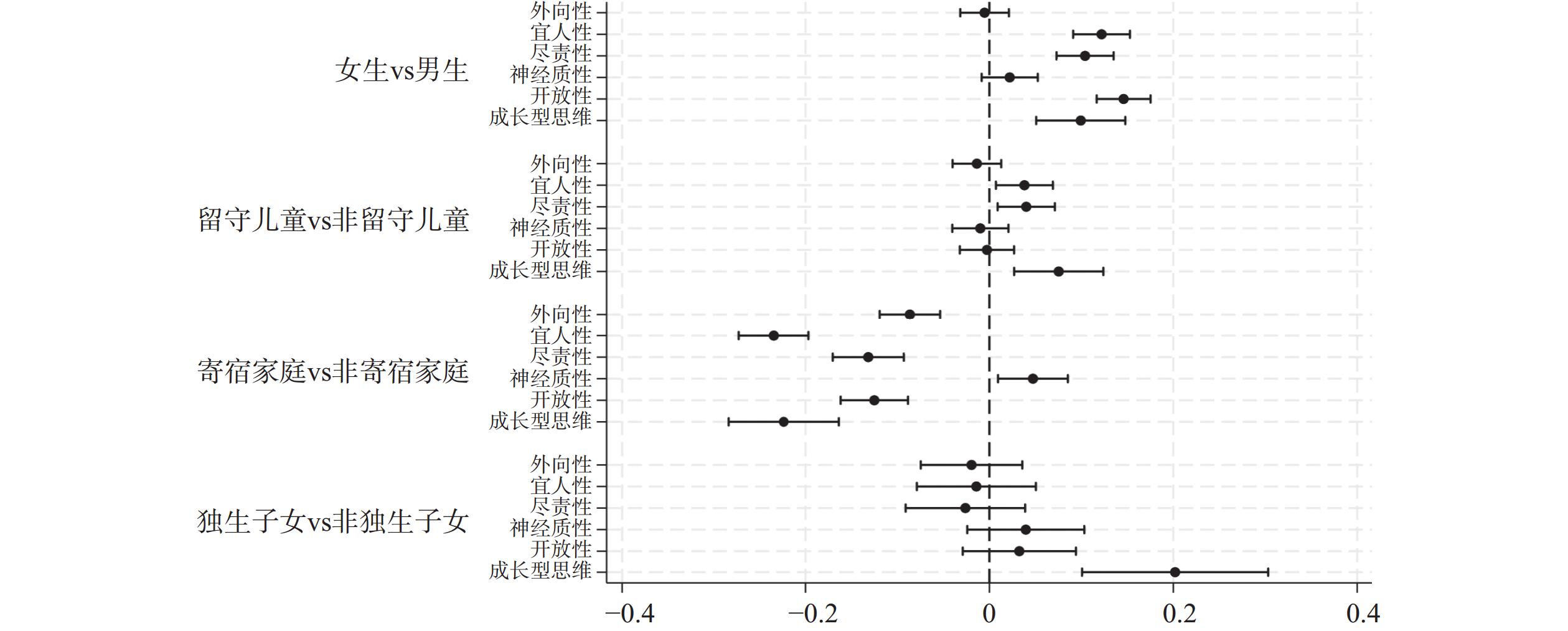
图 2
不同家庭特征(单亲家庭、父母学历和家庭资产)之间学生社会情感能力的比较"
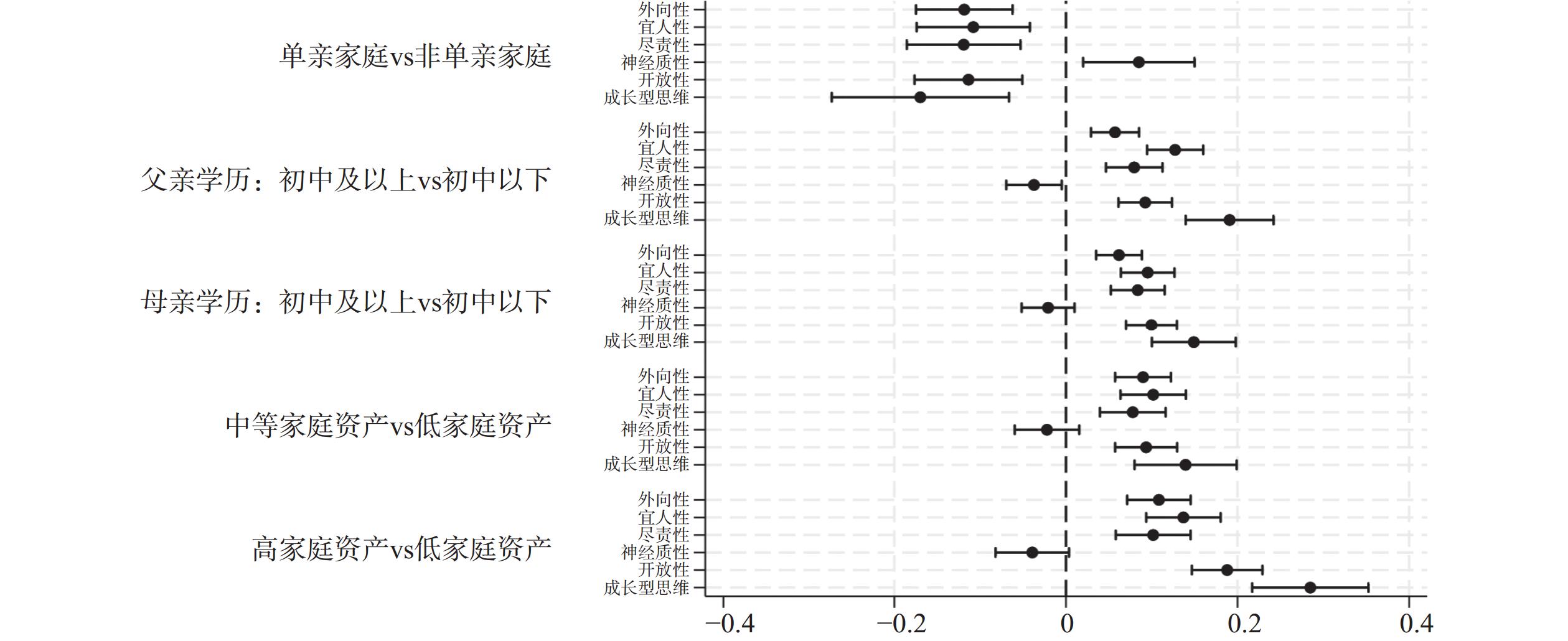
图 3
不同学校特征之间的学生社会情感能力比较"
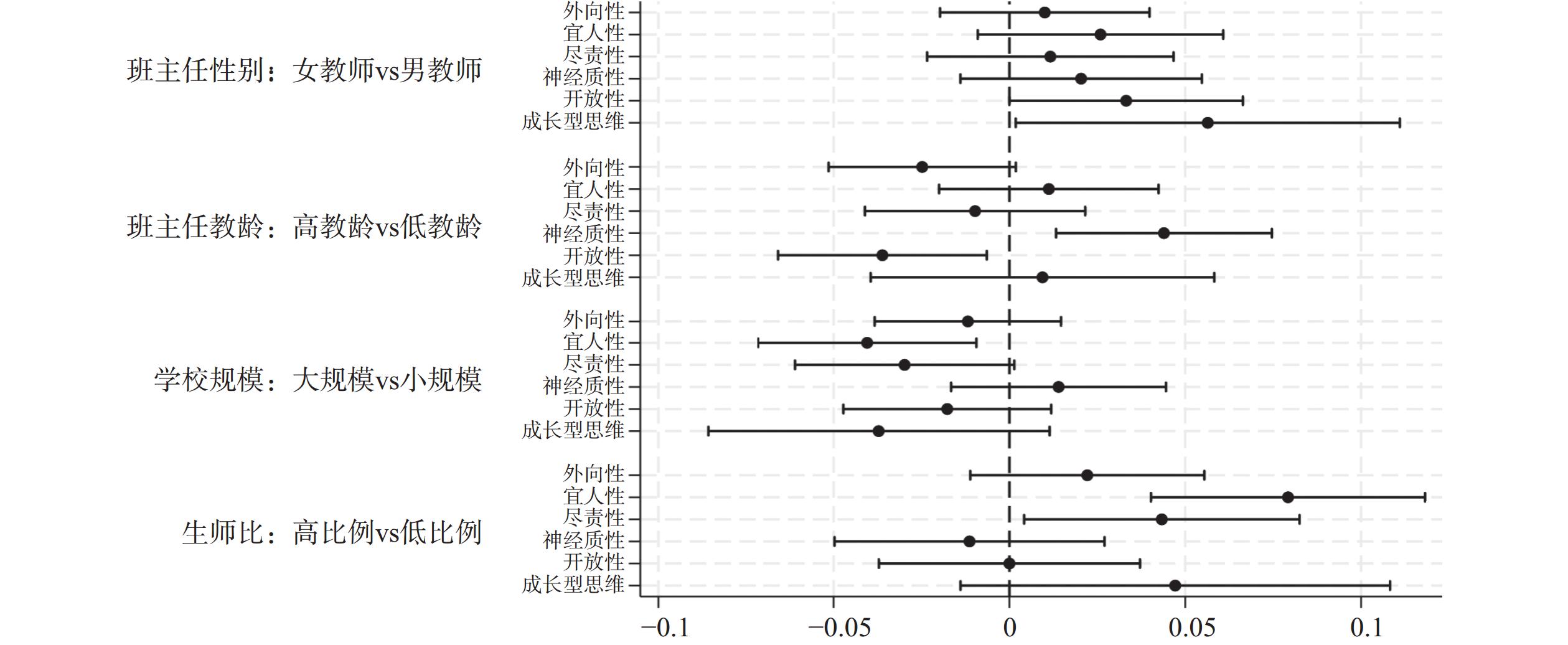
表 2
影响西北农村地区学生社会情感能力的相关因素"
| (1) | (2) | (3) | (4) | (5) | (6) | |
| 因变量:社会情感能力 | 外向性 | 宜人性 | 尽责性 | 神经质性 | 开放性 | 成长型思维 |
| 性别(女生=1) | −0.022 | 0.055*** | 0.039** | 0.062*** | 0.118*** | 0.059* |
| (0.016) | (0.018) | (0.019) | (0.020) | (0.019) | (0.030) | |
| 年龄(年) | −0.014 | −0.034*** | −0.028** | 0.014 | −0.023* | −0.058*** |
| (0.012) | (0.013) | (0.012) | (0.012) | (0.014) | (0.022) | |
| 留守儿童(留守儿童=1) | −0.010 | 0.020 | 0.037** | −0.017 | 0.013 | 0.066** |
| (0.016) | (0.019) | (0.018) | (0.021) | (0.018) | (0.030) | |
| 寄宿学生(寄宿学生=1) | −0.028 | −0.100*** | −0.035 | 0.027 | −0.064** | −0.076 |
| (0.022) | (0.031) | (0.025) | (0.023) | (0.026) | (0.050) | |
| 独生子女(独生子女=1) | −0.010 | −0.003 | −0.009 | 0.039 | 0.057 | 0.214*** |
| (0.035) | (0.042) | (0.037) | (0.043) | (0.040) | (0.060) | |
| 单亲家庭(单亲家庭=1) | −0.068* | −0.059 | −0.073* | 0.038 | −0.066* | −0.172*** |
| (0.034) | (0.037) | (0.040) | (0.036) | (0.038) | (0.065) | |
| 父亲受教育水平(初中及以上=1,初中以下=0) | 0.008 | 0.038* | 0.018 | −0.016 | 0.029 | 0.074** |
| (0.020) | (0.021) | (0.021) | (0.021) | (0.021) | (0.033) | |
| 母亲受教育水平(初中及以上=1,初中以下=0) | 0.019 | −0.011 | 0.022 | −0.007 | 0.030 | 0.001 |
| (0.019) | (0.020) | (0.019) | (0.021) | (0.020) | (0.033) | |
| 家庭资产 | 0.022** | 0.021** | 0.018* | −0.006 | 0.042*** | 0.067*** |
| (0.009) | (0.010) | (0.010) | (0.010) | (0.010) | (0.016) | |
| 理解型父亲 | 0.034*** | 0.028** | 0.044*** | −0.041*** | 0.035*** | 0.005 |
| (0.012) | (0.012) | (0.011) | (0.013) | (0.013) | (0.023) | |
| 惩罚型父亲 | −0.033*** | −0.040*** | −0.006 | 0.024** | −0.005 | −0.027 |
| (0.012) | (0.013) | (0.012) | (0.012) | (0.012) | (0.019) | |
| 理解型母亲 | 0.036*** | 0.058*** | 0.035*** | −0.037*** | 0.051*** | 0.100*** |
| (0.012) | (0.011) | (0.012) | (0.014) | (0.013) | (0.021) | |
| 惩罚型母亲 | −0.005 | −0.041*** | −0.032*** | 0.041*** | 0.008 | 0.010 |
| (0.011) | (0.012) | (0.012) | (0.010) | (0.012) | (0.018) | |
| 亲子交流(父亲) | 0.019** | 0.027** | 0.036*** | −0.029*** | 0.029*** | 0.010 |
| (0.009) | (0.011) | (0.010) | (0.011) | (0.009) | (0.016) | |
| 亲子交流(母亲) | 0.040*** | 0.032*** | 0.036*** | −0.011 | 0.042*** | 0.027 |
| (0.009) | (0.010) | (0.012) | (0.010) | (0.011) | (0.020) | |
| 自己或者和朋友们一起玩(不包括玩电子游戏) | 0.019*** | 0.021*** | 0.015** | −0.007 | 0.031*** | 0.057*** |
| (0.006) | (0.008) | (0.007) | (0.007) | (0.007) | (0.012) | |
| 读课外书 | 0.022*** | 0.050*** | 0.045*** | −0.013 | 0.047*** | 0.072*** |
| (0.007) | (0.008) | (0.009) | (0.008) | (0.007) | (0.013) | |
| 看电视 | 0.010 | −0.016** | −0.023*** | 0.011 | −0.012* | −0.021* |
| (0.006) | (0.008) | (0.008) | (0.008) | (0.006) | (0.012) | |
| 上网、玩游戏、玩手机 | −0.010 | −0.063*** | −0.055*** | 0.031*** | −0.020*** | −0.062*** |
| (0.007) | (0.007) | (0.008) | (0.007) | (0.007) | (0.012) | |
| 做家务或帮父母干活 | 0.004 | 0.023*** | 0.036*** | 0.010 | 0.023*** | −0.018* |
| (0.007) | (0.006) | (0.007) | (0.008) | (0.007) | (0.011) | |
| 班主任性别(女教师=1) | 0.011 | 0.027 | 0.014 | 0.016 | 0.019 | 0.018 |
| (0.021) | (0.030) | (0.031) | (0.025) | (0.026) | (0.040) | |
| 班主任教龄 | 0.000 | 0.002 | 0.001 | 0.002 | −0.000 | 0.000 |
| (0.001) | (0.002) | (0.001) | (0.002) | (0.001) | (0.002) | |
| 学校规模 | −0.037 | −0.025 | −0.022 | 0.017 | −0.006 | −0.006 |
| (0.027) | (0.034) | (0.037) | (0.029) | (0.033) | (0.048) | |
| 学校生师比 | 0.001 | 0.001 | 0.002 | −0.002 | −0.002 | 0.000 |
| (0.003) | (0.004) | (0.005) | (0.004) | (0.005) | (0.006) | |
| 常数项 | 3.243*** | 3.858*** | 3.344*** | 2.723*** | 2.988*** | −0.125 |
| (0.192) | (0.219) | (0.248) | (0.202) | (0.234) | (0.347) | |
| 县级固定效应 | 是 | 是 | 是 | 是 | 是 | 是 |
| 样本数 | ||||||
| 0.048 | 0.128 | 0.101 | 0.029 | 0.100 | 0.069 |
表 3
西北农村学生社会情感能力对学业表现、学校归属感、校园欺凌和师生关系的影响"
| (1) | (2) | (3) | (4) | |
| 标准化数学成绩 | 学校归属感 | 校园欺凌 | 师生关系 | |
| 外向性 | 0.077** | 0.125*** | −0.035 | 0.033 |
| (0.031) | (0.014) | (0.024) | (0.080) | |
| 宜人性 | 0.181*** | 0.128*** | −0.202*** | 0.232** |
| (0.030) | (0.015) | (0.023) | (0.091) | |
| 尽责性 | −0.069** | 0.043*** | −0.020 | 0.336*** |
| (0.029) | (0.014) | (0.024) | (0.080) | |
| 神经质性 | 0.059*** | −0.086*** | 0.203*** | −0.219*** |
| (0.022) | (0.013) | (0.022) | (0.064) | |
| 开放性 | 0.092*** | 0.046*** | 0.005 | 0.164* |
| (0.026) | (0.013) | (0.026) | (0.088) | |
| 成长型思维 | 0.213*** | 0.065*** | −0.007 | 0.074* |
| (0.015) | (0.008) | (0.014) | (0.043) | |
| 常数项 | −1.540*** | 2.213*** | 2.047*** | 4.888*** |
| (0.419) | (0.177) | (0.349) | (1.342) | |
| 控制变量 | 是 | 是 | 是 | 是 |
| 县级固定效应 | 是 | 是 | 是 | 是 |
| 样本量 | ||||
| 0.266 | 0.238 | 0.139 | 0.102 |
表 4
西北农村学生社会情感能力与心理健康之间的关系"
| (1) | (1) | (2) | (3) | (4) | |
| 情绪问题 | 行为问题 | 多动症问题 | 同伴问题 | 亲社会行为 | |
| 外向性 | −0.295*** | 0.105* | 0.117** | −0.161*** | 0.262*** |
| (0.071) | (0.057) | (0.054) | (0.052) | (0.056) | |
| 宜人性 | −0.348*** | −0.843*** | −0.397*** | −0.545*** | 0.911*** |
| (0.062) | (0.055) | (0.050) | (0.047) | (0.074) | |
| 尽责性 | −0.031 | −0.262*** | −1.009*** | 0.074 | 0.244*** |
| (0.071) | (0.053) | (0.051) | (0.049) | (0.057) | |
| 神经质性 | 1.321*** | 0.269*** | 0.322*** | 0.229*** | 0.280*** |
| (0.055) | (0.036) | (0.047) | (0.042) | (0.044) | |
| 开放性 | 0.548*** | 0.171*** | −0.025 | −0.012 | 0.756*** |
| (0.059) | (0.053) | (0.051) | (0.051) | (0.052) | |
| 成长型思维 | −0.104*** | −0.176*** | −0.062** | −0.139*** | 0.084** |
| (0.034) | (0.028) | (0.028) | (0.029) | (0.034) | |
| 常数项 | −1.294 | 4.188*** | 7.989*** | 4.257*** | −3.458*** |
| (0.893) | (0.669) | (0.677) | (0.578) | (0.720) | |
| 控制变量 | 是 | 是 | 是 | 是 | 是 |
| 县级固定效应 | 是 | 是 | 是 | 是 | 是 |
| 样本量 | |||||
| 0.202 | 0.190 | 0.256 | 0.108 | 0.279 |
表 5
两种工具的测评框架"
| (1) | (2) | |
| 维度 | OECD测评框架 | 本研究大五人格测评框架 |
| 外向性 | 乐群、果敢、活力 | 社交、果断、活力 |
| 宜人性 | 共情、合作、信任 | 同情、谦恭、信任 |
| 尽责性 | 毅力、责任感、自控力 | 条理、效率、负责 |
| 神经质性 (情绪稳定性的反面) | 抗压力、乐观、情绪控制 | 焦虑、抑郁、易变 |
| 开放性 | 包容度、好奇心、创造性 | 好奇、审美、想象 |
图 4
国内国际比较:外向性得分的差异"
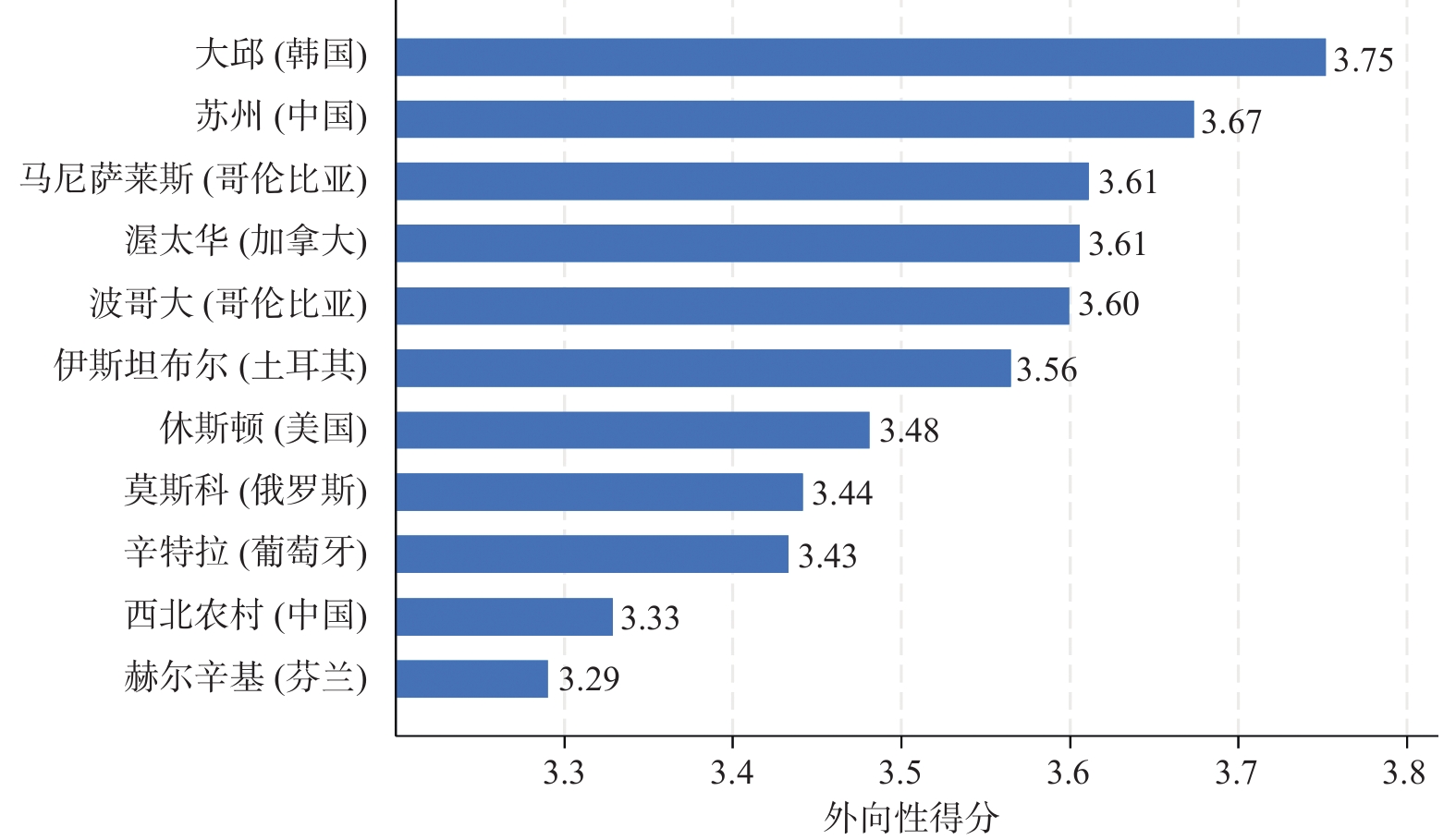
图 5
国内国际比较:宜人性得分的差异"
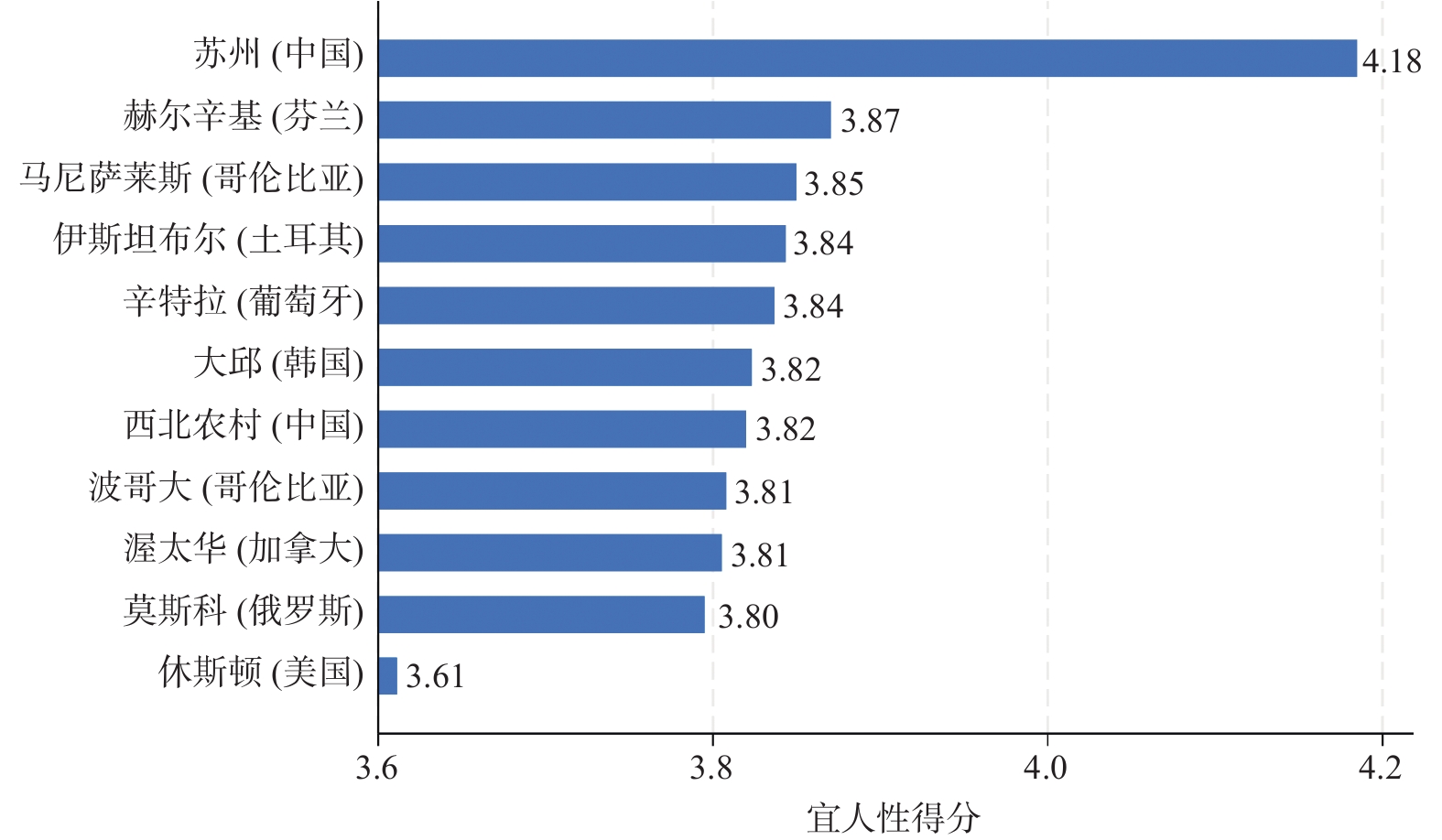
图 6
国内国际比较:尽责性得分的差异"
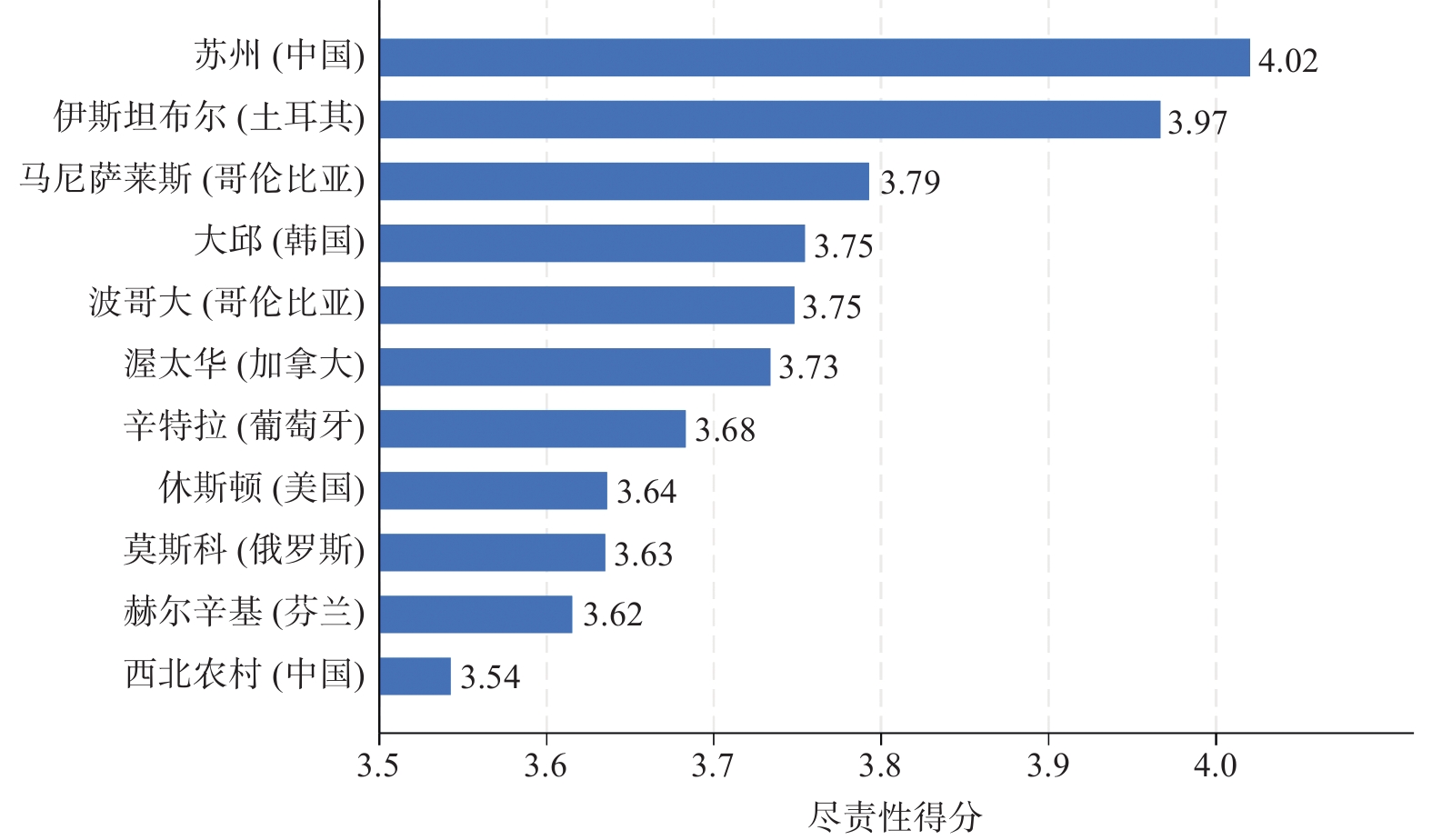
图 7
国内国际比较:神经质性得分的差异"
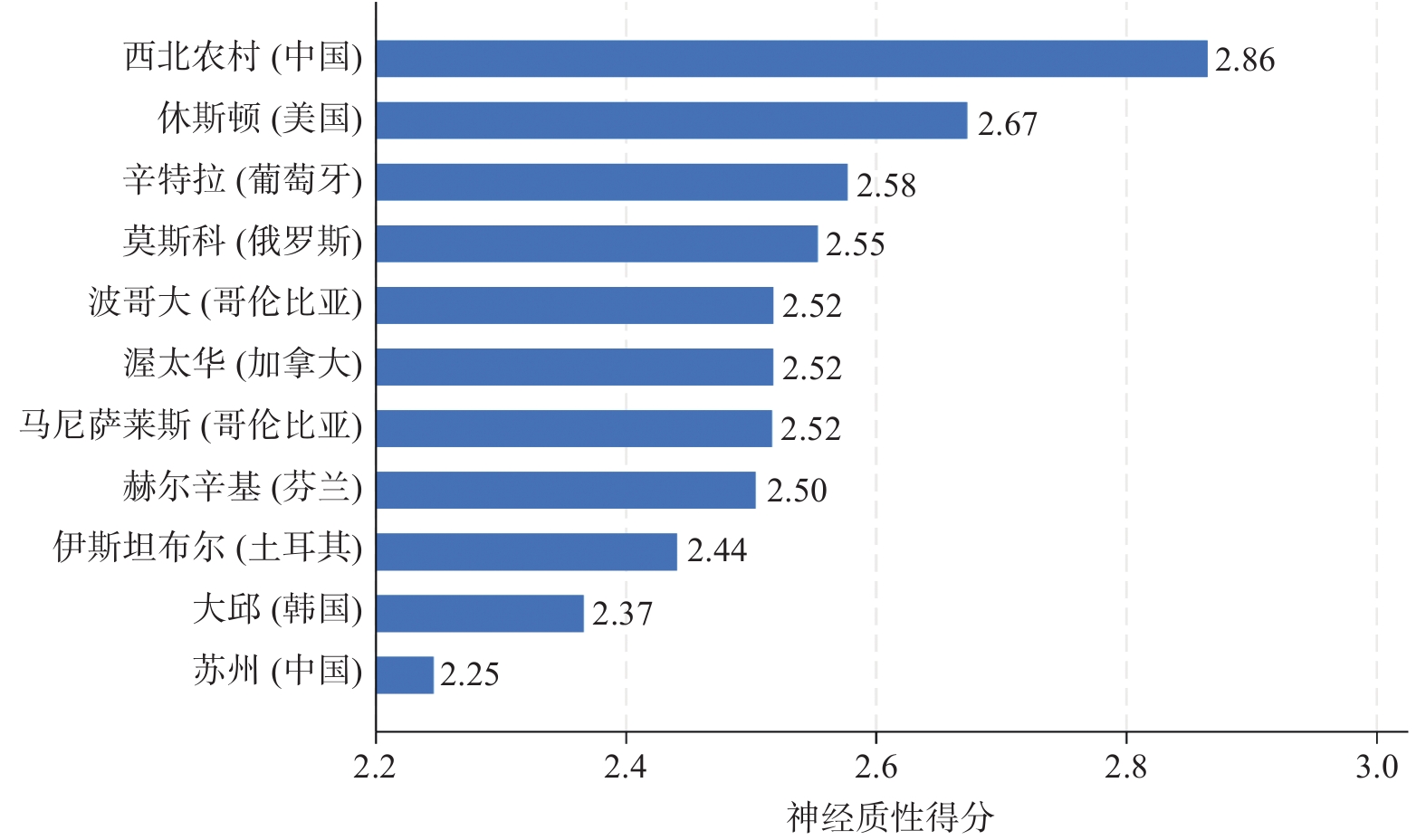
图 8
国内国际比较:开放性得分的差异"
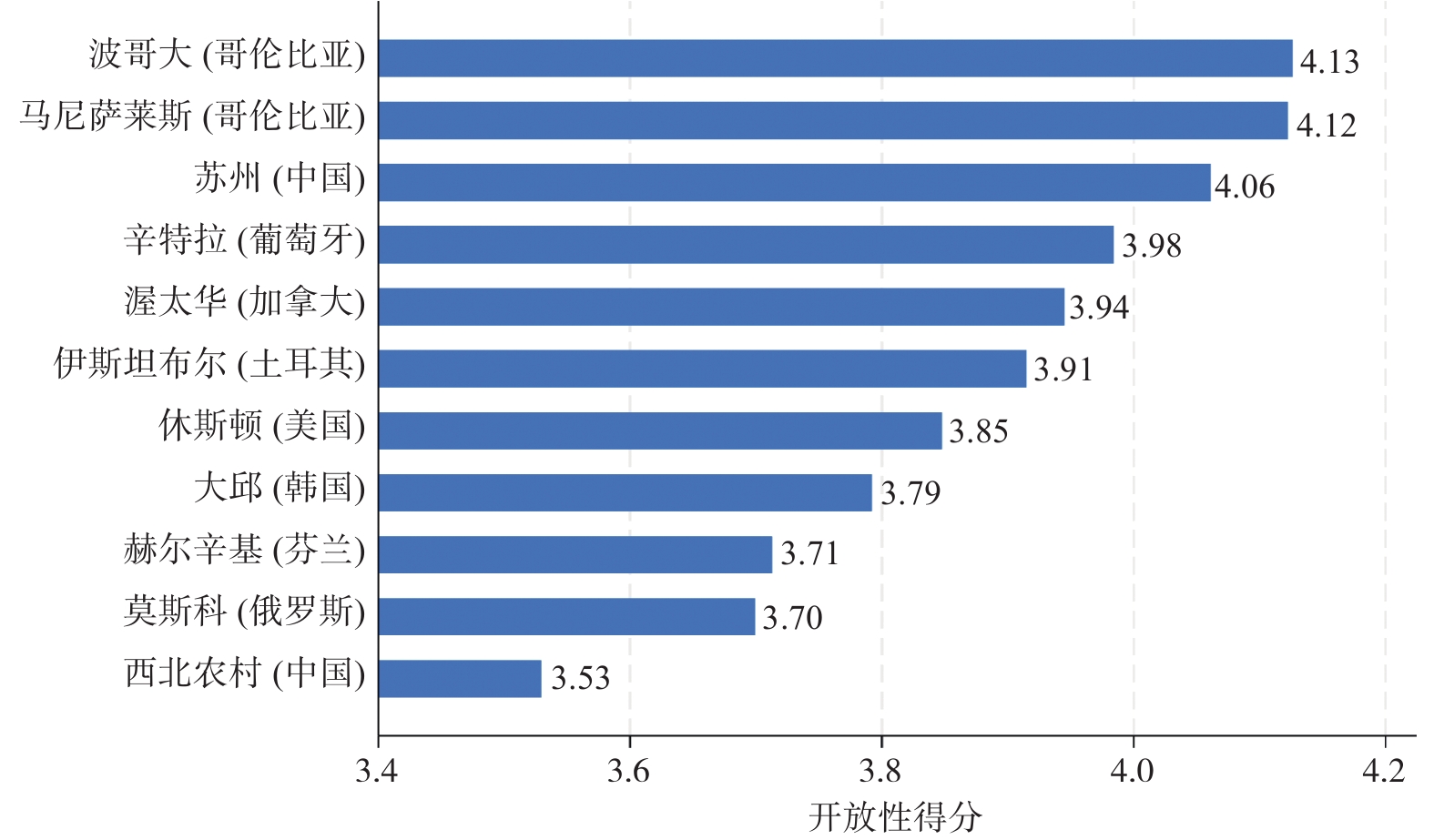
图 9
分性别比较:外向性得分的差异"
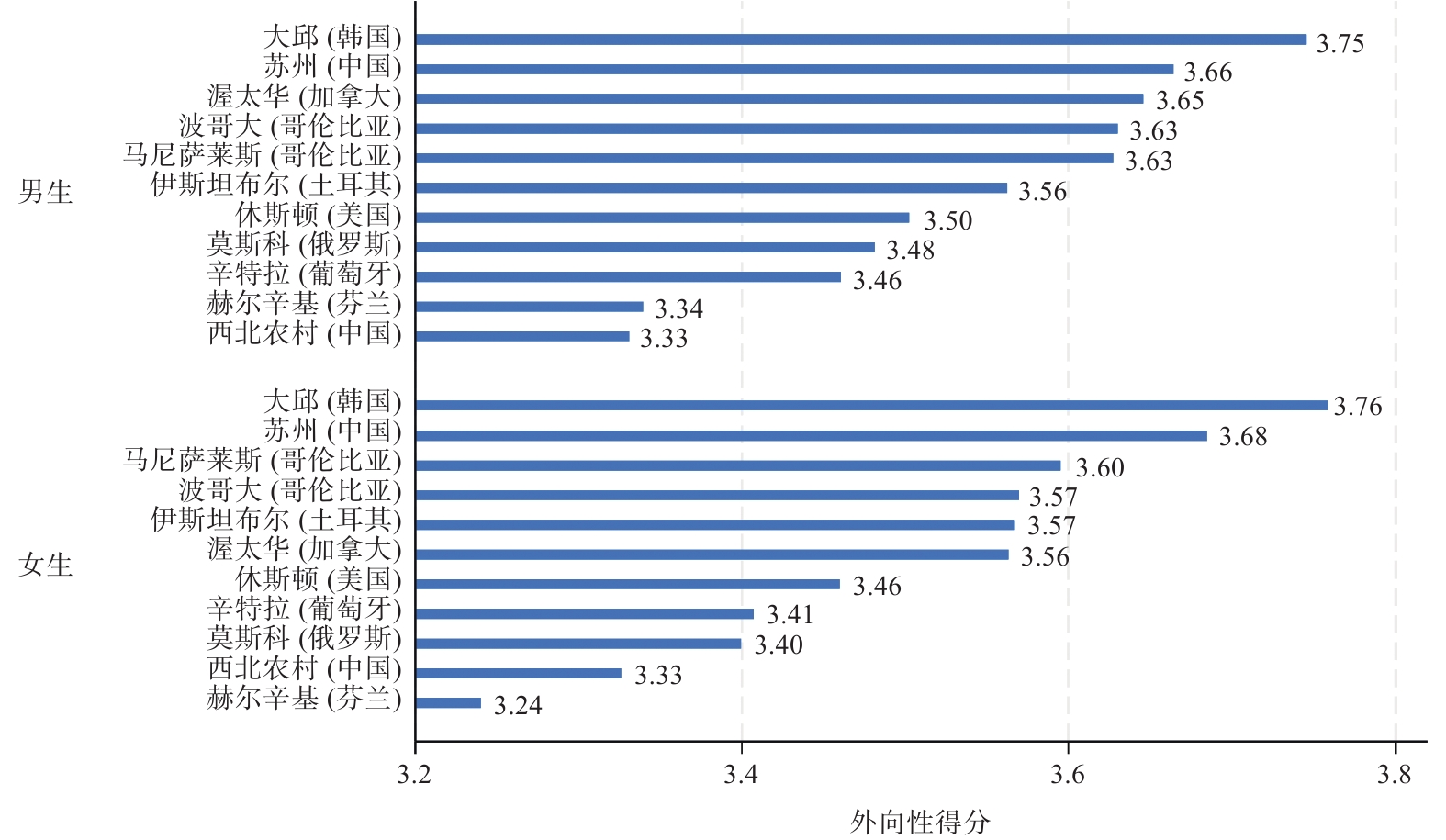
图 10
分性别比较:宜人性得分的差异"
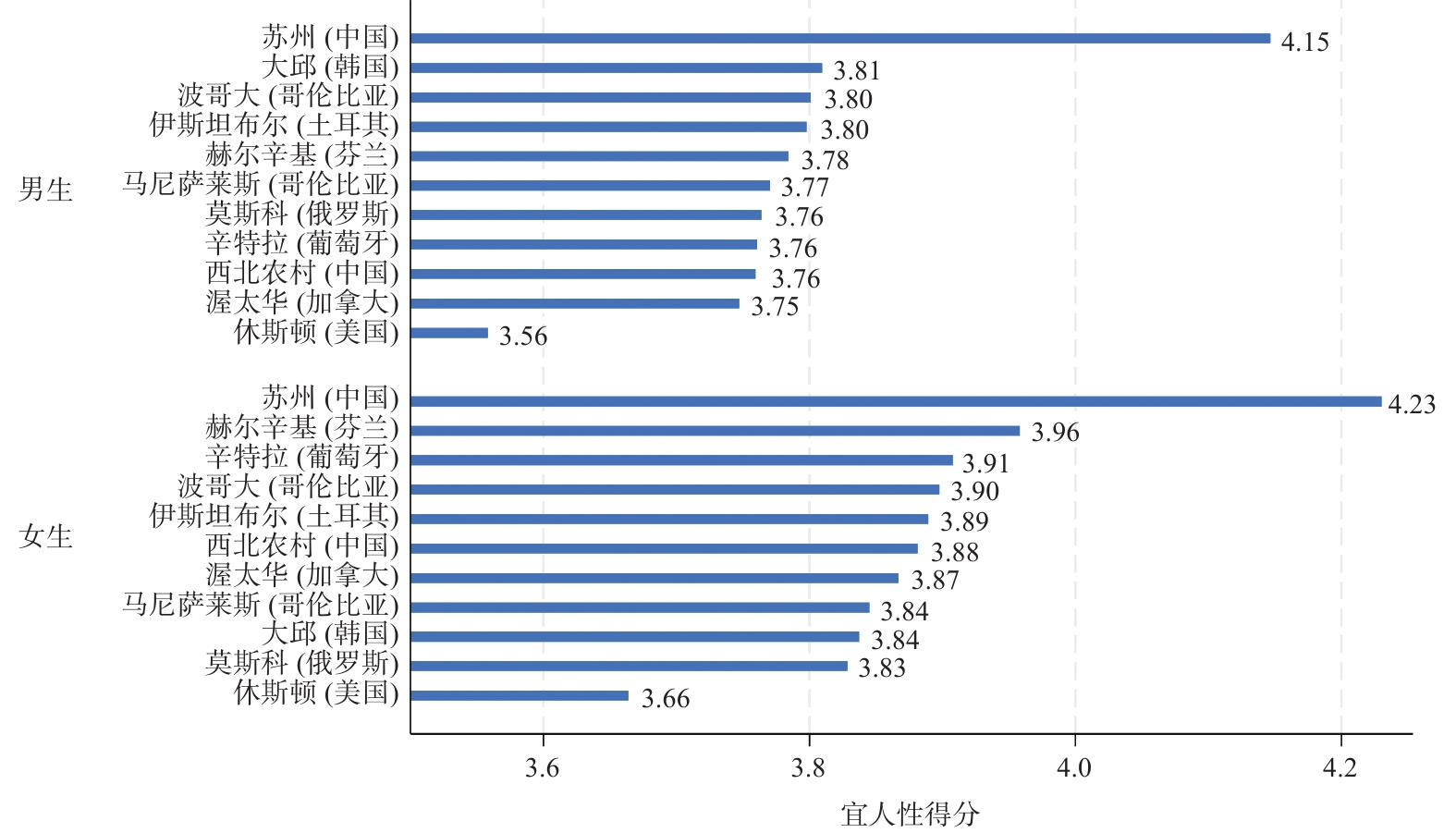
图 11
分性别比较:尽责性得分的差异"
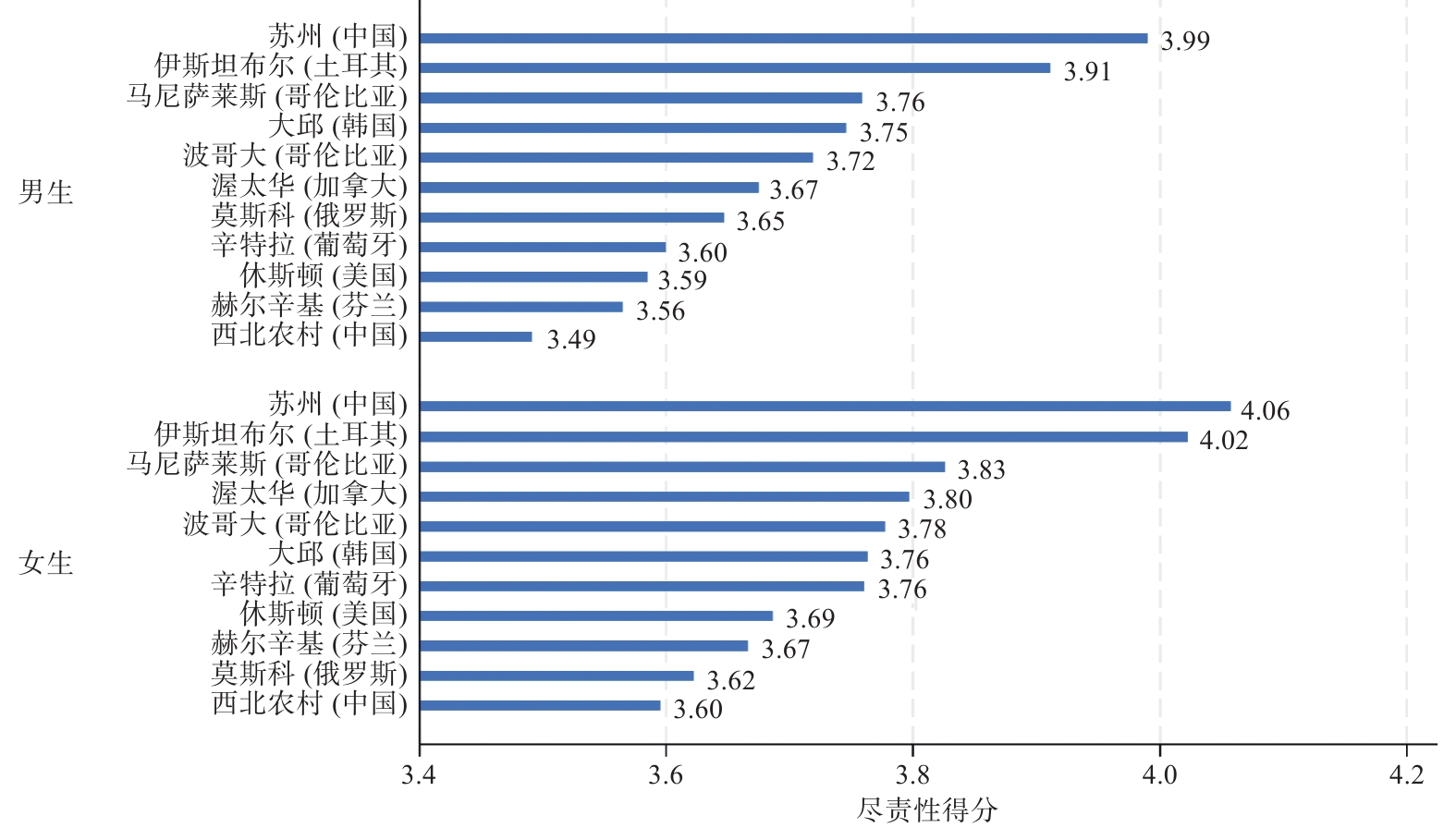
图 12
分性别比较:神经质性得分的差异"
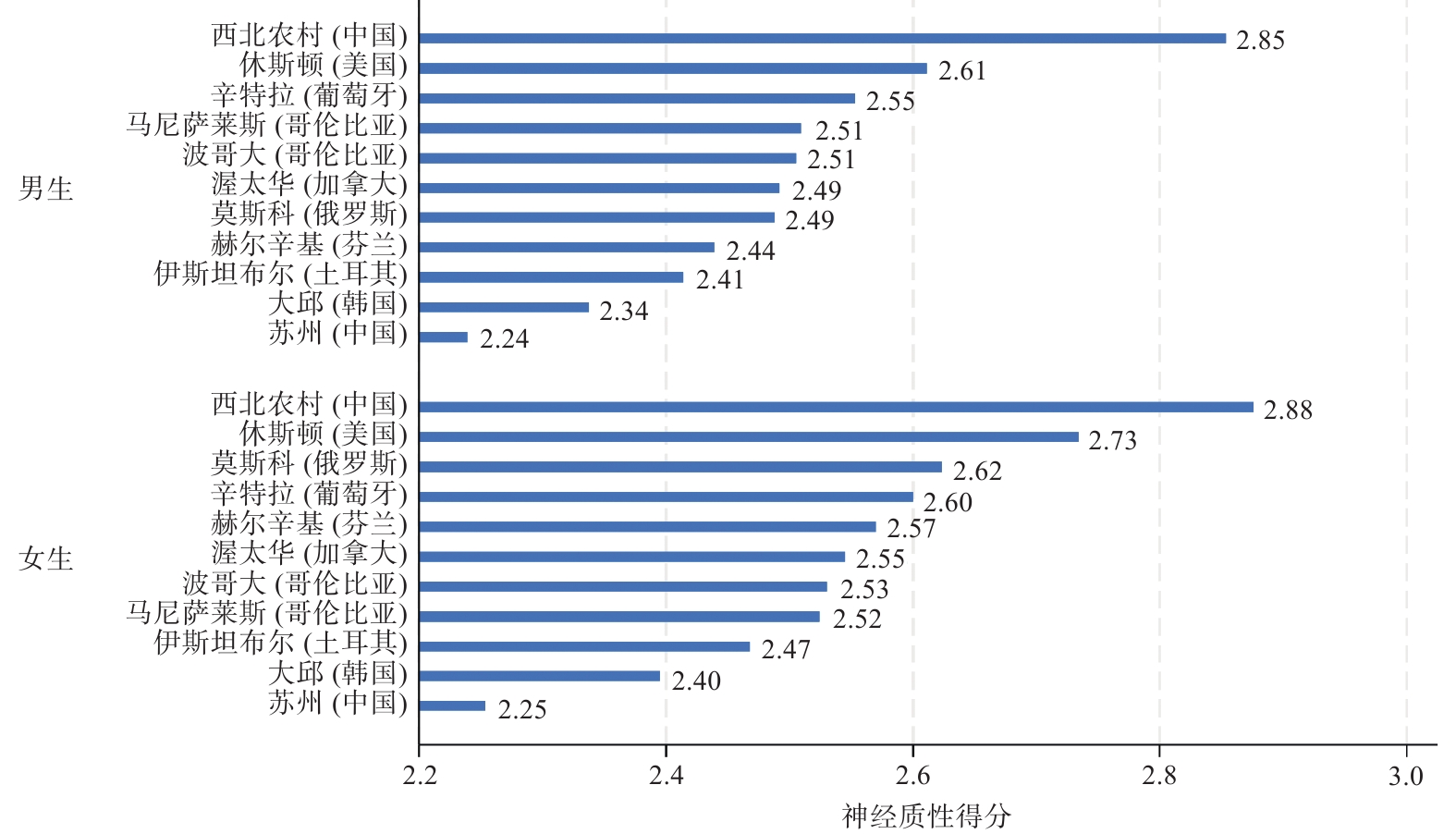
图 13
分性别比较:开放性得分的差异"
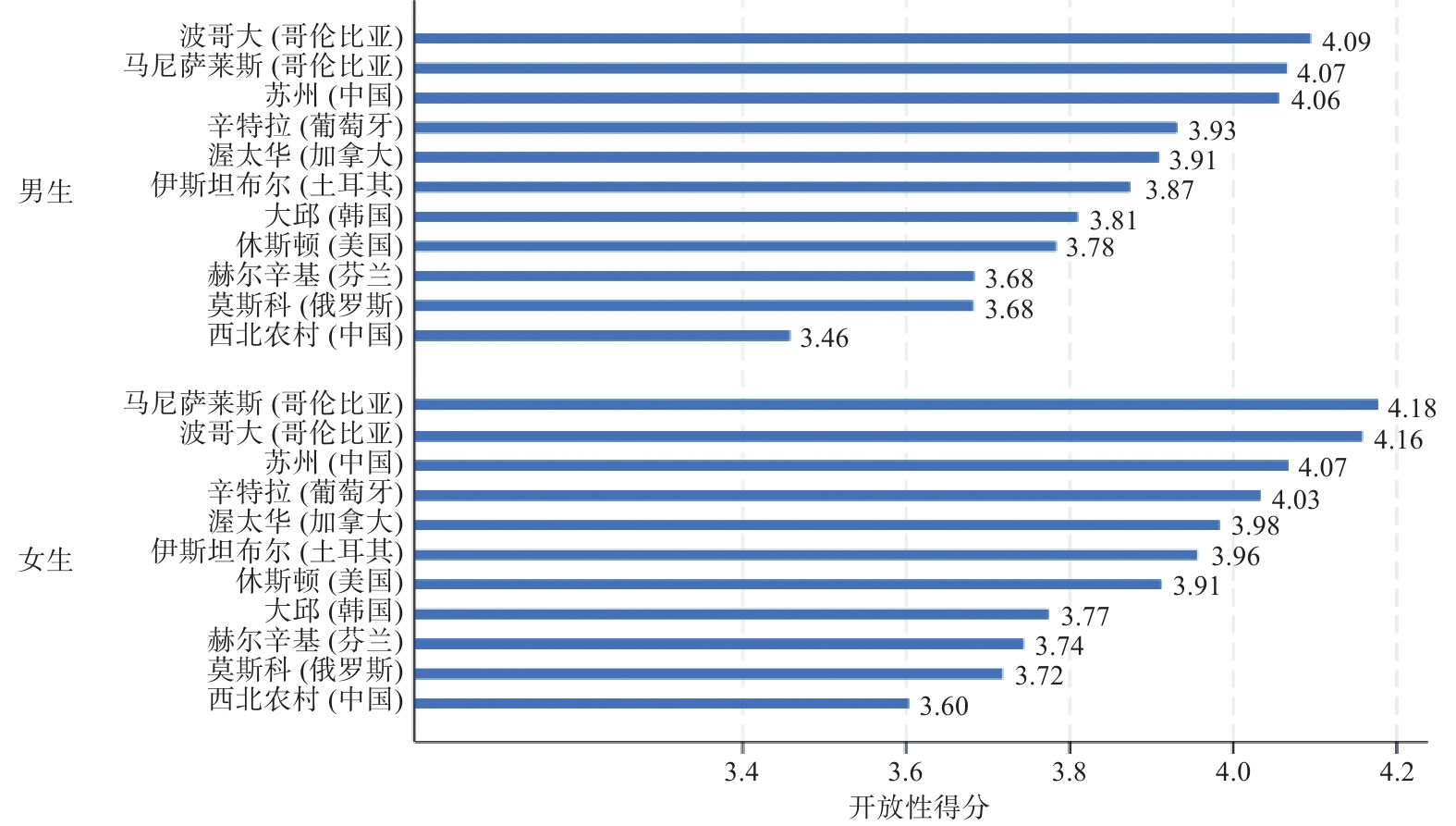
图 14
分成绩比较:外向性得分的差异"
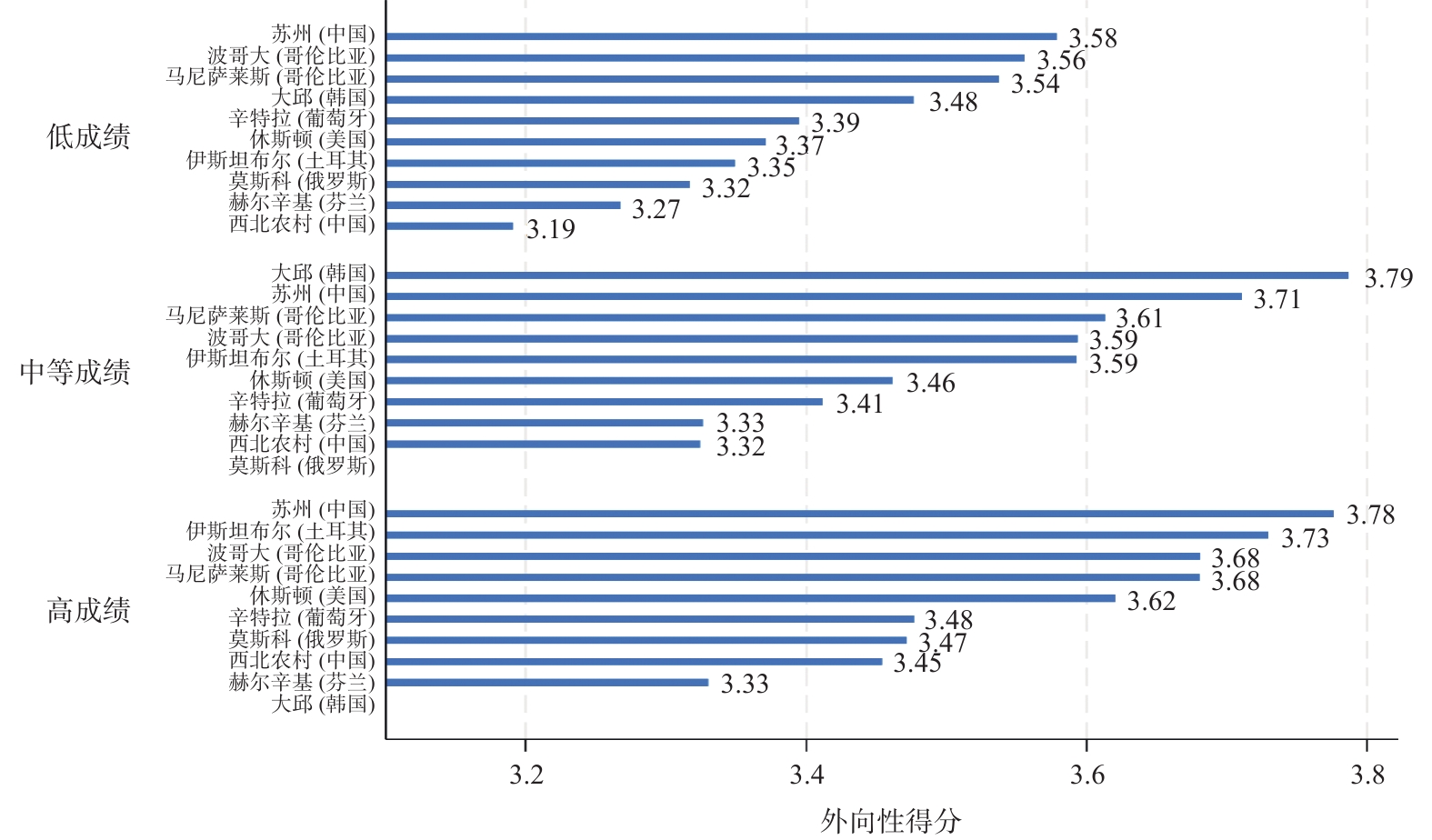
图 15
分成绩比较:宜人性得分的差异"
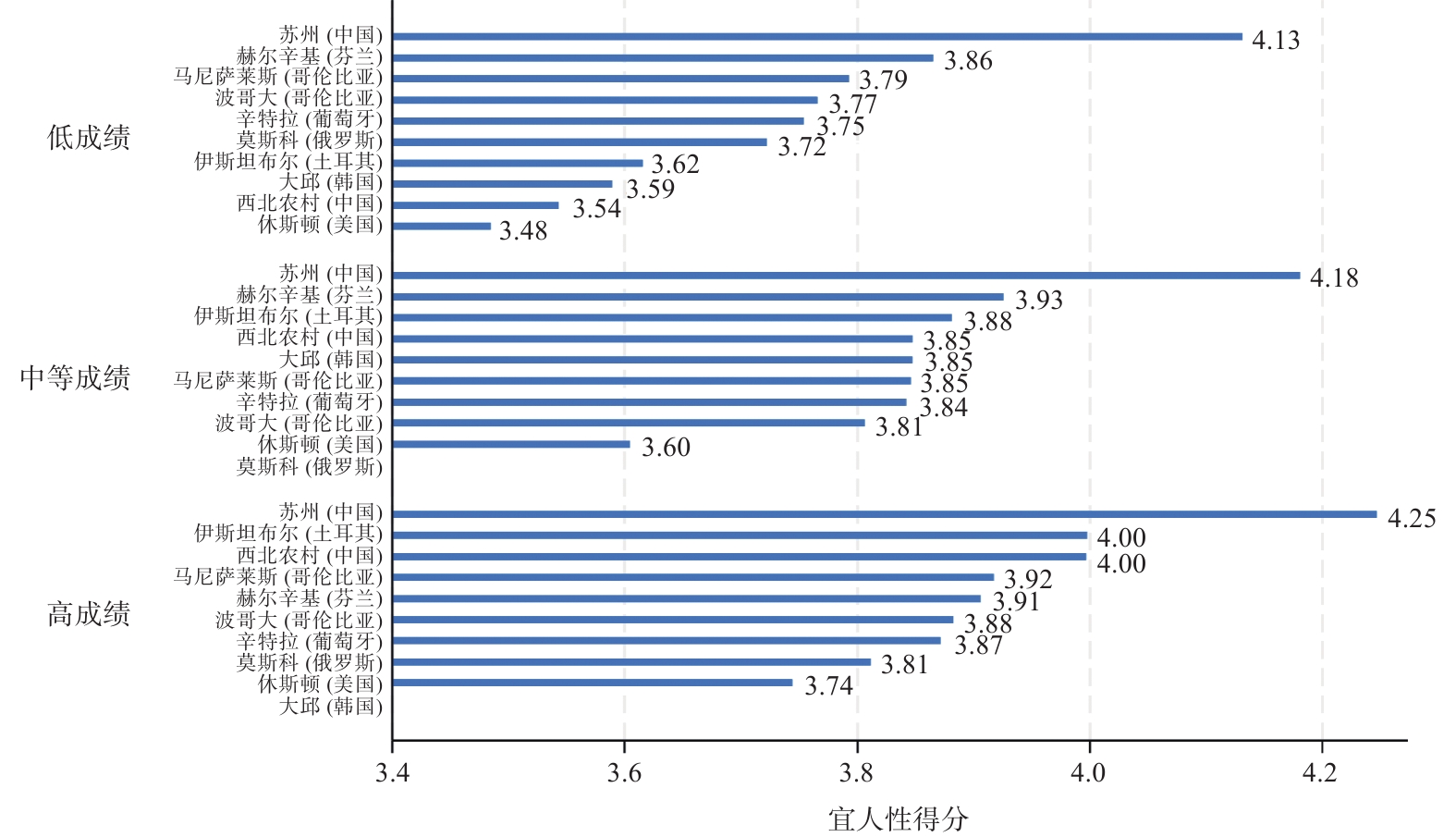
图 16
分成绩比较:尽责性得分的差异"
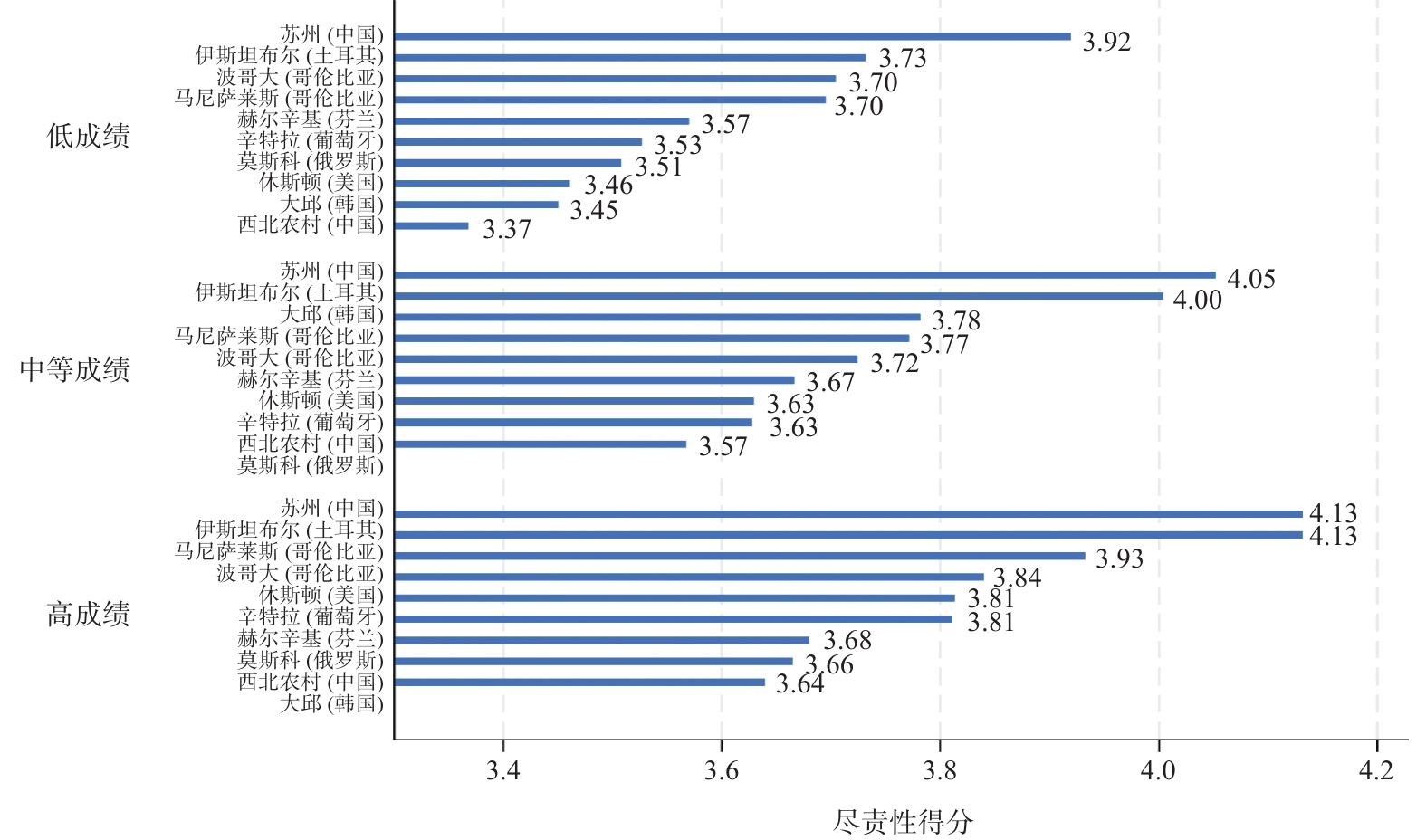
图 17
分成绩比较:神经质性得分的差异"
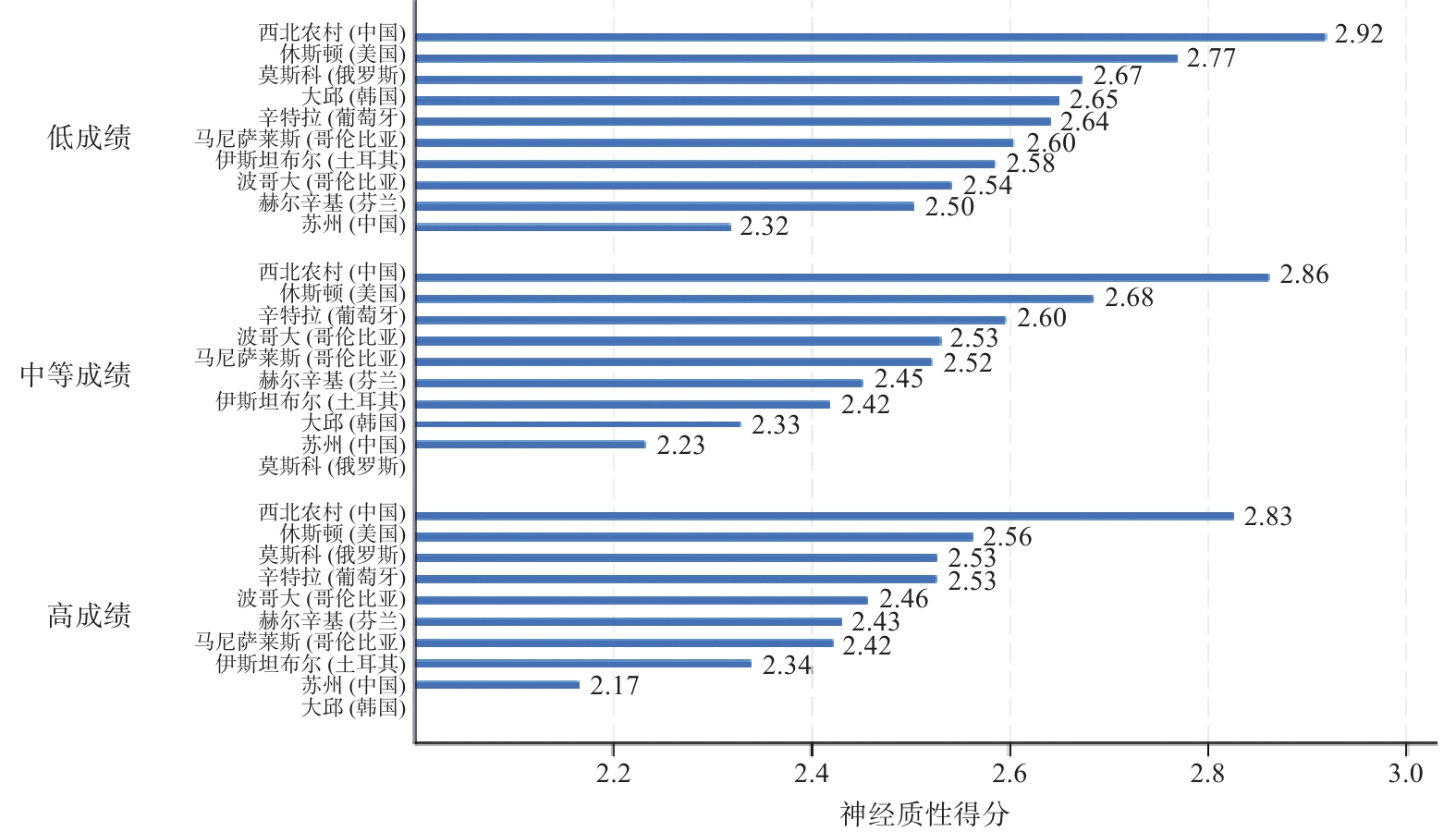
图 18
分成绩比较:开放性得分的差异"
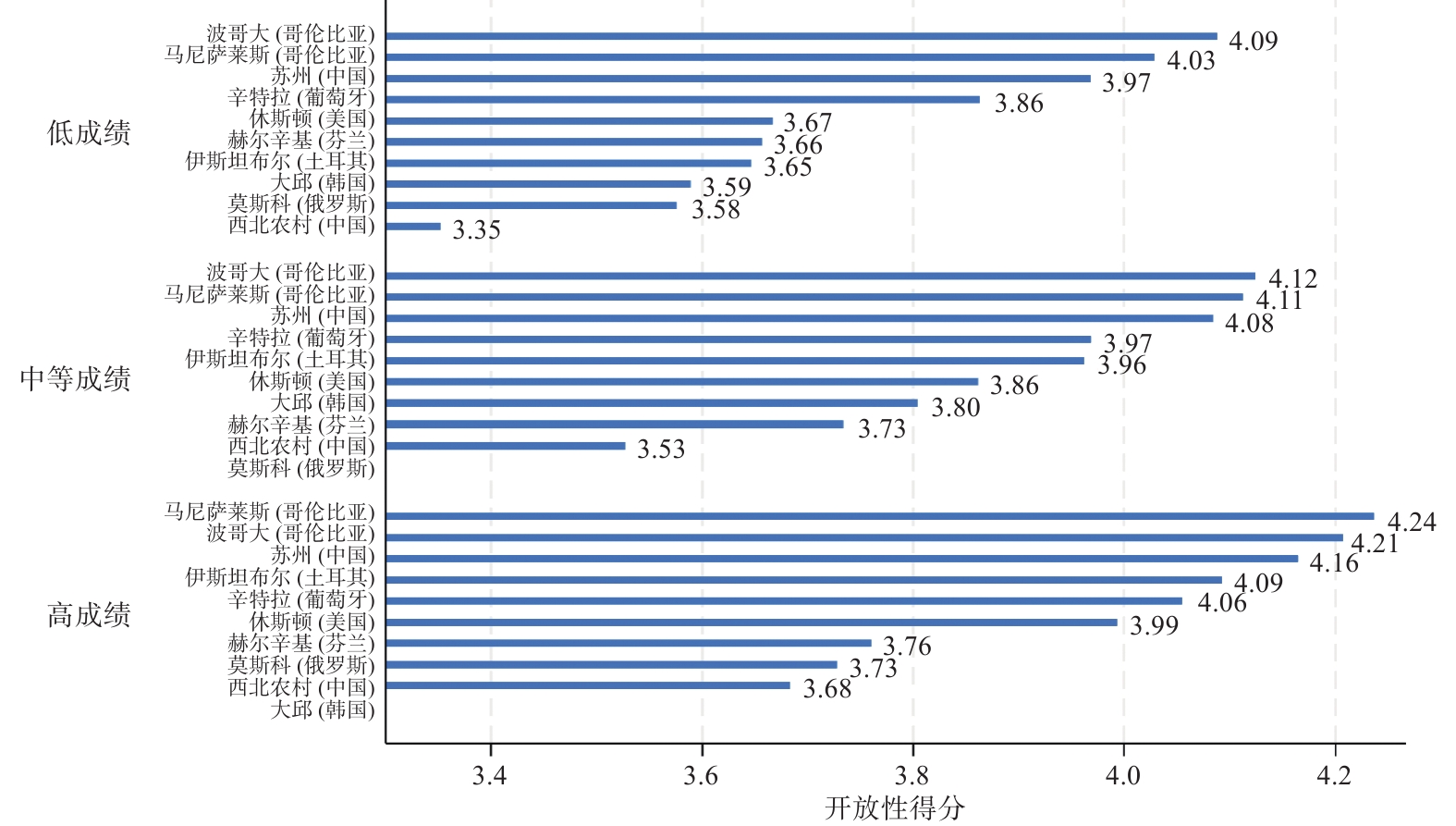
图 19
分家庭资产比较:外向性得分的差异"
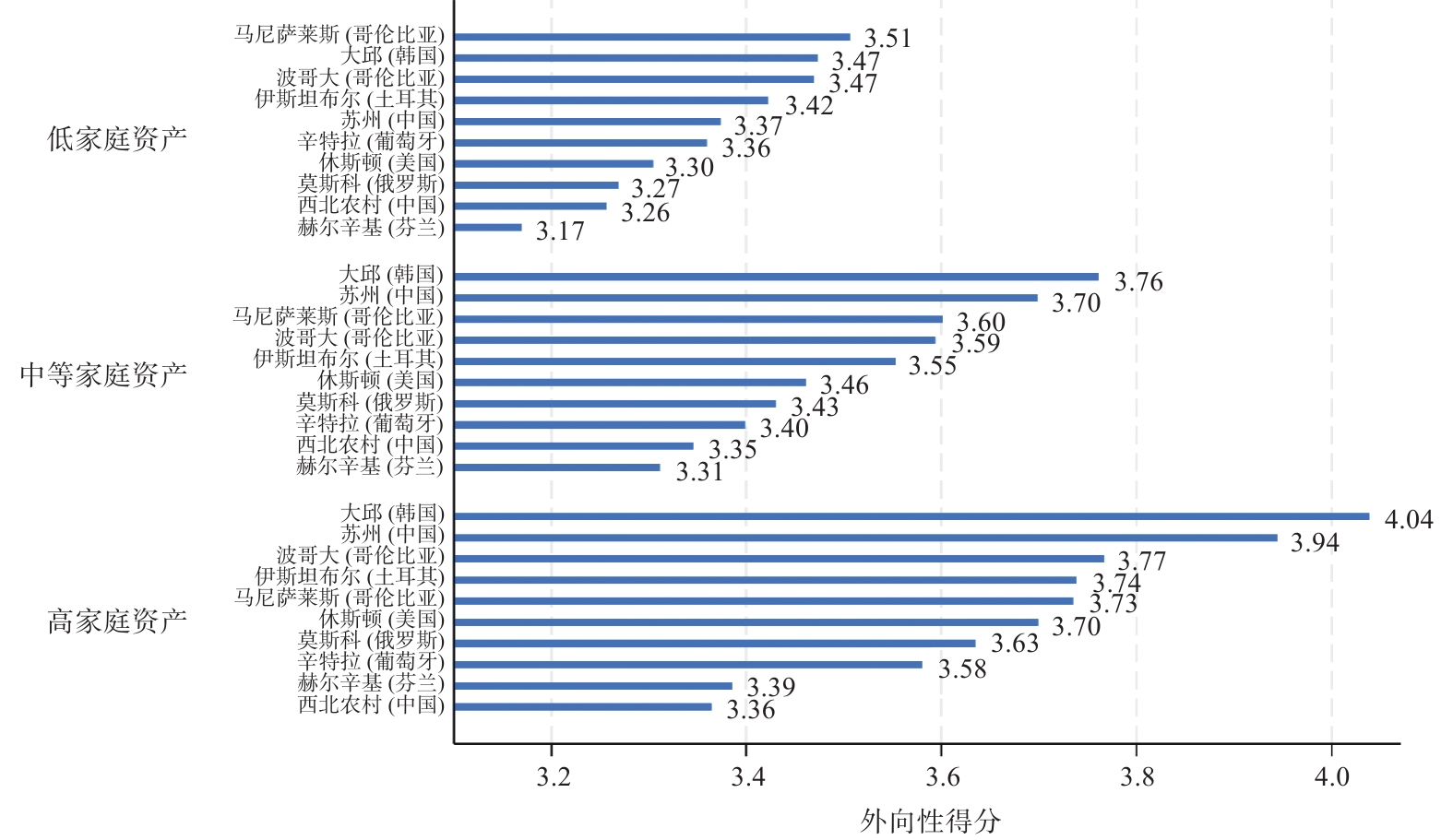
图 20
分家庭资产比较:宜人性得分的差异"
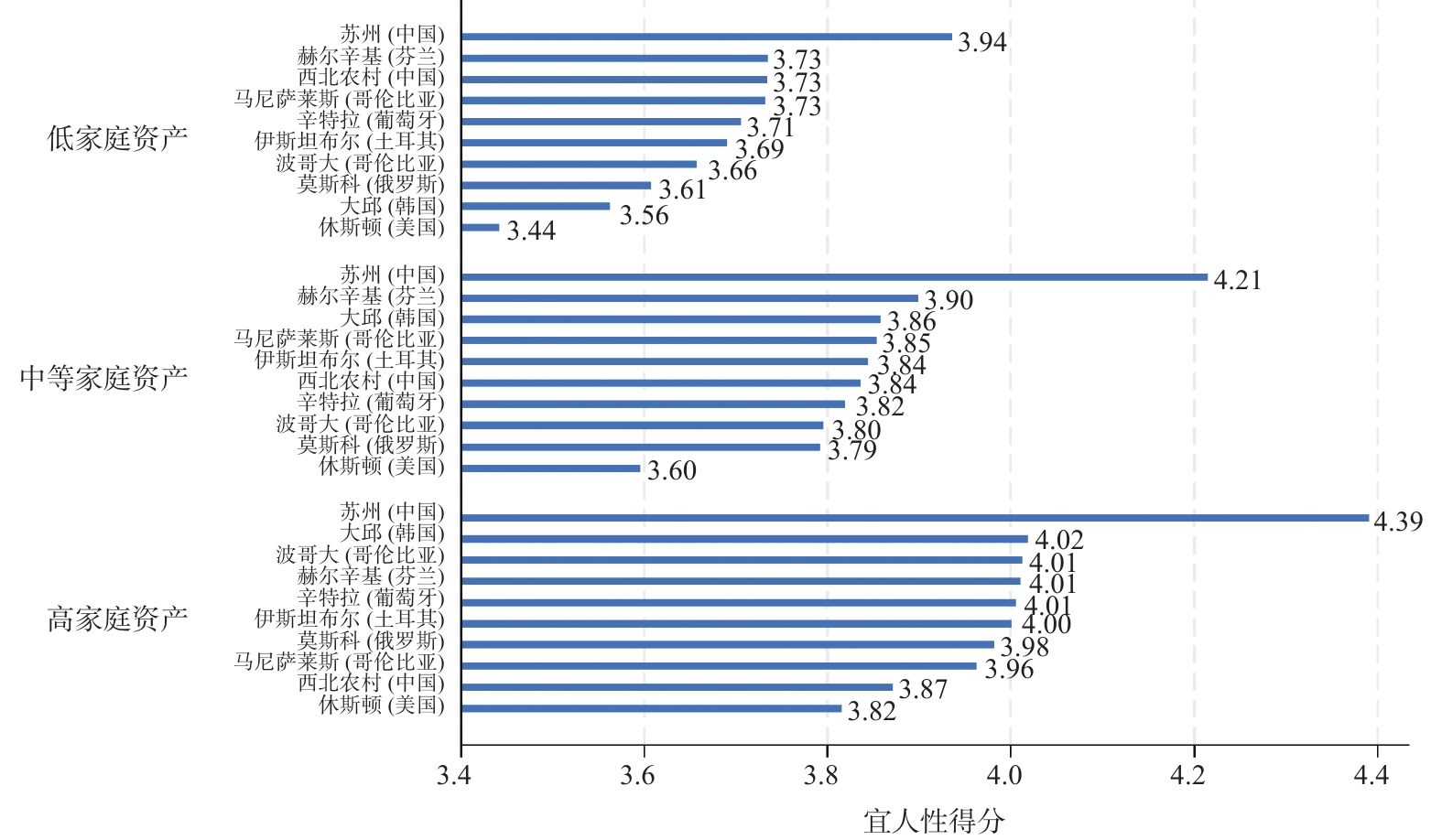
图 21
分家庭资产比较:尽责性得分的差异"
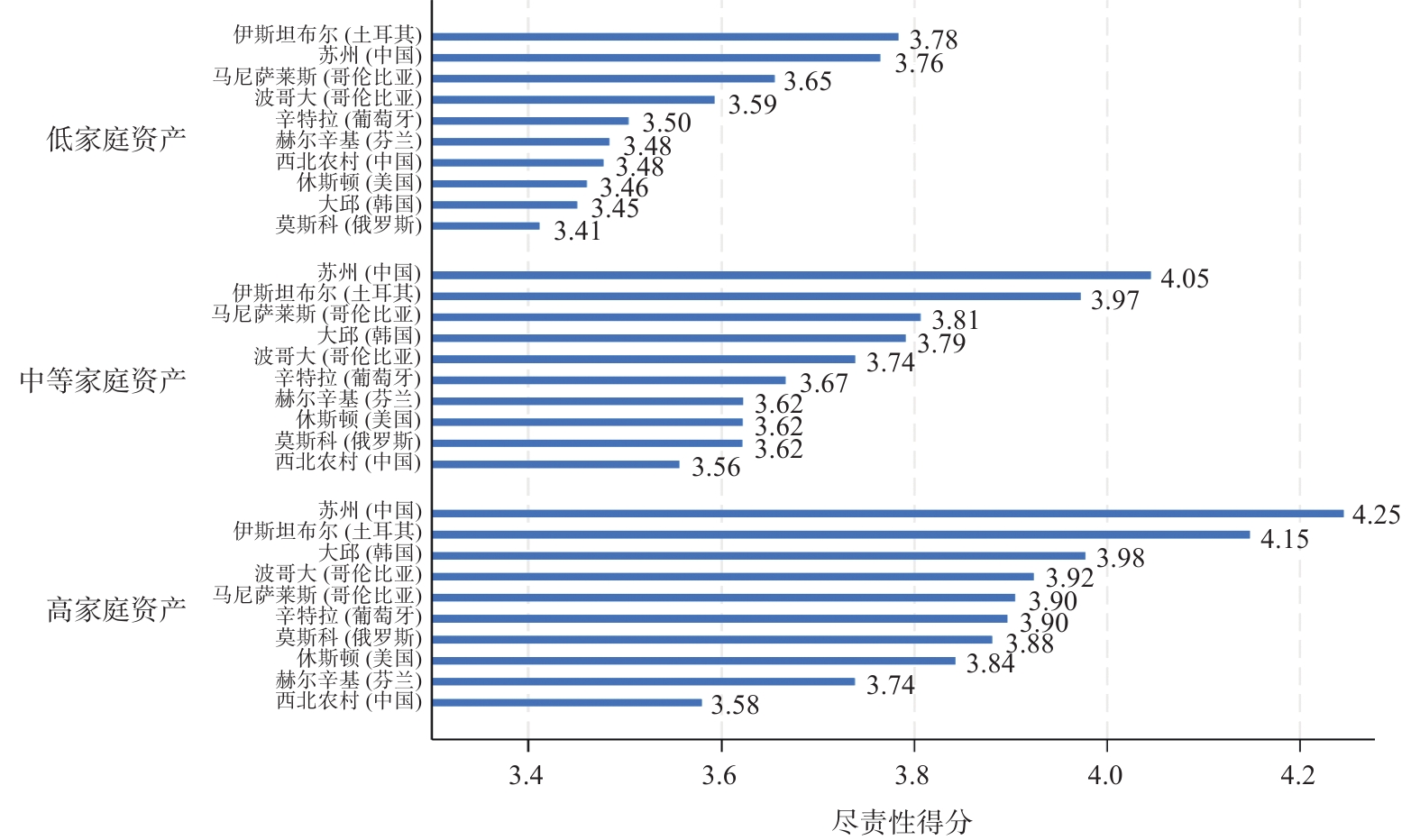
图 22
分家庭资产比较:神经质性得分的差异"
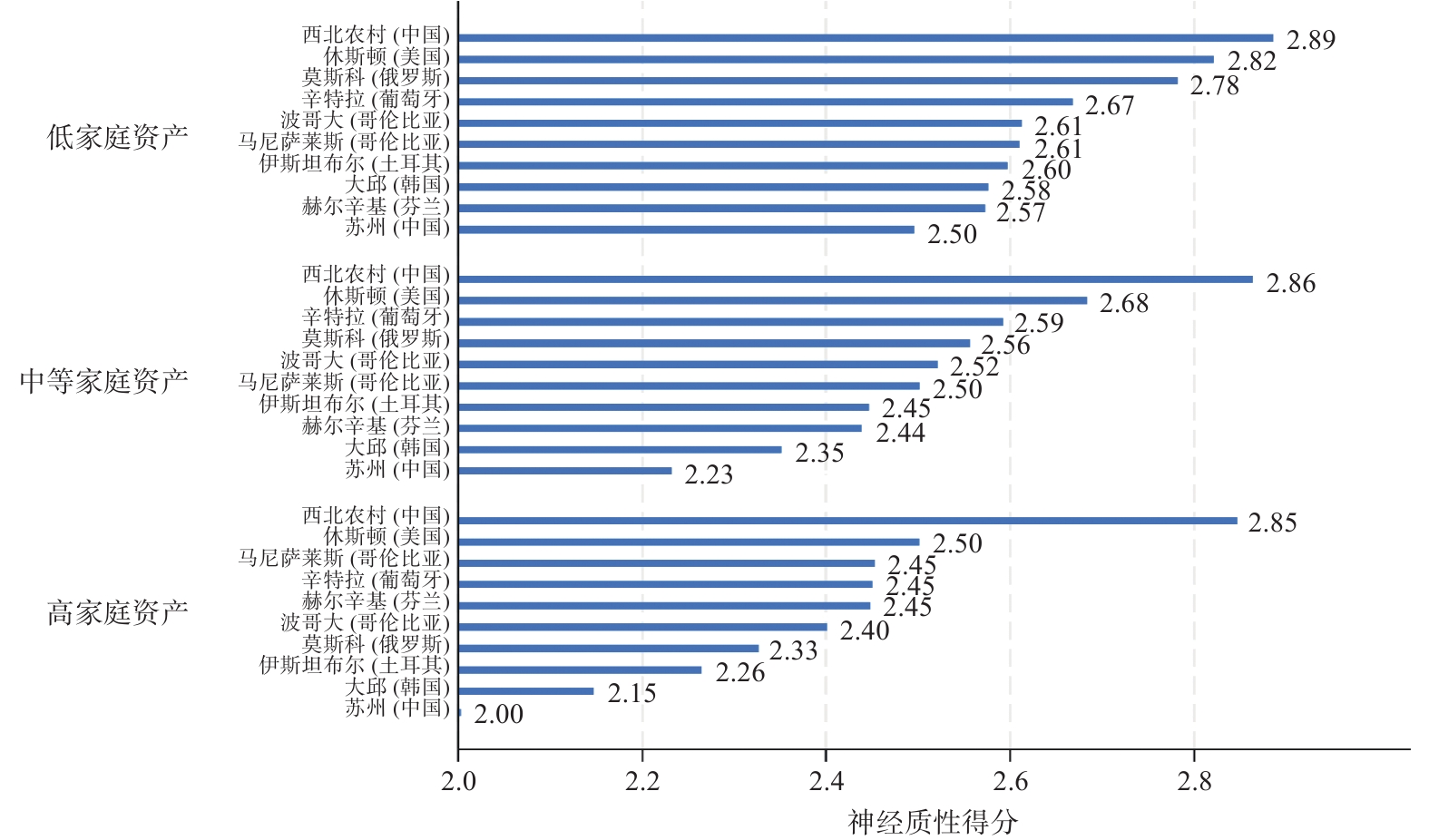
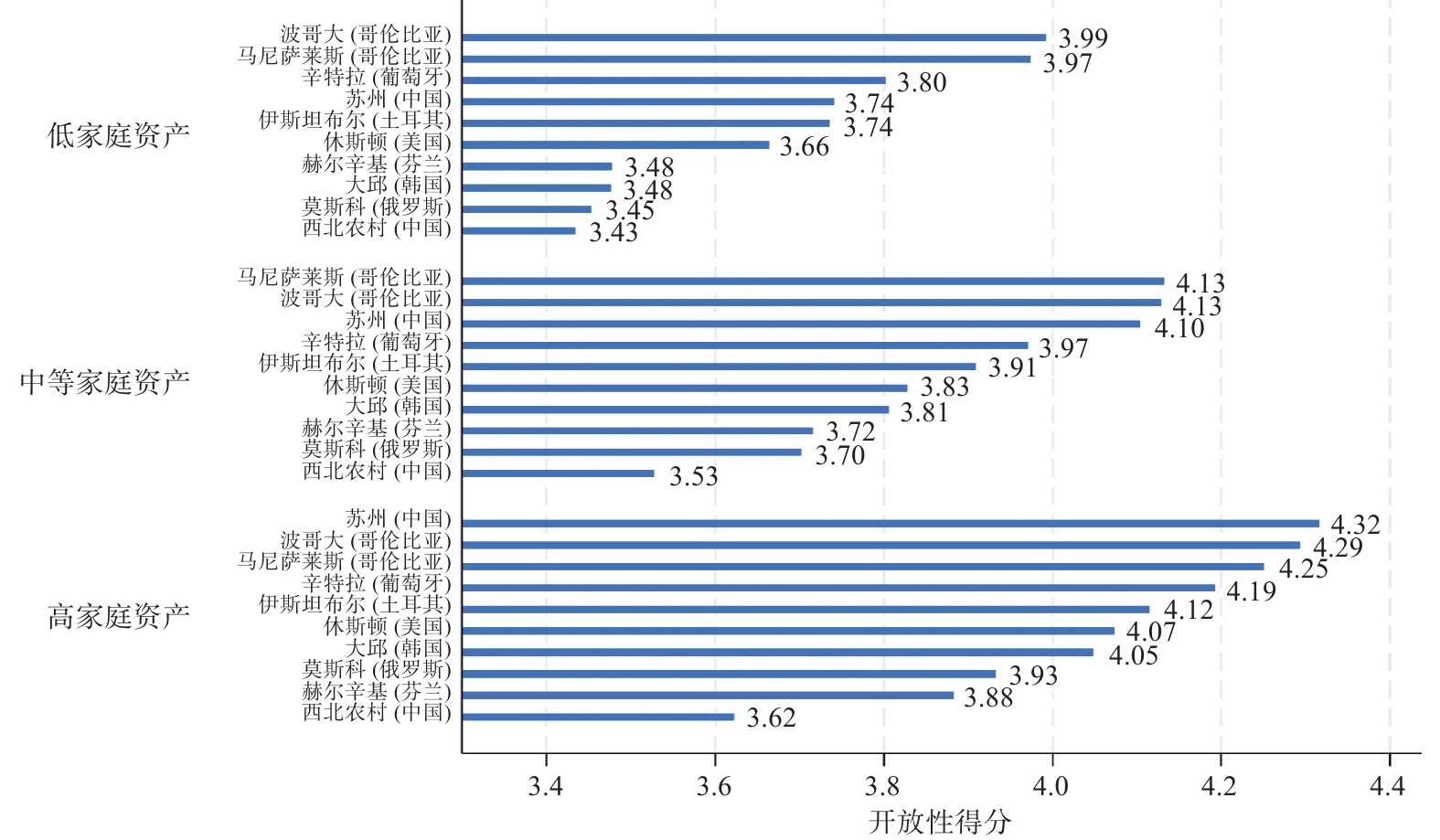
图 23
分家庭资产比较:开放性得分的差异"
| 陈技伟, 刘华, 王琳. (2024). 父母受教育程度对子女人力资本发展的影响. 人口与发展, 30 (1), 129- 142. | |
| 陈祉妍. (2021). 乡村儿童心理调查报告. 中华社会救助基金会网(2022年1月10日). https://www.csaf.org.cn/content/1437. | |
| 崔宝琛. (2023). 家庭社会经济地位、亲子关系与欠发达地区农村留守儿童积极发展——基于两省两校农村儿童调查数据的研究. 人口与发展, 4, 2- 19. | |
| 高屾, 闵文斌, 常芳, 史耀疆. (2018). 农村初中生校园欺凌与心理健康的相关性研究. 华东师范大学学报(教育科学版), 36 (2), 60- 67+155. | |
| 黄忠敬, 唐一鹏, 王娟. (2024). 学生社会与情感能力: 国际比较与中国表现. 华东师范大学学报(教育科学版), 5, 33- 57. | |
| 教育部办公厅. (2021). 教育部办公厅关于加强学生心理健康管理工作的通知. 中华人民共和国教育部网(2021年7月12日). http://www.moe.gov.cn/srcsite/A12/moe_1407/s3020/202107/t20210720_545789.html. | |
| 李波. (2018). 父母参与对子女发展的影响——基于学业成绩和非认知能力的视角. 教育与经济, 3, 54- 64. | |
| 李瑞, 刘颖, 刘超. (2022). 隔代照料对青少年非认知能力的影响研究. 基础教育, 19 (5), 89- 101. | |
| 李晓曼, 曾湘泉. (2012). 新人力资本理论——基于能力的人力资本理论研究动态. 经济学动态, 11, 120- 126. | |
| 刘彬彬, 崔菲菲, 史清华. (2018). 劳动力流动与村庄离婚率. 中国农村经济, 10, 71- 92. | |
| 刘争先, 赵萌, 杨岚. (2022). 小学生社会情感能力影响学业成绩的机制及教育启示. 教育科学, 4, 29- 35. | |
| 柳笛. (2017). 特质情绪智力如何影响学生的学业成就——以小学数学为例. 湖南师范大学教育科学学报, 16 (6), 44- 50. | |
| 吕利丹, 梅自颖, 李睿, 李姝, 阎芳, 王旭, 段成荣. (2024). 中国农村留守儿童的最新状况和变动趋势: 2010~2020. 人口研究, 1, 103- 117. | |
| 罗静, 王薇, 高文斌. (2009). 中国留守儿童研究述评. 心理科学进展, 5, 990- 995. | |
| 沈伟, 王娟. (2019). 社会情感学习为国家人才培养带来了什么——基于政策流动的视角. 教育发展研究, 39 (20), 8- 17. | |
| 唐一鹏, 黄忠敬. (2023). 社会与情感能力培养成效的实证研究——基于SSES数据的国际比较分析. 华东师范大学学报(教育科学版), 41 (4), 33- 45. | |
| 王欢, 常芳, 刘涵, 史耀疆. (2019). 西北农村地区学校规模与学生学业表现关系的实证研究. 教育与经济, 4, 28- 35. | |
| 王树涛, 毛亚庆. (2015). 寄宿对留守儿童社会情感能力发展的影响: 基于西部11省区的实证研究. 教育学报, 11 (5), 111- 120. | |
| 吴贾, 吴莞生. (2024). 农村留守儿童的同伴溢出效应: 基于非认知能力视角的研究. 世界经济, 8, 199- 227. | |
| 徐瑾劼, 杨雨欣. (2021). 学生社会情感能力的国际比较: 现状、影响及培养路径——基于OECD的调查. 开放教育研究, 27 (5), 44- 52+120. | |
| 许鑫凤, 王骏, 王洛忠. (2022). 非认知能力发展与学生表现的性别差异. 开放教育研究, 28 (3), 111- 120. | |
| 杨传利, 毛亚庆. (2017). 西部农村小学生社会情感能力与学校管理的关系研究: 基于公平有质量的教育视角. 基础教育, 1, 37- 46. | |
| 杨钋, 颜芷邑. (2022). 寄宿如何影响学生的心理健康?. 华东师范大学学报(教育科学版), 40 (8), 67- 82. | |
| 殷戈, 黄海, 黄炜. (2020). 人力资本的代际外溢性——来自“别人家的父母”的证据. 经济学(季刊), 19 (4), 1491- 1514. | |
| 袁振国, 黄忠敬, 李婧娟, 张静. (2021). 中国青少年社会与情感能力发展水平报告. 华东师范大学学报(教育科学版), 39 (9), 1- 32. | |
| 张静, 唐一鹏, 郭家俊, 邵志芳. (2021). 中国青少年社会与情感能力测评之技术报告. 华东师范大学学报(教育科学版), 39 (9), 109- 126. | |
| 周春芳, 苏群. (2023). 农村儿童留守经历对人力资本质量的长期效应研究——基于CFPS2010—2016的实证检验. 农业技术经济, 7, 108- 123. | |
| 中共中央办公厅、国务院办公厅. (2017). 中共中央办公厅 国务院办公厅印发《关于深化教育体制机制改革的意见》.中华人民共和国中央人民政府网 (2017年9月24日). https://www.gov.cn/xinwen/2017-09/24/content_5227267.htm. | |
| Abbasi, B. N., Luo, Z., & Sohail, A. (2023). Effect of parental migration on the noncognitive abilities of left-behind school-going children in rural China. Humanities and Social Sciences Communications, 10 (1), 1- 14. | |
| Alan, S., Boneva, T., & Ertac, S. (2019). Ever Failed, Try Again, Succeed Better: Results from a Randomized Educational Intervention on Grit*. The Quarterly Journal of Economics, 134 (3), 1121- 1162. | |
| Algan, Y., Beasley, E., Côté, S., Park, J., Tremblay, R. E., & Vitaro, F. (2022). The Impact of Childhood Social Skills and Self-Control Training on Economic and Noneconomic Outcomes: Evidence from a Randomized Experiment Using Administrative Data. American Economic Review, 112 (8), 2553- 2579. | |
| Attanasio, O., Blundell, R., Conti, G., & Mason, G. (2020). Inequality in socio-emotional skills: A cross-cohort comparison. Journal of Public Economics, 191, 104171. | |
| Benavot, A., & Antoninis, M. (2015). Education 2030 Framework for Action: Let’s get started. UNESOC. https://gemreportunesco.wordpress.com/2015/11/04/education-2030-framework-for-action-lets-get-started/. | |
| Connolly, M., & Haeck, C. (2022). Nonlinear Class Size Effects on Cognitive and Noncognitive Development of Young Children. Journal of Labor Economics, 40 (S1), S341- S382. | |
| Deng, L., & Tong, T. (2020). Parenting style and the development of noncognitive ability in children. China Economic Review, 62, 101477. | |
| Farkas, G. (2003). Cognitive Skills and Noncognitive Traits and Behaviors in Stratification Processes. Annual Review of Sociology, 29 (1), 541- 562. | |
| Gong, J., Lu, Y., & Song, H. (2018). The Effect of Teacher Gender on Students’ Academic and Noncognitive Outcomes. Journal of Labor Economics, 36 (3), 743- 778. | |
| Goodman, R., Meltzer, H., & Bailey, V. (1998). The Strengths and Difficulties Questionnaire: A pilot study on the validity of the self-report version. European Child & Adolescent Psychiatry, 7 (3), 125- 130. | |
| Gutman, L. M., & Schoon, I. (2016). A synthesis of causal evidence linking non-cognitive skills to later outcomes for children and adolescents. In M. S. Khine & S. Areepattamannil (Eds. ), Non-cognitive skills and factors in educational attainment (pp. 123-145). Rotterdam: SensePublishers. | |
| Heckman, J. J. (2006). Skill Formation and the Economics of Investing in Disadvantaged Children. Science, 312 (5782), 1900- 1902. | |
| Heckman, J. J., & Rubinstein, Y. (2001). The Importance of Noncognitive Skills: Lessons from the GED Testing Program. American Economic Review, 91 (2), 145- 149. | |
| Heckman, J. J., Stixrud, J., & Urzua, S. (2006). The Effects of Cognitive and Noncognitive Abilities on Labor Market Outcomes and Social Behavior. Journal of Labor Economics, 24 (3), 411- 482. | |
| Heller, S. B., Shah, A. K., Guryan, J., Ludwig, J., Mullainathan, S., & Pollack, H. A. (2017). Thinking, Fast and Slow? Some Field Experiments to Reduce Crime and Dropout in Chicago*. The Quarterly Journal of Economics, 132 (1), 1- 54. | |
| John, O. P., Naumann, L. P., & Soto, C. J. (2008). Paradigm shift to the integrative Big Five trait taxonomy: History, measurement, and conceptual issues. In O. P. John, R. W. Robins, & L. A. Pervin (Eds. ), Handbook of personality: Theory and research (3rd ed., pp. 114-158). New York: The Guilford Press. | |
| John, O. P., & Srivastava, S. (1999). The Big Five Trait Taxonomy: History, measurement and theoretical perspectives. In L. A. Pervin & O. P. John (Eds. ), Handbook of personality: Theory and research (2rd ed., pp. 102–138). Guilford Press. | |
| Kautz, T., Heckman, J. J., & Diris, R. (2014). Fostering and Measuring Skills: Improving Cognitive and Non-Cognitive Skills to Promote Lifetime Success. Working Paper20749, National Bureau of Economic Research. | |
| Leithwood, K., & Jantzi, D. (2009). A Review of Empirical Evidence About School Size Effects: A Policy Perspective. Review of Educational Research, 79 (1), 464- 490. | |
| Li, J., & Hesketh, T. (2024). A social emotional learning intervention to reduce psychosocial difficulties among rural children in central China. Applied Psychology: Health and Well-Being, 16 (1), 235- 253. | |
| Liu, H., Chang, F., Corn, H., Zhang, Y., & Shi, Y. (2021). The impact of parental migration on non-cognitive abilities of left behind children in northwestern China. Journal of Asian Economics, 72, 101261. | |
| OECD. (2015). Skills for social progress: The power of social and emotional skills. OECD Skills Studies, OECD Publishing, Paris. https://www.oecd-ilibrary.org/education/skills-for-social-progress_9789264226159-en. | |
| OECD. (2021). Beyond Academic Learning: First Results from the Survey of Social and Emotional Skills. OECD Publishing, Paris. https://doi.org/10.1787/92a11084-en. | |
| Poropat, A. E. (2009). A meta-analysis of the five-factor model of personality and academic performance. Psychological Bulletin, 135 (2), 322- 338. | |
| Richardson, M., Abraham, C., & Bond, R. (2012). Psychological correlates of university students’ academic performance: A systematic review and meta-analysis. Psychological Bulletin, 138 (2), 353- 387. | |
| Sorrenti, G., Zölitz, U., Ribeaud, D., & Eisner, M. (2024). The Causal Impact of Socio-Emotional Skills Training on Educational Success. The Review of Economic Studies, rdae018. | |
| Soto, C. J., John, O. P., Gosling, S. D., & Potter, J. (2008). The developmental psychometrics of Big Five self-reports: Acquiescence, factor structure, coherence, and differentiation from ages 10 to 20. Journal of Personality and Social Psychology, 94 (4), 718- 737. | |
| Soto, C. J., John, O. P., Gosling, S. D., & Potter, J. (2010). Age differences in personality traits from 10 to 65: Big Five domains and facets in a large cross-sectional sample. Journal of Personality and Social Psychology, 100 (2), 330- 348. | |
| Strohschein, L. (2005). Parental Divorce and Child Mental Health Trajectories. Journal of Marriage and Family, 67 (5), 1286- 1300. | |
| Vergunst, F., Tremblay, R. E., Nagin, D., Algan, Y., Beasley, E., Park, J., Galera, C., Vitaro, F., & Côté, S. M. (2019). Association of Behavior in Boys From Low Socioeconomic Neighborhoods With Employment Earnings in Adulthood. JAMA Pediatrics, 173 (4), 334. | |
| Wang, H., Chu, J., Loyalka, P., Xin, T., Shi, Y., Qu, Q., & Yang, C. (2016). Can Social–Emotional Learning Reduce School Dropout in Developing Countries?. Journal of Policy Analysis and Management, 35 (4), 818- 847. | |
| Williamson, B. (2018). PISA for personality testing – the OECD and the psychometric science of social-emotional skills. Code Acts in Education. https://codeactsineducation.wordpress.com/2018/01/16/pisa-for-personality-testing/. | |
| Xu, D., Zhang, Q., & Zhou, X. (2022). The Impact of Low-Ability Peers on Cognitive and Noncognitive Outcomes: Random Assignment Evidence on the Effects and Operating Channels. Journal of Human Resources, 57 (2), 555- 596. | |
| Yeager, D. S., Hanselman, P., Walton, G. M., Murray, J. S., Crosnoe, R., Muller, C., Tipton, E., Schneider, B., Hulleman, C. S., Hinojosa, C. P., Paunesku, D., Romero, C., Flint, K., Roberts, A., Trott, J., Iachan, R., Buontempo, J., Yang, S. M., Carvalho, C. M., … & Dweck, C. S. (2019). A national experiment reveals where a growth mindset improves achievement. Nature, 573 (7774), 364- 369. | |
| Zhao, C., & Chen, B. (2022). Parental migration and non-cognitive abilities of left-behind children in rural China: Causal effects by an instrumental variable approach. Child Abuse & Neglect, 123, 105389. | |
| Zhao, Q., Sun, X., Guo, P., & Liu, X. (2018). China’s migrant and left-behind children: Correlation of parental migration on health, cognitive and non-cognitive outcomes. AgEcon Search. https://ageconsearch.umn.edu/record/277164?v=pdf. |
| [1] | 黄忠敬, 唐一鹏, 王娟. 学生社会与情感能力:国际比较与中国表现[J]. 华东师范大学学报(教育科学版), 2024, 42(5): 33-57. |
| [2] | 唐一鹏, 黄忠敬. 社会与情感能力培养成效的实证研究——基于SSES数据的国际比较分析[J]. 华东师范大学学报(教育科学版), 2023, 41(4): 33-45. |
| [3] | 吴永和, 许秋璇, 王珠珠. 教育数字化转型成熟度模型研究[J]. 华东师范大学学报(教育科学版), 2023, 41(3): 25-35. |
| [4] | 赵勇. 教育评价的几大问题及发展方向[J]. 华东师范大学学报(教育科学版), 2021, 39(4): 1-14. |
| [5] | 常芳, 党伊玮, 史耀疆, 刘承芳. “优绩优酬”:关于西北农村教师绩效工资的实验研究[J]. 华东师范大学学报(教育科学版), 2018, 36(4): 131-141+167. |
| [6] | 林拓;袁锦贵;范楠楠. 在规范管理中释放科研生产力:经费管理的国际比较[J]. 华东师范大学学报(教育科学版), 2016, 34(4): 71-74. |
| [7] | 杨启光, 陈明选. 家庭与学校教育改革的关系:西方的经验与中国的问题[J]. 华东师范大学学报(教育科学版), 2011, 29(4): 30-39. |
| 阅读次数 | ||||||
|
全文 |
|
|||||
|
摘要 |
|
|||||
