
 中国人文社会科学核心期刊
华东师范大学学报(教育科学版) ›› 2026, Vol. 44 ›› Issue (7): 45-60.doi: 10.16382/j.cnki.1000-5560.2026.07.004
郭丛斌, 沙桀民, 高致远, 张首登
出版日期:2026-07-01
发布日期:2026-06-23
基金资助:Congbin Guo, Jiemin Sha, Zhiyuan Gao, Shoudeng Zhang
Online:2026-07-01
Published:2026-06-23
摘要:
普通高中的体育特长生培养模式作为推进体教融合育人的重要尝试和有力举措,成效显著,愈发得到社会各界的关注。但也有不少老师和家长对体育生与文化生的混合教学表示了担忧和质疑。基于2022年中部某省调查数据,采用门槛回归模型等研究方法,考察班级中体育生比例对高中学生学业成绩的影响。研究发现:班级中体育生比例与学生成绩之间呈现出明显的“倒U型”关系。适当、少量的体育生(班级体育生比例≤7.32%)进入班级中对班级同学的学习成绩并不存在显著的负向影响,相反还会通过帮助同学舒缓学业压力和改善体质健康等方式助力学生学业发展。但如果班级中体育生比例过高,来自体育生的负向影响就会显现并占据主导,影响班级同学的学业发展。进一步异质性分析表明,在地市级高中里,体育生的积极影响不再显著,班级所能容纳的体育生数量也相对更少,并且体育生同伴过多带来的负向效应相较于县域高中也更加明显。鉴于此,应合理配置班级中体育生比例,增强体育生和文化生间的良性互动,充分激活体育生的独特资源价值,实现体育生和文化生的共同健康成长。
郭丛斌, 沙桀民, 高致远, 张首登. “害群之马”?体育特长生同伴对高中学生学习成绩的影响[J]. 华东师范大学学报(教育科学版), 2026, 44(7): 45-60.
Congbin Guo, Jiemin Sha, Zhiyuan Gao, Shoudeng Zhang. “A Bad Apple” : The Impact of Peers with PE Specialty on High School Students’ Academic Performance[J]. Journal of East China Normal University(Educationa, 2026, 44(7): 45-60.
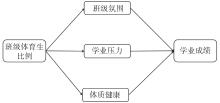
图 1
适量体育生同伴影响学生成绩的作用机制图"
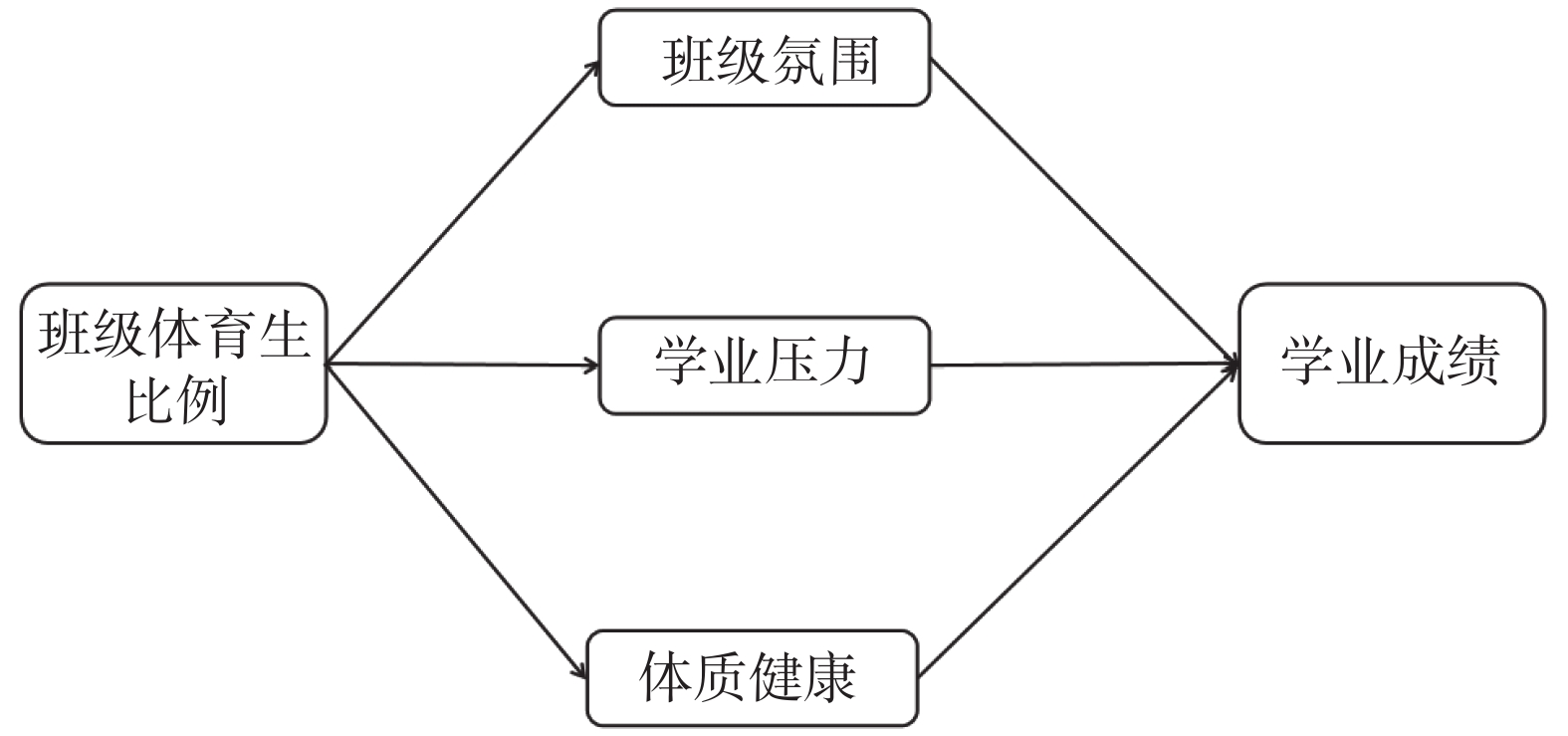
表 1
主要变量的分组描述性统计结果"
| 样本分类 | 变量 | Mean | SD | 差异检验 | 变量 | Mean | SD | 差异检验 |
| 文化生 | 入学成绩 | 502.5 | 0.13 | −15.00** (0.038) | 母亲教育水平 | 3.46 | 1.50 | −0.04 (0.396) |
| 体育生 | 487.5 | 0.18 | 3.42 | 1.38 | ||||
| 全体学生 | 500.2 | 0.14 | 3.46 | 1.50 | ||||
| 文化生 | 性别 | 0.51 | 0.50 | 0.17*** (35.590) | 父亲职业类型 | 8.05 | 3.13 | 0.13 (0.299) |
| 体育生 | 0.68 | 0.47 | 8.18 | 3.06 | ||||
| 全体学生 | 0.52 | 0.50 | 8.06 | 3.13 | ||||
| 文化生 | 年龄 | 16.16 | 0.64 | 0.09 (0.286) | 母亲职业类型 | 8.61 | 3.08 | 0.07 (0.238) |
| 体育生 | 16.25 | 0.65 | 8.68 | 2.78 | ||||
| 全体学生 | 16.16 | 0.64 | 8.62 | 2.78 | ||||
| 文化生 | 户口类型 | 0.08 | 0.27 | 0.01** (5.831) | 家庭经济状况 | 2.84 | 0.51 | −0.10*** (0.001) |
| 体育生 | 0.09 | 0.28 | 2.74 | 0.62 | ||||
| 全体学生 | 0.08 | 0.27 | 2.83 | 0.52 | ||||
| 文化生 | 体质健康 | 3.66 | 0.95 | 0.38*** (0.001) | 班级规模 | 43.07 | 11.57 | −1.99*** (0.001) |
| 体育生 | 4.04 | 0.99 | 41.08 | 12.61 | ||||
| 全体学生 | 3.69 | 0.95 | 42.95 | 11.85 | ||||
| 文化生 | 父亲教育水平 | 3.87 | 1.56 | −0.14* (0.078) | 班级成绩水平 | 0.67 | 0.09 | −0.03 (0.342) |
| 体育生 | 3.73 | 1.50 | 0.64 | 0.12 | ||||
| 全体学生 | 3.86 | 1.56 | 0.67 | 0.09 |
表 2
倾向得分匹配结果"
| 班级中是否有体育生 | 未匹配成功 | 匹配成功 | 总计 |
| 有 | 37 | 76 | 113 |
| 无 | 2 | 32 | 34 |
| 总计 | 39 | 108 | 147 |
表 3
控制变量平衡性检验表"
| 变量 | 均值 | 匹配后差异 | 偏差下降(%) | T检验 | |||||
| 无体育生班级 (实验组) | 有体育生班级 (控制组) | ||||||||
| 匹配前 | 匹配后 | 匹配前 | 匹配后 | t统计量 | p值 | ||||
| 班级规模 | 41.88 | 42.03 | 43.53 | 42.58 | −5.7 | 60.2% | −1.49 | 0.137 | |
| 班级性别 | 0.48 | 0.48 | 0.53 | 0.48 | 5.0 | 79.1% | 1.17 | 0.244 | |
| 班级年龄 | 16.17 | 16.17 | 16.17 | 16.17 | −1.0 | −300.2% | −0.24 | 0.810 | |
| 班级父亲平均受教育情况 | 3.90 | 3.87 | 3.84 | 3.82 | 9.4 | −15.9% | 1.10 | 0.273 | |
| 班级经济情况 | 2.86 | 2.85 | 2.82 | 2.85 | −2.5 | 91.5% | −0.68 | 0.500 | |
| 班级平均入学成绩 | 0.82 | 0.82 | 0.82 | 0.82 | −6.5 | 13.9% | −0.37 | 0.710 | |
| 班级母亲平均受教育情况 | 3.42 | 3.41 | 3.47 | 3.37 | 5.7 | 20.1% | 1.39 | 0.166 | |
| 重点学校 | 0.24 | 0.22 | 0.13 | 0.22 | −2.7 | 90.6% | −0.62 | 0.538 | |
| 县中 | 0.55 | 0.53 | 0.53 | 0.54 | −1.3 | 49.6% | −0.31 | 0.754 | |
表 4
匹配前后因变量平均处理效应表"
| 变量 | 样本 | 实验组 | 控制组 | 差异 | T检验 |
| 卡尺内近邻匹配 | 未匹配 | −0.009 | 0.003 | −0.012 | −0.37 |
| 匹配 | 0.010 | 0.014 | 0.004 | 0.10 | |
| 核匹配 | 未匹配 | −0.009 | 0.003 | −0.012 | −0.37 |
| 匹配 | 0.010 | 0.019 | 0.009 | 0.25 | |
| 局部线性匹配 | 未匹配 | −0.009 | 0.003 | −0.012 | −0.37 |
| 匹配 | 0.010 | 0.016 | 0.006 | 0.13 |
表 5
OLS基线回归结果与稳健性检验结果"
| 模型1 | 模型2 | |
| 学生成绩 | 学生成绩 | |
| 体育生比例 | −0.008 | −0.002 |
| (0.019) | (0.019) | |
| 标准化入学成绩 | 0.570*** | 0.577*** |
| (0.018) | (0.018) | |
| 性别 | 0.053* | 0.050** |
| (0.026) | (0.025) | |
| 年龄 | 0.009 | 0.005 |
| (0.021) | (0.021) | |
| 民族 | −0.206** | −0.011 |
| (0.079) | (0.078) | |
| 户口类型 | 0.072** | 0.068** |
| (0.028) | (0.028) | |
| 父亲受教育水平 | −0.004 | −0.005 |
| (0.012) | (0.011) | |
| 母亲受教育水平 | 0.017 | 0.021* |
| (0.012) | (0.011) | |
| 父亲职业类型 | 0.002 | −0.000 |
| (0.005) | (0.005) | |
| 母亲职业类型 | 0.003 | 0.002 |
| (0.004) | (0.005) | |
| 家庭经济情况 | −0.004 | −0.037 |
| (0.025) | (0.028) | |
| 班级规模 | 0.000 | 0.000 |
| (0.001) | (0.001) | |
| 班级性别 | −0.047 | −0.031 |
| (0.027) | (0.060) | |
| 班级年龄 | −0.048* | −0.029 |
| (0.020) | (0.043) | |
| 班级平均父亲受教育水平 | −0.002 | −0.010 |
| (0.146) | (0.061) | |
| 班级平均经济水平 | −0.016 | 0.026 |
| (0.036) | (0.086) | |
| 班级平均入学成绩 | − | |
| ( | ( | |
| 班级平均母亲受教育水平 | −0.011 | 0.002 |
| (0.016) | (0.021) | |
| 学校固定效应 | √ | √ |
| Constant | 0.577* | 0.332 |
| (0.187) | (0.266) | |
| Observations | 4,387 | 5,559 |
| R-squared | 0.324 | 0.334 |
表 6
班级中体育生比例的门槛效应检验"
| 模型 | F统计量 | P值 | Bootstrap次数 | 临界值 | 门槛 估计值 | ||
| 10% | 5% | 1% | |||||
| 单门槛 | 13.687* | 500 | 11.602 | 18.127 | 22.508 | ||
| 双门槛 | 5.524 | 500 | 13.551 | 19.964 | 26.452 | ||
表 7
门槛效应模型估计结果"
| 学生成绩 | 学生成绩 | ||
| 体育生比例 | 体育生比例 | 文化生样本 | |
| <= | > | 体育生比例<= | |
| 体育生比例 | 0.310* | −0.259** | 0.370** |
| (0.193) | (0.051) | (0.123) | |
| 个体特征 | √ | √ | √ |
| 家庭特征 | √ | √ | √ |
| 班级特征 | √ | √ | √ |
| 学校固定效应 | √ | √ | √ |
| Constant | 0.531 | 0.233 | −0.024 |
| (0.289) | (0.840) | (0.454) | |
| Observations | |||
| R-squared | 0.345 | 0.320 | 0.340 |
表 8
区分学校类型的门槛效应模型估计结果"
| 县域高中 | 地市级高中 | |||
| <= | > | <= | > | |
| 体育生比例 | 0.462** | −0.156** | 0.430 | −0.212** |
| (0.191) | (0.063) | (0.596) | (0.094) | |
| 个体特征 | √ | √ | √ | √ |
| 家庭特征 | √ | √ | √ | √ |
| 班级特征 | √ | √ | √ | √ |
| 学校固定效应 | √ | √ | √ | √ |
| Constant | 0.698 | −1.047*** | 0.829 | 0.547 |
| (0.342) | (0.441) | (0.351) | (0.538) | |
| Observations | 506 | 1,781 | 443 | |
| R-squared | 0.337 | 0.359 | 0.364 | 0.293 |
表 9
中介效应估计结果"
| 机制路径 | 效应类型 | 效应值 | 标准误 | 置信区间 | |
| 下限 | 上限 | ||||
| 班级体育生比例→改善班级氛围→学业表现 | 间接效应 | −0.013 | 0.006 | −0.025 | 0.001 |
| 直接效应 | 0.384 | 0.169 | 0.053 | 0.715 | |
| 班级体育生比例→舒缓学业压力→学业表现 | 间接效应 | 0.118 | 0.031 | 0.057 | 0.179 |
| 直接效应 | 0.253 | 0.085 | 0.086 | 0.420 | |
| 班级体育生比例→增强体质健康→学业表现 | 间接效应 | 0.094 | 0.017 | 0.061 | 0.127 |
| 直接效应 | 0.279 | 0.103 | 0.077 | 0.481 | |
| 曹蕊, 吴愈晓. (2019). 班级同辈群体与青少年教育期望: 社会遵从与社会比较效应. 青年研究, (05), 25- 33+94—95. | |
| 陈颉. (2023). 体教融合背景下高中体育特长生全面发展路径探析. (eds.)第十三届全国体育科学大会论文摘要集——墙报交流(学校体育分会)(八). 成都体育学院. | |
| 陈林会. (2023). 我国青少年业余体校转型发展的时代旨趣与实践策略. 首都体育学院学报, 35 (05), 512- 520. | |
| 陈媛媛, 董彩婷, 朱彬妍. (2021). 流动儿童和本地儿童之间的同伴效应: 孰轻孰重?. 经济学(季刊), 21 (02), 511- 532. | |
| 杜思慧, 成刚, 于文珊. (2023). 体重受同伴影响吗?——基于班级单位的实证考察. 华东师范大学学报(教育科学版), 41 (12), 85- 99. | |
| 方黎明. (2020). 体育锻炼对青少年认知能力和学业成绩的影响. 体育科学, 40(04), 35-41. | |
| 李佳宝. (2015). 不利的身份: 高中体育生生活体验的质性研究. 北京: 北京体育大学硕士学位论文. | |
| 李可伟, 赵子誉, 刘翔. (2025). 体教融合政策在高中体育生培养中的执行梗阻与立体化优化路径. (eds. )第六届国际体育科学大会论文集(上). 阜阳师范大学. | |
| 梁哲, 张羽. (2016). 中小学生身体形态、心肺功能与学业成绩的关系——基于新旧国家体质健康标准的分析. 体育与科学, 37 (05), 89- 97. | |
|
柳鸣毅, 但艳芳, 张毅恒. (2020). 中国体育运动学校嬗变历程、现实问题与治理策略研究. 体育学研究, 34 (03), 64- 77.
doi: 10.15877/j.cnki.nsic.20200522.001 |
|
| 芦晋汉. (2024). 自我的追寻——高校学生运动员的反叛与循规. 北京: 北京师范大学学士学位论文. | |
| 念贵, 任海巍. (2021). 中学体育特长生班级管理的现实困境及破解之策. 体育视野, (12), 57- 58. | |
| 裴丽萍. (2019). 普通高中体育“学困生”脱困解读. 西北成人教育学院学报, (06), 111- 112. | |
| 权小娟, 卢春天. (2020). 青少年体育锻炼中的同伴效应及性别差异. 上海体育学院学报, 44 (04), 41- 49. | |
|
田麦久, 徐刚, 石岩. (2024). 运动训练理论的国际发展与中国学派的建立. 北京体育大学学报, 47 (01), 1- 12.
doi: 10.19582/j.cnki.11-3785/g8.2024.01.001 |
|
| 王霄. (2016). 高中体育特长生科学训练的重要性. 当代体育科技, 6(19), 43+45. | |
| 吴愈晓, 张帆. (2020). “近朱者赤”的健康代价: 同辈影响与青少年的学业成绩和心理健康. 教育研究, 41 (07), 123- 142. | |
| 武玮, & 祁翔. (2019). 流动儿童会影响城市本地儿童的学业表现吗?——基于同伴效应的考察. 教育与经济, (03), 87- 96. | |
| 熊丙奇. (2024). 停止降分录取“体育生”“艺术生”让兴趣特长回归本源. 取自中国青年报(2024年1月17日): https://baijiahao.baidu.com/s?id=1788293222291125327&wfr=spider&for=pc. | |
| 许双成, 张立昌. (2015). 教育公平之殇——分层分班教学. 西北民族大学学报(哲学社会科学版), (04), 184- 188. | |
|
杨桦, 刘志国. (2021). 体教融合: 中国特色竞技体育后备人才培养模式转化与创新. 成都体育学院学报, 47 (03), 1- 8.
doi: 10.15942/j.jcsu.2021.03.001 |
|
| 张瀚文, 安许心. (2025). 教室与操场之间: 体育生的身体经验与道德处境. 华东师范大学学报(教育科学版), 43 (07), 86- 95. | |
| 张烁. (2021). 艺考、高水平运动队考试招生不是“升学捷径”. 取自光明网(2021年9月25日): https://m.gmw.cn/baijia/2021-09/25/1302602524. html. | |
| 宗庆庆, 李雪松. (2018). 基础教育中的同伴效应估计. 财经研究, 44 (07), 4- 15. | |
| 邹红军. (2019). 承认与抵制: 我国普通高中多样化发展的扎根理论研究. 中国教育学刊, (07), 35-41. | |
| 佐藤学, 钟启泉. (2010). "分层教学"有效吗. 全球教育展望, 39 (05), 3- 7. | |
| Aries, E., McCarthy, D., Salovey, P., & Banaji, M. R. (2004). A comparison of athletes and non-athletes at highly selective colleges: Academic performance and personal development. Research in higher education, 45 (6), 577- 602. | |
| Lavy, V., & Schlosser, A. (2011). Mechanisms and Impacts of Gender Peer Effects at School. American Economic Journal: Applied Economics, 3 (2), 1- 33. | |
| Brunello, G., & Rocco, L. (2013). The effect of immigration on the school performance of natives: Cross country evidence using PISA test scores. Economics of Education Review, 32, 234- 246. | |
| Carrell, S. E., Hoekstra, M., & Kuka, E. (2018). The Long-Run Effects of Disruptive Peers. American Economic Review, 108 (11), 3377- 3415. | |
| Carrell, S. E., Sacerdote, B. I., & West, J. E. (2013). From natural variation to optimal policy? The importance of endogenous peer group formation. Econometrica, 81 (3), 855- 882. | |
| Contini, D. (2013). Immigrant background peer effects in Italian schools. Social Science Research, 42 (4), 1122- 1142. | |
| Dee, T. S. (2014). Stereotype threat and the student‐athlete. Economic Inquiry, 52 (1), 173- 182. | |
| Engel, C. (2023). How little does it take to trigger a peer effect? An experiment on crime as conditional rule violation. Journal of Research in Crime and Delinquency, 60 (4), 455- 492. | |
| Feld, J., & Zölitz, U. (2017). Understanding peer effects: On the nature, estimation, and channels of peer effects. Journal of Labor Economics, 35 (2), 387- 428. | |
| Finnell, C. (2022). The Impact of Peer Mentoring on Freshmen Student-Athlete Retention and Experience. Lindenwood University. | |
| Frattini, T., & Meschi, E. (2019). The effect of immigrant peers in vocational schools. European Economic Review, 113, 1- 22. | |
| Geisner, I. M., Grossbard, J., Tollison, S., & Larimer, M. E. (2012). Differences between athletes and non-athletes in risk and health behaviors in graduating high school seniors. Journal of child & adolescent substance abuse, 21 (2), 156- 166. | |
| Hanushek, E. A., Kain, J. F., & Rivkin, S. G. (2009). New evidence about Brown v. Board of Education: The complex effects of school racial composition on achievement. Journal of Labor Economics, 27 (3), 349- 383. | |
| Harrison, C. K., Martin, B. E., & Fuller, R. (2015). “Eagles don’t fly with sparrows”: Self-determination theory, African American male scholar-athletes and peer group influences on motivation. The Journal of Negro Education, 84 (1), 80- 93. | |
| Heil, J. (2014). A Comparison in the Academic Achievement of High School Athletes vs. Non-athletes in the State of Kansas (Doctoral dissertation, Northwest Missouri State University). | |
| Hood, A. B., Craig, A. F., & Ferguson, B. W. (1992). The impact of athletics, part-time employment, and other activities on academic achievement. Journal of College Student Development, 33 (5), 447- 453. | |
| Hoxby, C. M., & Weingarth, G. (2005). Taking race out of the equation: School reassignment and the structure of peer effects (No. 7867). Working paper. | |
| Hu, F. (2018). Migrant peers in the classroom: Is the academic performance of local students negatively affected?. Journal of Comparative Economics, 46 (2), 582- 597. | |
| Imberman, S. A., Kugler, A. D., & Sacerdote, B. (2012). Katrina’s children: Evidence on the structure of peer effects from hurricane evacuees. American Economic Review, 102 (5), 2048- 2082. | |
| Jensen, P., & Rasmussen, A. W. (2011). The effect of immigrant concentration in schools on native and immigrant children’s reading and math skills. Economics of Education Review, 30 (6), 1503- 1515. | |
| Jõesaar, H., Hein, V., & Hagger, M. S. (2011). Peer influence on young athletes' need satisfaction, intrinsic motivation and persistence in sport: A 12-month prospective study. Psychology of Sport and Exercise, 12 (5), 500- 508. | |
| Jones, G. J., Hyun, M., Edwards, M. B., Casper, J. N., Bocarro, J. N., & Lynch, J. (2020). Is “school sport” associated with school belongingness? Testing the influence of school sport policy. Sport Management Review, 23 (5), 925- 936. | |
| Peng, Y., & Bai, X. (2024). Identifying social tipping point through perceived peer effect. Environmental Innovation and Societal Transitions, 51, 100847. | |
| Pestana, E. R., de Carvalho, W. R. G., de Menezes Nunes, L. A., Almeida Junior, F. D. A. D. S., & Salvador, E. P. (2018). Sports practice and factors associated with school performance in grade and high school: comparison between athletes and non-athletes. Sport Sciences for Health, 14 (3), 639- 644. | |
| Richard, S., & Aries, E. (1999). The Division III student-athlete: Academic performance, campus involvement and growth. Journal of College Student Development, 40 (3), 211- 218. | |
| Sacerdote, B. (2011). Peer effects in education: How might they work, how big are they and how much do we know thus far? In Handbook of the Economics of Education (Vol. 3, pp. 249-277). | |
| Seaton, M., Marsh, H. W., & Craven, R. G. (2010). Big-fish-little-pond effect: Generalizability and moderation—Two sides of the same coin. American Educational Research Journal, 47 (2), 390- 433. | |
| Shulman, J. L., & Bowen, W. G. (2001). The Game of Life: College Sports and Educational Values. Princeton: Princeton University Press. | |
| Tomon, J. E., & Ting, S. R. (2010). Effects of team climate on substance use behaviors, perceptions, and attitudes of student-athletes at a large, public university. Journal of College Student Development, 51 (2), 162- 179. | |
| Tran, A. G., Holzapfel, J., Lam, C. K., & Eustice, K. L. (2023). Race and student-athlete status: Peer appraisals of academic skills, intelligence, and favorability. Journal of Diversity in Higher Education, 16 (3), 346. | |
| Tran, C., & Zheleva, E. (2022). Heterogeneous peer effects in the linear threshold model. Proceedings of the AAAI Conference on Artificial Intelligence, 36 (4), 4175- 4183. | |
| Trogdon, J. G., Nonnemaker, J., & Pais, J. (2008). Peer effects in adolescent overweight. Journal of Health Economics, 27 (5), 1388- 1399. |
| [1] | 张瀚文, 安许心. 教室与操场之间:体育生的身体经验与道德处境[J]. 华东师范大学学报(教育科学版), 2025, 43(7): 86-95. |
| [2] | 杜思慧, 成刚, 于文珊. 体重受同伴影响吗?——基于班级单位的实证考察[J]. 华东师范大学学报(教育科学版), 2023, 41(12): 85-99. |
| 阅读次数 | ||||||
|
全文 |
|
|||||
|
摘要 |
|
|||||
