
 中国人文社会科学核心期刊
Journal of East China Normal University(Educationa ›› 2026, Vol. 44 ›› Issue (10): 88-105.doi: 10.16382/j.cnki.1000-5560.2026.10.007
Previous Articles Next Articles
Fan Yang1, Yonghui Qian2, Songyan Jiang1, Yingbin Zhu3, Zhichen Xia4
Online:2026-10-01
Published:2026-09-28
Fan Yang, Yonghui Qian, Songyan Jiang, Yingbin Zhu, Zhichen Xia. How Does Teacher Evaluation Affect Students’ Development in the Context of Home-school Cooperation: Based on A Paired Survey of Experimental Schools for Home-school Cooperation in Kunshan City[J]. Journal of East China Normal University(Educationa, 2026, 44(10): 88-105.
"
"
| 分类 | 教师性别 | 教师教龄 | |||||
| 女 | 男 | 4年及以下 | 5-9年 | 10-14年 | 15-19年 | 20年及以上 | |
| 人数 | 596 | 448 | 521 | 291 | 150 | 263 | |
| 比重(%) | 35.6 | 64.4 | 26.8 | 31.1 | 17.4 | 9.0 | 15.7 |
| 分类 | 教师学历 | 教师职称 | |||||
| 大专及以下 | 大学本科 | 研究生 | 三级或未定 | 二级 | 一级 | 高级及以上 | |
| 人数 | 82 | 202 | 286 | 592 | 656 | 139 | |
| 比重(%) | 4.9 | 83.0 | 12.1 | 17.1 | 35.4 | 39.2 | 8.3 |
| 分类 | 学生性别 | 学生学段 | 监护人性别 | ||||
| 女 | 男 | 小学 | 初中 | 高中 | 女 | 男 | |
| 人数 | 1865 | 391 | |||||
| 比重(%) | 46.0 | 54.0 | 63.4 | 26.9 | 9.7 | 60.1 | 39.9 |
"
| 题号 | 题项 | 因素1 | 因素2 | 因素3 | 共同度 |
| NO01 | 我能在家访、家长会、校园开放日等活动中充分地将学生的在校表现传达给家长 | .874 | .801 | ||
| NO05 | 我能够结合学生的综合表现向家长提供家庭教育的有效建议 | .872 | .850 | ||
| NO03 | 我能够把学生的在校情况分析给家长听并让他们理解如何配合学校进行教育 | .843 | .739 | ||
| NO02 | 我知道如何使家长与自己形成共同的评价目标并吸引家长参与到子女的 教育环节中来 | .749 | .633 | ||
| NO04 | 我能够让家长明白学校进行教育评价的目的是为了培养学生 而不是为了对学生进行排名 | .681 | .664 | ||
| NO08 | 我认为应该定期和家长交流学生的在校表现 | .930 | .867 | ||
| NO09 | 我认为应该向家长说明学生存在的不足或问题 | .903 | .840 | ||
| NO06 | 我认为向家长客观准确地传达学生发展状况非常重要 | .885 | .796 | ||
| NO07 | 我希望通过教育评价使得学校与家长之间形成教育合力 | .830 | .695 | ||
| NO11 | 我认为应该要让家长认识到评价的作用是促进学生更好的发展 | .655 | .676 | ||
| NO10 | 我会有意识地让家长理解并接受学生的评价结果 | .641 | .676 | ||
| NO14 | 在家长会、校园开放日等公共场合,我不会公布学生的评价结果 | .759 | .583 | ||
| NO13 | 我非常重视评价对家庭的影响,不会使用带有伤害性的评价语言 | .706 | .699 | ||
| NO12 | 在与家长交流学生的在校表现时,我会注意规避家庭矛盾的发生 | .655 | .605 | ||
| NO15 | 我乐于与家长谈论学生的闪光点,而不是仅仅用分数来评价学生 | .652 | .700 | ||
| NO16 | 我不会为了满足自己或集体的利益,而做出不利于学生发展的评价 | .622 | .616 | ||
| 特征值 | 6.626 | 3.467 | 1.349 | ||
| 贡献率 | 26.155 | 25.580 | 19.778 | 71.512 |
"
| 模型 | k | AIC | BIC | SSA-BIC | Entropy | LMR(p) | BLRT(p) | 各潜在类别占比 |
| 一 | 2 | .918 | <.001 | <.001 | .448/.552 | |||
| 二 | 3 | .941 | <.001 | <.001 | .062/.448/.490 | |||
| 三 | 4 | .946 | <.001 | <.001 | .059/.336/.112/.493 | |||
| 四 | 5 | .960 | <.001 | <.001 | .032/.114/.225/.179/.396 |
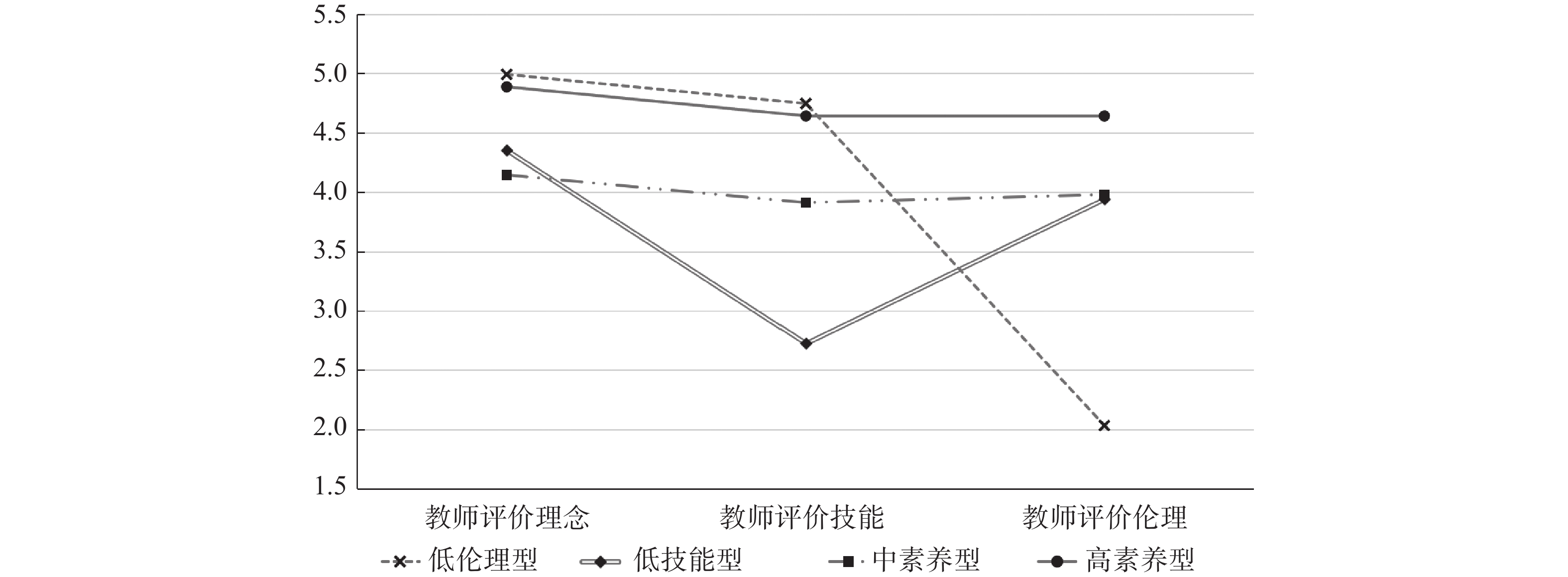
"
"
| 变量 | 1 | 2 | 3 | 4 | 5 | 6 | 7 | 8 | 9 | 10 |
| 1.教师性别 | 1 | |||||||||
| 2.教师学历 | −.122** | 1 | ||||||||
| 3.教师职称 | .095** | .076** | 1 | |||||||
| 4.教师教龄 | .124** | −.166** | .720** | 1 | ||||||
| 5.教师评价 | −.010 | .120** | .088** | .045** | 1 | |||||
| 6.家庭教育指导 | .012 | .046** | .026 | .020 | .242*** | 1 | ||||
| 7.家长参与 | −.027 | .020 | .032 | .025 | .445*** | .202*** | 1 | |||
| 8.师生关系 | −.013 | .016 | .006 | −.013 | .326*** | .173*** | .390*** | 1 | ||
| 9.学业表现 | −.012 | .008 | .017 | −.001 | .315*** | .166*** | .366*** | .650*** | 1 | |
| 10.社会与情感能力 | −.006 | .011 | .006 | −.015 | .360*** | .174*** | .377*** | .689*** | .844*** | 1 |
| 平均数 | .356 | 2.557 | 2.387 | 4.068 | 4.590 | 4.176 | 3.091 | 4.147 | 4.169 | 4.263 |
| 标准差 | .479 | 1.381 | .863 | .422 | .542 | .801 | .574 | .815 | .656 | .543 |
"
| 变量 | 低伦理型(C1) | 低技能型(C2) | 中素养型(C3) | 高素养型(C4) | 各剖面间的比较 |
| 学业表现 | 4.159 | 3.860 | 4.558 | 4.783 | χ2= |
| 社会与情感能力 | 2.630 | 3.480 | 4.243 | 4.688 | χ2= |
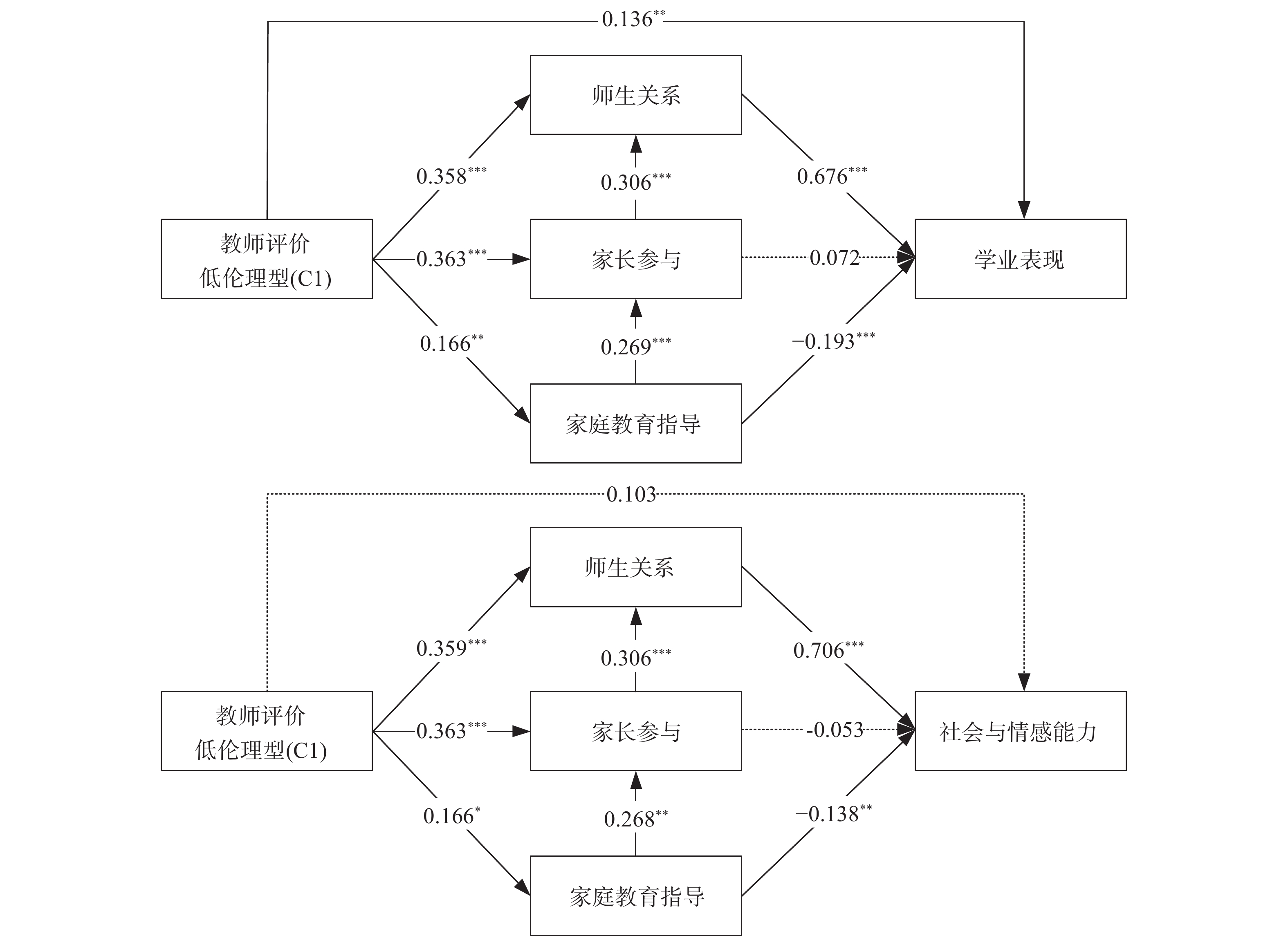
"
"
"
"
| 程亚华, 闫琳, 张锋. (2025). 批评方式对初、高中学生行为改善意向的影响: 师生关系亲密度的作用. 心理发展与教育, 41 (1), 42- 50. | |
| 郭衎, 曹一鸣. (2021). 知识与信念: 基于学生表现的教师核心素养研究. 数学教育学报, 30 (4), 1- 5. | |
| 黄忠敬. (2022). 从“智力”到“能力”——社会与情感概念史考察. 教育研究, 43 (10), 83- 94. | |
| 江苏省教育厅. (2025). 苏州昆山市: 校企协同 共筑生涯教育“童”心圆. 取自江苏省教育厅政府网(2025年10月31日): https://jyt.jiangsu.gov.cn/art/2025/10/31/art_57812_11666912.html. | |
| 雷万鹏, 向蓉. (2022). 家庭教育指导服务的双重差异与政策启示. 南京师大学报(社会科学版), (6), 14- 23. | |
| 李大印, 张顾文. (2022). 家校合作何以影响高中生社会情感能力——基于SESS 2019调查数据的实证分析. 湖南师范大学教育科学学报, 21 (5), 52- 61. | |
| 李毅, 郑鹏宇. (2025). 智能时代教师评价素养的内涵重构、价值阐释、框架构建及应用. 中国电化教育, (9), 87- 96. | |
| 梁文艳, 李涛, 何茜. (2022). 教师性别对学生人力资本发展的影响——基于中国教育追踪调查数据的实证研究. 教育与经济, 38 (6), 35- 44. | |
| 陆道坤, 邱宇莲. (2017). 教师伤害事件折射出的师生生态失谐及调适. 中国教育学刊, (12), 73- 78. | |
| 蒲蕊, 崔晓楠, 钱佳. (2024). 家校合作如何影响留守儿童社会情感能力发展. 教育研究, 45 (6), 101- 114. | |
| 祁占勇, 余瑶瑶, 杜越, 王书琴. (2021). 论家庭教育指导服务支持体系的供给主体及其行为选择. 中国教育学刊, (6), 33- 38. | |
| 宋萑, 胡馨. (2022). 为未来而教: 教师专业发展的时代命题. 中小学管理, (9), 10- 14. | |
| 苏州市教育局. (2018). 昆山: 凝心聚力, 推动昆家校合作走向美好那方. 取自苏州市教育局政府网(2018年12月4日): https://jyj.suzhou.gov.cn/szjyj/2018jjnhbkcz/201812/d5849878249b473bb2efa0806079b16a.shtml. | |
| 孙雯雯, 王洪席. (2023). 中学生感知的教师评价素养问卷编制及应用研究. 上海教育科研, (10), 59- 65. | |
| 王帅. (2013). 教师评价偏见与反偏见评价构建. 中国教育学刊, (6), 81- 84. | |
| 王阳. (2025). 着眼“五个一”, 构建校家社协同育人新生态. 江苏教育报, 2025-03-12(003). | |
| 温忠麟, 谢晋艳, 王惠惠. (2023). 潜在类别模型的原理、步骤及程序. 华东师范大学学报(教育科学版), 41 (1), 1- 15. | |
| 徐彬, 刘志军. (2023). 作为德性实践的学生评价. 教育研究, 44 (2), 45- 54. | |
| 杨帆. (2021). 家庭环境是怎样影响小学生学习表现的——基于对新教育实验“家校合作共育”行动效果的调查. 华东师范大学学报(教育科学版), 39 (3), 71- 83. | |
| 杨帆, 陈昊璇, 朱永新. (2024). 人工智能助力教师专业发展: 价值定位、现实制约与制度建设. 中国远程教育, 44 (4), 58- 68. | |
| 杨帆, 何雨璇, 夏之晨. (2022). 反思会持续改善教师的课堂行为吗?——基于对不同教学理念教师的追踪调查. 华东师范大学学报(教育科学版), 40 (10), 17- 28. | |
| 杨帆, 许庆豫. (2015). “教师中心”与“学生中心”教学理念辨析——基于中小学教师的问卷调查. 高等教育研究, 36 (12), 78- 86. | |
| 姚东旻, 许艺煊, 李昊洋, 等. (2021). 教师的表扬或批评如何影响学生成绩——基于CEPS数据的中介效应分析. 北京大学教育评论, 19 (1), 109. | |
| 袁振国. (2021). 高度重视社会与情感能力培养为人生的成功和幸福奠基. 中国教育学刊, (2), 5. | |
| 张磊. (2003). 中学生师生关系的特点及其与学校适应的关系研究(硕士学位论文). 北京师范大学. | |
| 赵希斌. (2005). 不同学段、年级学生对教师评价行为知觉的特点. 心理发展与教育, (4), 61- 67. | |
| 郑东辉. (2022). 新时期教师到底需要怎样的评价素养. 教育发展研究, 42 (4), 46- 51. | |
| 周晓慧, 刘妍希, 陈欣等. (2023). 父母教育卷入对初中生生活满意度的影响: 校内人际关系和学业自我效能感的链式中介作用. 心理发展与教育, 39 (5), 691- 701. | |
| Association for Educational Assessment-Europe. (2012). European Framework of Standards for Educational Assessment 1.0. Rome: Edizioni Nuova Cultura. | |
| Black P., & Wiliam D. (1998). Assessment and Classroom Learning. Assessment in Education: Principles, Policy & Practice, 5(1), 7—74. | |
| Brookhart, S. M. (2011). Educational Assessment Knowledge and Skills for Teachers. Educational Measurement: Issues and Practice, 30 (1), 3- 12. | |
| Cheng, Y. T. (2019). Involvement Practices, Socioeconomic Status, and Student Science Achievement: Insights from a Typology of Home and School Involvement Patterns. American Educational Research Journal, 56 (3), 899- 924. | |
| Cornelius-White, J. (2007). Learner-centered Teacher-student Relationships are Effective: A Meta-analysis. Review of Educational Research, 77 (1), 113- 143. | |
| Cui, H., Zhang, M., & Gao, X. (2026). Teacher Feedback and Student Social and Emotional Skills: An Empirical Study Based on Second Round of SSES 2023 Data. ECNU Review of Education, 9(2). | |
| DeLuca, C., Schneider, C., Coombs, A., Pozas, M., & Rasooli, A. (2020). A Cross-cultural Comparison of German and Canadian Student Teachers’ Assessment Competence. Assessment in Education: Principles, Policy & Practice, 27(1), 26—45. | |
| Deng, L., Zhou, N., Nie, R., Jin, P., Yang, M., & Fang, X. (2018). Parent-teacher Partnership and High School Students’ Development in Mainland China: The Mediating Role of Teacher-student Relationship. Asia Pacific Journal of Education, 38 (1), 15- 31. | |
| Hoover-Dempsey, K. V., Walker, J. M., Sandler, H. M., Whetsel, D., Green, C. L., Wilkins, A. S., & Closson, K. (2005). Why do Parents Become Involved? Research Findings and Implications. The Elementary School Journal, 106 (2), 105- 130. | |
| Hou, Y. J., & Hsieh, M. F. (2019). Helping Parents Reexamine Children’s Emergent Writing Performance through Parent–teacher Portfolio Sharing Conferences. Australasian Journal of Early Childhood, 44 (4), 378- 391. | |
| Jensen, M., Dufur, M. J., Jarvis, J. A., & Pribesh, S. L. (2025). Bridging the Gap: The Role of Parent-teacher Perception in Child Developmental Outcomes. Children, 12 (9), 1260. | |
| Kankaraš, M., & Suarez-Alvarez, J. (2019). Assessment Framework of the OECD Study on Social and Emotional Skills. OECD Education Working Papers, 207. | |
| Li, H. (2016). How is Formative Assessment Related to Students’ Reading Achievement? Findings from PISA 2009. Assessment in Education: Principles, Policy & Practice, 23(4), 473—494. | |
| Matthew, A. K., & Todd, R. (2015). The Underutilized Potential of Teacher-to-parent Communication: Evidence from a Field Experiment. Economics of Education Review, 47, 49- 63. | |
| National Board for Professional Teaching Standards (NBPTS). (2012). What Teachers Should Know and Be Able to Do. Arlington, VA. Retrieved from http://www.nbpts.org. | |
| Remesal, A. (2011). Primary and Secondary Teachers’ Conceptions of Assessment: A Qualitative Study. Teaching and Teacher Education, 27 (2), 472- 482. | |
| Rogers, W. T. (1993). Principles for Fair Student Assessment Practices for Education in Canada. Canadian Journal of School Psychology, 9 (1), 110. | |
| Taylor, B. M., & Pearson, P. D. (2004). Research on Learning to Read—at School, at Home, and in the Community. Elementary School Journal, 105 (2), 167- 181. | |
| Tikhomirova, T., Malykh, A., Malykh, S. (2020). Predicting Academic Achievement with Cognitive Abilities: Cross-sectional Study Across School Education. Behavioral Sciences, 10 (10), 158. | |
| Wong, R. S. M., Ho, F. K. W., Wong, W. H. S., Tung, K. T. S., Chow, C. B., Rao, N., Chan, K. L., & Ip, P. (2018). Parental Involvement in Primary School Education: Its Relationship with Children’s Academic Performance and Psychosocial Competence through Engaging Children with School. Journal of Child and Family Studies, 27 (5), 1544- 1555. | |
| Yang, F., Qian, Y. & Xia, Z. (2024). Cognitive Ability and Locus of Control: The Effect of Parental Involvement on the Academic Performance of Elementary and Secondary School Students. Current Psychology,43,2816-2831. | |
| Young, N. A. (2020). Getting the Teacher’s Attention: Parent-teacher Contact and Teachers’ Behavior in the Classroom. Social Forces, 99 (2), 560- 589. | |
| Stiggins, R. J. (1991). Assessment Literacy. Phi Delta Kappan, 72 (7), 534- 539. |
| [1] | Fang Chang, Yajie Wang, Huijie Ma, Yaojiang Shi. A Study on the Social and Emotional Skills of Students in Rural Northwestern China [J]. Journal of East China Normal University(Educationa, 2025, 43(10): 64-83. |
| [2] | Zhenguo Yuan, Zhongjing Huang, Hong Wang, Xiangyu Wang, Jing Zhang. First Report on the Development of Chinese Adolescents’ Social and Emotional Skills: Based on the Second Round of SSES Data [J]. Journal of East China Normal University(Educational Sciences), 2024, 42(5): 1-32. |
| [3] | Zhongjing Huang, Yipeng Tang, Juan Wang. Student Social and Emotional Competence: International Comparison and Chinese Performance [J]. Journal of East China Normal University(Educational Sciences), 2024, 42(5): 33-57. |
| [4] | Zhifang Shao, Yipeng Tang, Jing Zhang. The Technical Report on the 2nd Round OECD Survey of Social and Emotional Skills of Chinese Adolescence [J]. Journal of East China Normal University(Educational Sciences), 2024, 42(5): 58-71. |
| [5] | Jing Zhang, Jie Zheng, Haili Cui, Lijun Zhang. How School Education Contributes to the Social and Emotional Development of Students: A Study Based on Cluster Analysis [J]. Journal of East China Normal University(Educational Sciences), 2024, 42(5): 72-82. |
| [6] | Zhi Liu, Jia Li, Chenxi Liang. The Impact of Family Socioeconomic Status on Students’ Social and Emotional Skills: The Serial Mediation Role of Growth Mindset and Test and Class Anxiety [J]. Journal of East China Normal University(Educational Sciences), 2024, 42(5): 83-98. |
| [7] | Hanwei Tang, Hong Zhang, Xingyuan Gao. How Social and Emotional Skills Influence Students’ Public Engagement: Based on the Second Round of SSES [J]. Journal of East China Normal University(Educational Sciences), 2024, 42(5): 99-111. |
| [8] | Zhongjing Huang, Kaiyue Shang, Jing Zhang. Does Growth Mindset Affect Students’ Social and Emotional Skills Development: Empirical Analyses Based on OECD Social and Emotional Skills Study [J]. Journal of East China Normal University(Educational Sciences), 2023, 41(4): 22-32. |
| [9] | Yipeng Tang, Zhongjing Huang. Empirical Research on the Cultivation Performance of Social and Emotional Skills: An International Comparative Analysis Based on SSES 2021 [J]. Journal of East China Normal University(Educational Sciences), 2023, 41(4): 33-45. |
| [10] | Jing Zhang, Zeliang Jin, Zhongjing Huang. Can Social and Emotional Skills Effectively Reduce Students’ Bullying: Empirical Analyses Based on OECD Social and Emotional Skills Study [J]. Journal of East China Normal University(Educational Sciences), 2023, 41(4): 46-55. |
| [11] | Lei Zheng, Yu Sun. Where there is a Will, there is a Way: Heterogeneous Effects of Students’ Willpower on Cognitive Abilities [J]. Journal of East China Normal University(Educational Sciences), 2022, 40(8): 83-95. |
| [12] | Jing Zhang. IQ or EQ: Which is More Important for Students’ Learning ? [J]. Journal of East China Normal University(Educational Sciences), 2022, 40(11): 69-79. |
| [13] | Gang Cheng, Sihui Du, Qian Yu. Are Your Educational Expectations Rational? Research on Effects of Parent-Child Discrepancies in Educational Expectations on Academic Performance [J]. Journal of East China Normal University(Educational Sciences), 2022, 40(1): 74-87. |
| [14] | Zhongjing Huang, Qian Wang, Huanchun Chen, Xingyuan Gao. Engaging with Others: The Report on the Study on Social and Emotional Skills of Chinese Adolescents (V) [J]. Journal of East China Normal University(Educational Sciences), 2021, 39(9): 93-108. |
| [15] | Zhifang Shao, Zhi Liu, Shuyu Yang, Zhongjing Huang. Open-mindedness: Report on the Study on Social and Emotional Skills of Chinese Adolescence (IV) [J]. Journal of East China Normal University(Educational Sciences), 2021, 39(9): 77-92. |
| Viewed | ||||||
|
Full text |
|
|||||
|
Abstract |
|
|||||
