
 中国人文社会科学核心期刊
华东师范大学学报(教育科学版) ›› 2026, Vol. 44 ›› Issue (4): 91-105.doi: 10.16382/j.cnki.1000-5560.2026.04.008
赵平1,2, 胡咏梅3
出版日期:2026-04-01
发布日期:2026-03-31
基金资助:Ping Zhao1,2, Yongmei Hu3
Online:2026-04-01
Published:2026-03-31
摘要:
在个体主义逐渐觉醒与高等教育高质量发展的背景下,助力高学历女性将职业发展与子女生育平衡兼顾,是新时代统筹推进教育强国建设与人口高质量发展面临的重要挑战。根据偏好理论与资源保存理论,构建高学历女性职业发展错失恐惧对其生育意愿影响的理论模型,使用“高学历女性生育意愿”问卷调查数据开展实证分析。研究发现,高学历女性非常重视个体的职业发展,职业发展错失恐惧对其生育意愿具有显著的负向影响;工作生活平衡感在高学历女性的职业发展错失恐惧对其生育意愿的负向影响中起中介作用;配偶用于子女照料支持的时长能够在高学历女性职业发展错失恐惧对其工作生活平衡感的负向影响中起缓冲作用,但代际支持的作用有限;职业发展错失恐惧对高学历女性生育意愿的消极影响在38岁及以下的群体中相当显著,但在38岁以上的群体中并不显著。基于以上研究发现,建议营造职业女性生育支持环境,平衡母亲职业发展与养育责任;构建父亲育儿激励政策体系,切实提高父亲育儿参与程度;强化优质托育支持网络,完善替代性养育机制。
赵平, 胡咏梅. 升职与生子可否兼得?——职业发展错失恐惧对高学历女性生育意愿的影响机制与破局之法[J]. 华东师范大学学报(教育科学版), 2026, 44(4): 91-105.
Ping Zhao, Yongmei Hu. Can Career Development and Childbearing Be Balanced? Exploring the Influence Mechanism and Possible Solutions to Workplace Fear of Missing Out on Highly-Educated Women's Fertility Intention[J]. Journal of East China Normal University(Educationa, 2026, 44(4): 91-105.
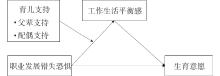
图 1
高学历女性职业发展错失恐惧对其生育意愿的影响机制"
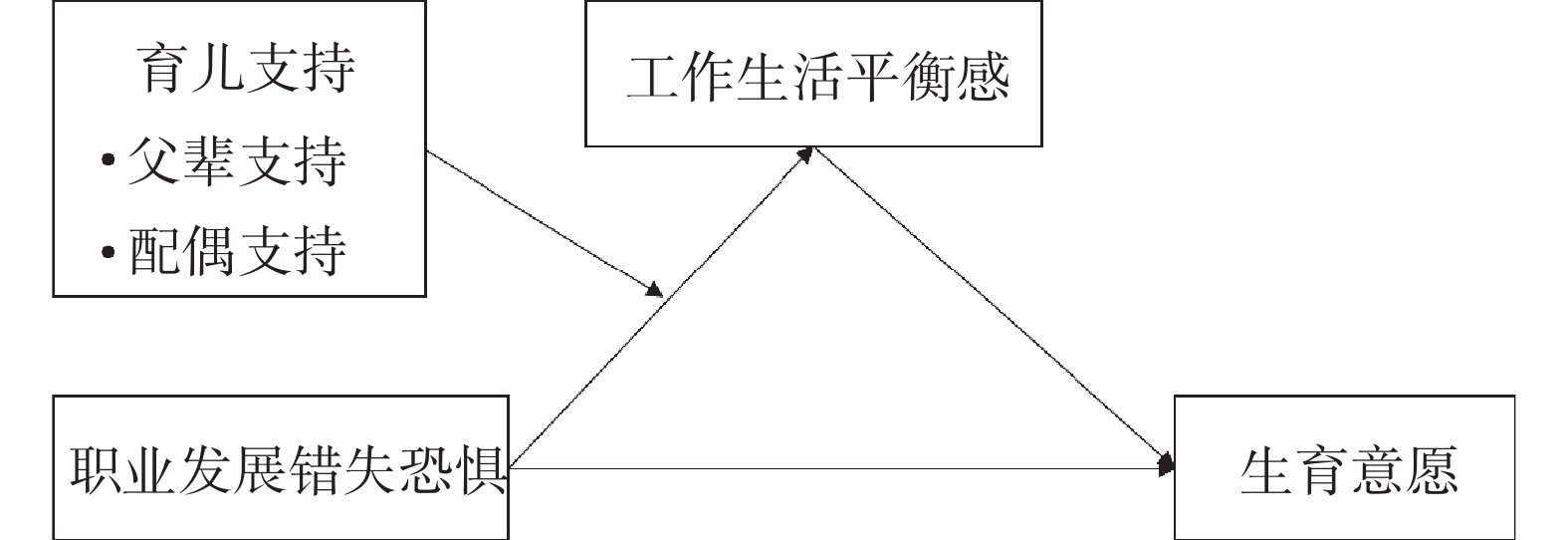

表 1
变量定义与描述性统计"
| 变量名称 | 变量说明 | 均值 | 标准差 |
| 被解释变量 | |||
| 生育意愿 | 计划生育子女数 | 1.387 | 0.638 |
| 解释变量 | |||
| 职业发展错失恐惧 | 参考Budnick et al.( | 0.000 | 0.827 |
| 中介变量 | |||
| 工作生活平衡感 | 参考Brough et al. ( | 0.000 | 0.770 |
| 调节变量 | |||
| 有无代际照护支持 | 提供代际支持的老人是否提供过与子女照护相关的劳动支持和经济支持:0-未提供相关支持,1-提供相关支持 | 0.932 | 0.252 |
| 配偶子女照料时间 | 配偶去年平均每天用于子女照料的小时数 | 2.479 | 1.935 |
| 控制变量 | |||
| 年龄 | 被访时的年龄 | 35.420 | 4.788 |
| 民族 | 是否少数民族:0-汉族,1-少数民族 | 0.083 | 0.276 |
| 独生属性 | 是否独生子女:0-非独生子女,1-独生子女 | 0.360 | 0.480 |
| 职业 | 1-教师,2-国家机关事业单位以及国有企业工作人员,3-其他 | 1.163 | 0.446 |
| 家庭月收入 | 家庭平均月收入(万元) | 3.417 | 4.296 |
表 2
职业发展错失恐惧对生育意愿影响的泊松回归结果"
| 变量 | 模型(1) | 模型(2) | |||
| 系数 | 发生率比 | 系数 | 发生率比 | ||
| 职业发展错失恐惧 | −0.042** | 0.959** | −0.038* | 0.963* | |
| (0.021) | (0.020) | (0.021) | (0.020) | ||
| 年龄 | 0.094* | 1.099* | |||
| (0.051) | (0.056) | ||||
| 年龄平方项 | −0.001* | 0.999* | |||
| (0.001) | (0.001) | ||||
| 少数民族(否=0) | −0.120* | 0.887* | |||
| (0.062) | (0.055) | ||||
| 独生子女(否=0) | −0.070* | 0.932* | |||
| (0.036) | (0.034) | ||||
| 职业(参照组:教师) | |||||
| 国家机关事业单位企业工作人员 | 0.029 | 1.029 | |||
| (0.055) | (0.056) | ||||
| 其他职业 | −0.138 | 0.871 | |||
| (0.121) | (0.106) | ||||
| 家庭月收入 | 0.007* | 1.007* | |||
| (0.004) | (0.004) | ||||
| 常数项 | 0.326*** | 1.386*** | −1.444 | 0.236 | |
| (0.017) | (0.023) | (0.921) | (0.217) | ||
| pseudo R2 | 0.001 | 0.004 | |||
| N | 747 | 747 | |||
| 皮尔逊拟合优度 | 217.659 | 213.095 | |||
| P值 | 1.000 | 1.000 | |||
表 3
工作生活平衡感的中介效应"
| 变量 | 模型(1) | 模型(2) | 模型(3) |
| 因变量: 生育意愿 | 因变量: 工作生活平衡感 | 因变量: 生育意愿 | |
| 职业发展错失恐惧 | −0.038* | −0.185*** | −0.023 |
| (0.021) | (0.038) | (0.021) | |
| 工作生活平衡感 | 0.078*** | ||
| (0.022) | |||
| 控制变量 | Yes | Yes | Yes |
| 常数项 | −1.444 | 5.323*** | −1.861** |
| (0.921) | (1.342) | (0.932) | |
| R2/pseudo R2 | 0.004 | 0.076 | 0.006 |
| N | 747 | 747 | 747 |
| 皮尔逊拟合优度 | 213.095 | −- | 210.172 |
| P值 | 1.000 | −- | 1.000 |
表 4
家庭支持的调节效应检验"
| 模型(1) | 模型(2) | |
| 职业发展错失恐惧 | −0.404** | −0.314*** |
| (0.184) | (0.085) | |
| 有无代际照护支持 | 0.016 | |
| (0.175) | ||
| 有无代际照护支持*职业发展错失恐惧 | 0.252 | |
| (0.191) | ||
| 配偶子女照料时间 | 0.020 | |
| (0.019) | ||
| 配偶子女照料时间*职业发展错失恐惧 | 0.056** | |
| (0.028) | ||
| 控制变量 | Yes | Yes |
| 常数项 | 7.582*** | 7.162*** |
| (2.323) | (2.339) | |
| R2 | 0.079 | 0.089 |
| N | 443 | 443 |
表 5
不同年龄群体的异质性"
| 变量 | 模型(1) | 模型(2) | |||
| 38岁及以下 | 38岁以上 | ||||
| 系数 | 发生率比 | 系数 | 发生率比 | ||
| 职业发展错失恐惧 | −0.059** | 0.943 | 0.015 | 1.015 | |
| (0.026) | (0.025) | (0.033) | (0.034) | ||
| 控制变量 | Yes | Yes | |||
| 常数项 | −0.131 | 0.877 | 1.143** | 3.135** | |
| (0.248) | (0.218) | (0.513) | (1.608) | ||
| pseudo R2 | 0.004 | 0.009 | |||
| N | 534 | 213 | |||
| 皮尔逊拟合优度 | 157.433 | 52.199 | |||
| P值 | 1.000 | 1.000 | |||
| 毕馨文, 魏星, 王美萍, 等. (2018). 父母受教育水平与青少年学业适应的关系: 父母教养与亲子沟通的中介作用. 心理科学, 41 (02), 330- 336. | |
| 陈强. (2014). 高级计量经济学及 Stata 应用 (第 2 版). 北京: 高等教育出版社. | |
| 陈艳莲. (2010). 影响女性职业抱负的因素分析. 人民论坛, (20), 284- 285. | |
| 杜安·舒尔茨, 西德尼·艾伦·舒尔茨. (2020). 人格心理学: 全面、科学的人性思考 (第 10 版). 北京: 机械工业出版社. | |
| 付正鑫, 杨小军, 康传坤. (2024). 升职还是生子——职业发展对女性生育的影响. 山西财经大学学报, 46 (10), 14- 27. | |
| 顾宝昌. (2011). 生育意愿、生育行为和生育水平. 人口研究, 35 (02), 43- 59. | |
| 胡安荣, 杨明媚, 包玉泽. (2023). 工作家庭冲突对城镇职工二孩生育意愿的影响——基于计划行为理论的分析. 人口与发展, 29 (03), 34- 48. | |
| 胡咏梅, 元静. (2022). 涨薪能提升西部地区高校教师的幸福感吗——基于工作压力与工作生活平衡感的序列中介效应分析. 重庆高教研究, 10 (06), 34- 54. | |
| 黄乾, 范子昂. (2023). 生育支持政策提升了女性生育意愿吗?——基于企业—员工匹配数据的实证研究. 中国人口科学, 37 (05), 18- 34. | |
| 蒋艺岑, 朱勤. (2024). 婚姻教育匹配的健康效应及其梯度差异. 人口学刊, 46 (03), 66- 84. | |
| 李静雅. (2023). 随迁祖辈的二孩照料意愿及其影响因素——基于孙代照料观念和一孩照料体验的分析. 人口与发展, 29 (01), 68- 82. | |
| 廖化化, 黄蕾, 胡斌. (2022). 资源保存理论在组织行为学中的应用: 演变与挑战. 心理科学进展, 30 (02), 449- 463. | |
| 刘婷婷. (2018). 阻力与助力: 工作—家庭冲突对城市职业女性二孩生育意愿的影响. 河北学刊, 38 (06), 187- 193+199. | |
| 石冠峰, 文梅, 方志斌, 等. (2022). 基于扎根理论的中国员工错失焦虑研究: 内涵、结构及形成机制. 管理评论, 34 (05), 176- 187. | |
| 石冠峰, 吴玉莹, 庞惠伟, 等. (2023). 职场错失焦虑的结构测量、多维效应与形成机制. 心理科学进展, 31 (08), 1374- 1388. | |
| 王晓辰, 徐乃赞, 刘剑, 等. (2019). 非工作时间连通行为对工作-家庭平衡满意度的影响研究: 一个有调节的中介模型. 心理科学, 42 (04), 956- 962. | |
| 王一帆, 罗淳. (2021). 促进还是抑制? 受教育水平对生育意愿的影响及内在机制分析. 人口与发展, 27 (05), 72- 82+23. | |
| 温忠麟, 侯杰泰, 张雷. (2005). 调节效应与中介效应的比较和应用. 心理学报, 37 (02), 268- 274. | |
| 温忠麟, 张雷, 侯杰泰, 等. (2004). 中介效应检验程序及其应用. 心理学报, 36 (05), 614- 620. | |
| 新华社. (2021a). 优化生育政策, 改善人口结构——国家卫生健康委有关负责人就实施三孩生育政策答新华社记者问. 取自https://www.gov.cn/zhengce/2021-06/01/content_5614518.htm. | |
| 新华社. (2021b). 国家鼓励设育儿假, 如何推动真正落地?. 取自http://www.xinhuanet.com/politics/2021-06/15/c_1127564761.htm. | |
| 许琪. (2021). 女性受教育程度对育儿分工的影响——基于第三期中国妇女社会地位调查数据的实证研究. 妇女研究论丛, (06), 58- 71. | |
| 於嘉, 谢宇. (2019). 中国的第二次人口转变. 人口研究, 43 (05), 3- 16. | |
| 张灵, 郑雪, 温娟娟. (2007). 自尊的心理结构与作用. 华南师范大学学报(社会科学版), (01), 124- 130+160. | |
| 张晓倩, 宋健. (2024). 工作—家庭冲突对女性再生育意愿的影响及家庭育儿支持的作用. 中国人口科学, 38 (03), 81- 97. | |
| 张杨波. (2018). 代际冲突与合作——幼儿家庭照料类型探析. 学术论坛, 41 (05), 125- 133. | |
| 张永梅, 顾和军. (2024). 隔代照料对中国育龄女性再生育行为的影响研究. 治理研究, 40 (05), 70- 82+158-159. | |
| 詹鹏, 毛逸波, 李实. (2021). 城镇女性劳动供给长期趋势研究: 来自教育扩张和生育行为的解释. 中国工业经济, (08), 56- 74. | |
| 邹红, 彭争呈, 栾炳江. (2018). 隔代照料与女性劳动供给——兼析照料视角下全面二孩与延迟退休悖论. 经济学动态, (07), 37- 52. | |
| 庄家炽. (2018). 从被管理的手到被管理的心——劳动过程视野下的加班研究. 社会学研究, 33(03), 74–91+243–244. | |
| Al-Bahrani, M. A., Allawati, S. M., Abu Shindi, Y. A., & Bakkar, B. S. (2020). Career aspiration and related contextual variables. International Journal of Adolescence and Youth, 25 (1), 703- 711. | |
| Aycan, Z., & Eskin, M. (2005). Relative contributions of childcare, spousal support, and organizational support in reducing work-family conflict for men and women: The case of Turkey. Sex Roles, 53 (7-8), 453- 471. | |
| Begall, K., & Mills, M. (2011). The impact of subjective work control, job strain and work-family conflict on fertility intentions: A European comparison. European Journal of Population, 27 (4), 433- 456. | |
|
Belsky, J. (1984). determinants of parenting: a process model. Child Development, 55 (1), 83- 96.
doi: 10.2307/1129836 |
|
| Brough, P. , Timms, C. , O’Driscoll, M. P. , Kalliath, T. , Siu, O. -L. , Sit, C. , & Lo, D. (2014). Work-life balance: A longitudinal evaluation of a new measure across Australia and New Zealand workers. International Journal of Human Resource Management, 25(19), 2724—2744. | |
| Budnick, C. J., Rogers, A. P., & Barber, L. K. (2020). The fear of missing out at work: Examining costs and benefits to employee health and motivation. Computers in Human Behavior, 104, 106161. | |
| Chang, P. -C. , Gao, X. , Wu, T. , & Lin, Y. -Y. (2023). Workaholism and work–family conflict: A moderated mediation model of psychological detachment from work and family-supportive supervisor behavior. Chinese Management Studies, 17(4), 770—786. | |
| Deschacht, N. , De Pauw, A. -S. , & Baert, S. (2017). Do gender differences in career aspirations contribute to sticky floors? International Journal of Manpower, 38(4), 580—593. | |
| Dupray, A., & Pailhé, A. (2018). Does employment uncertainty particularly impact fertility of children of North African immigrants in France? A gender perspective. Journal of Ethnic and Migration Studies, 44 (3), 401- 424. | |
| Ermisch, J. F. (1989). Purchased child care, optimal family size and mother’s employment: Theory and econometric analysis. Journal of Population Economics, 2 (2), 79- 102. | |
| Fiori, F., Rinesi, F., Pinnelli, A., & Prati, S. (2013). Economic insecurity and the fertility intentions of Italian women with one child. Population Research and Policy Review, 32 (3), 373- 413. | |
| French, K. A., Dumani, S., Allen, T. D., & Shockley, K. M. (2018). A meta-analysis of work-family conflict and social support. Psychological Bulletin, 144 (3), 284- 314. | |
| Goldin, C. A. (2014). Grand gender convergence: Its last chapter. American Economic Review, 104 (4), 1091- 1119. | |
| Grandey, A. A., & Cropanzano, R. (1999). The conservation of resources model applied to work–family conflict and strain. Journal of Vocational Behavior, 54 (2), 350- 370. | |
| Hakim, C. (2003). A new approach to explaining fertility patterns: Preference theory. Population and Development Review, 29 (3), 349- 374. | |
| Harding, J. F., Morris, P. A., & Hughes, D. (2015). The relationship between maternal education and children’s academic outcomes: A theoretical framework. Journal of Marriage and Family, 77 (1), 60- 76. | |
| Hartman, R. L., & Barber, E. G. (2020). Women in the workforce: The effect of gender on occupational self-efficacy, work engagement, and career aspirations. Gender in Management, 35 (1), 92- 118. | |
| Hobfoll, S. E. (1989). Conservation of resources: A new attempt at conceptualizing stress. American Psychologist, 44 (3), 513- 524. | |
| Hobfoll, S. E., Freedy, J., Lane, C., & Geller, P. (1990). Conservation of social resources: Social support resource theory. Journal of Social and Personal Relationships, 7 (4), 465- 478. | |
| Hobfoll, S. E. (2011). Conservation of resource caravans and engaged settings. Journal of Occupational and Organizational Psychology, 84 (1), 116- 122. | |
| Jansen, N. W. H., Kant, I., Kristensen, T. S., & Nijhuis, F. J. N. (2003). Antecedents and consequences of work-family conflict: A prospective cohort study. Journal of Occupational and Environmental Medicine, 45 (5), 479- 491. | |
| Kerrane, B. , Banister, E. , & Wijaya, H. (2022). Exploring the lived experiences of Singapore’s “opt-out” mothers: Introducing “Professional Motherhood. ” Gender, Work, and Organization, 29(3), 863—879. | |
|
Kleven, H., Landais, C., Posch, J., Steinhauer, A., & Zweimüller, J. (2024). Do Family Policies Reduce Gender Inequality? Evidence from 60 Years of Policy Experimentation. American Economic Journal: Economic Policy, 16 (2), 110- 149.
doi: 10.1257/pol.20210346 |
|
| Lee, S. , Duvander, A. -Z. , & Zarit, S. H. (2016). How can family policies reconcile fertility and women’s employment? Comparisons between South Korea and Sweden. Asian Journal of Women’s Studies, 22(3), 269—288. | |
| Li, X., Fan, Y., Assanangkornchai, S., & McNeil, E. B. (2019). Application of the theory of planned behavior to couples’ fertility decision-making in Inner Mongolia, China. PLoS ONE, 14 (8), e0221526. | |
| Li, Y., & Jiang, Q. (2019). Women’s gender role attitudes and fertility intentions of having a second child: Survey findings from Shaanxi Province of China. Asian Population Studies, 15 (1), 66- 86. | |
|
Liang, X., Lin, Y., Van IJzendoorn, M. H., & Wang, Z. (2021). Grandmothers are part of the parenting network, too! A longitudinal study on coparenting, maternal sensitivity, child attachment and behavior problems in a Chinese sample. New Directions for Child and Adolescent Development, 2021 (180), 95- 116.
doi: 10.1002/cad.20442 |
|
| Liu, S. , & Hynes, K. (2012). Are difficulties balancing work and family associated with subsequent fertility? Family Relations, 61(1), 16—30. | |
| Miller, W. B. (1994). Childbearing motivations, desires, and intentions: A theoretical framework. Genetic, Social, and General Psychology Monographs, 120(2), 223—258. | |
| Milyavskaya, M., Saffran, M., Hope, N., & Koestner, R. (2018). Fear of missing out: Prevalence, dynamics, and consequences of experiencing FOMO. Motivation and Emotion, 42 (5), 725- 737. | |
| Mohd. Shamsudin, F., Hamouche, S., Abdulmajid Cheikh Ali, D., Bani-Melhem, S., & Jamal Bani-Melhem, A. (2023). Why do employees withhold knowledge? The role of competitive climate, envy, and narcissism. Journal of Knowledge Management, 27 (7), 1925- 1947. | |
| O’Brien, K. M., Miller Friedman, S., Tipton, L. C., & Geschmay Linn, S. (2000). Attachment, separation, and women’s vocational development: A longitudinal analysis. Journal of Counseling Psychology, 47 (3), 301- 315. | |
| Przybylski, A. K., Murayama, K., DeHaan, C. R., & Gladwell, V. (2013). Motivational, emotional, and behavioral correlates of fear of missing out. Computers in Human Behavior, 29 (4), 1841- 1848. | |
| Rondinelli, C., Aassve, A., & Billari, F. C. (2010). Women’s wages and childbearing decisions: Evidence from Italy. Demographic Research, 22, 549- 578. | |
| Shi, G., Yan, W., Pang, H., Liu, Z., & Zheng, X. (2024). Workplace fear of missing out and job burnout: The chain mediating effect of psychological detachment and work-family conflict. Social Behavior and Personality, 52 (5), 13008E- 13016E. | |
|
Wang, J., & Schoppe-Sullivan, S. J. (2021). The Roles of Mothers’ Perceptions of Grandmothers’ Gatekeeping and Fathers’ Parenting Competence in Maternal Gatekeeping. Family Relations, 70 (5), 1435- 1448.
doi: 10.1111/fare.12569 |
|
| Watts, L. L., Frame, M. C., Moffett, R. G., Van Hein, J. L., & Hein, M. (2015). The relationship between gender, perceived career barriers, and occupational aspirations. Journal of Applied Social Psychology, 45 (1), 10- 22. | |
| Willett, L. L. , Wellons, M. F. , Hartig, J. R. , Roenigk, L. , Panda, M. , Dearinger, A. T. , Allison, J. , & Houston, T. K. (2010). Do women residents delay childbearing due to perceived career threats? Academic Medicine, 85(4), 640—646. | |
| Yarger, J., & Brauner-Otto, S. R. (2024). Women’s work characteristics and fertility expectations. Population Research and Policy Review, 43 (2), 26. | |
| Zhao, P., Yuan, J., & Hu, Y. (2024). Work hours, job resources and subjective well-being of Chinese faculty: An empirical analysis based on a sequential mediation model. Research in Higher Education, 65 (5), 965- 988. | |
| Zhang, C., Fong, V. L., Yoshikawa, H., Way, N., Chen, X., & Lu, Z. (2019). The rise of maternal grandmother child care in urban Chinese families. Journal of Marriage and Family, 81 (5), 1174- 1191. |
| [1] | 鲍威, 周晨, 徐长虹. 研究生教育选择对大学生未来婚育意愿的影响研究[J]. 华东师范大学学报(教育科学版), 2026, 44(2): 93-111. |
| [2] | 胡咏梅, 赵平. 高学历女性生育动机及世代差异——基于女博士研究生群体的调查研究[J]. 华东师范大学学报(教育科学版), 2026, 44(2): 75-92. |
| [3] | 陈祥梅, 宁本涛. “双减”政策影响家长再生育意愿吗?——基于全国29个省份的调查[J]. 华东师范大学学报(教育科学版), 2024, 42(6): 75-85. |
| 阅读次数 | ||||||
|
全文 |
|
|||||
|
摘要 |
|
|||||
