
 中国人文社会科学核心期刊
华东师范大学学报(教育科学版) ›› 2026, Vol. 44 ›› Issue (2): 93-111.doi: 10.16382/j.cnki.1000-5560.2026.02.006
鲍威1,2, 周晨3, 徐长虹2
出版日期:2026-02-01
发布日期:2026-01-26
基金资助:Wei Bao1,2, Chen Zhou3, Changhong Xu2
Online:2026-02-01
Published:2026-01-26
摘要:
在高层次创新人才培养战略与就业竞争持续加剧的双重背景下,读研已成为中国青年群体的重要教育选择。高等教育就读年限的延长不仅是学习生涯的纵向延伸,也对个体生命历程的建构产生深远影响,在引发“教育-就业-婚育”时序挤压的同时或将加速我国人口少子化进程。本文基于全国大学生追踪调查数据,实证考察了研究生教育选择对大学生未来婚育意愿的冲击。研究发现,研究生教育选择显著抑制大学生的婚姻意愿、推迟预期初婚年龄、降低生育意愿及预期生育子女数量,且对女性和低收入家庭背景群体的抑制效应尤为显著。研究拓展了教育与婚育关系研究的理论视角,为未来高等教育制度与人口政策的协同变革提供了经验依据。
鲍威, 周晨, 徐长虹. 研究生教育选择对大学生未来婚育意愿的影响研究[J]. 华东师范大学学报(教育科学版), 2026, 44(2): 93-111.
Wei Bao, Chen Zhou, Changhong Xu. The Impact of Graduate Education Choices on College Students’ Future Marriage and Fertility Intentions[J]. Journal of East China Normal University(Educationa, 2026, 44(2): 93-111.
表 1
变量及其操作化定义"
| 类型 | 名称 | 指标 | 操作化 | 均值 | 标准差 |
| 因变量 | 婚姻 意愿 | 婚姻意愿 | 有=1,无=0 | 0.832 | 0.374 |
| 预期初婚年龄 | 有序分类变量,预期初婚年龄分为22岁及以下、23—25岁、 26—29岁和30岁及以上4个区间 | 3.036 | 0.569 | ||
| 生育 意愿 | 生育意愿 | 有=1,无=0 | 0.763 | 0.425 | |
| 预期生育子女数 | 计数型变量,预期生育的子女数量 | 1.100 | 0.795 | ||
| 自变量 | 研究生 教育选择 | 本科毕业后 是否读研 | 读研=1(包括国内读研和海外留学),就业=0 (包括就业和创业) | 0.418 | 0.493 |
| 控制 变量 | 个体 特征 | 性别 | 女性=1,男性=0 | 0.438 | 0.496 |
| 家庭社会经济地位 | 家庭经济收入 | 连续变量,学生家庭年收入(万元),对数化处理 | 15.912 | 18.112 | |
| 职业预期 | 保留工资 | 连续变量,学生毕业后可接受的最低起薪(万元), 对数化处理 | 0.763 | 0.928 | |
| 外部压力感知 | 求职压力感知 | 对于未来求职难度的主观认知:低压力=1,中等压力=2, 高压力=3 | 2.554 | 0.541 | |
| 生育成本感知 | 对于生育成本压力的主观认知:低压力=1,中等压力=2, 高压力=3 | 2.689 | 0.493 | ||
| 学科 特征 | 专业门类 | 人文、社会科学、理学、工学4大门类(虚拟变量, 以人文类为基准项) | ---- | ---- |
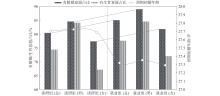
图 1
不同群体未来婚育意愿水平对比(按性别、研究生教育选择划分)"
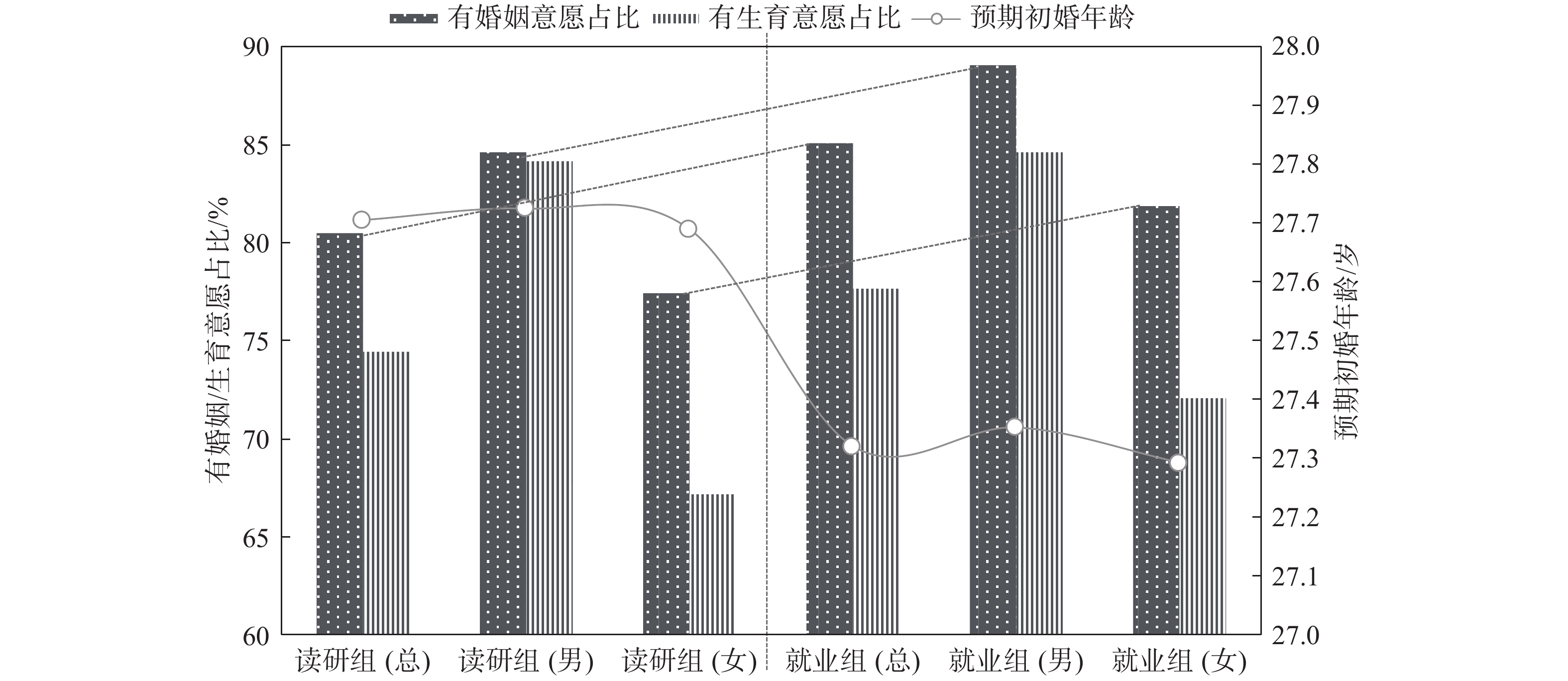
表 2
研究生教育选择对婚姻意愿和预期初婚年龄的影响效应估计"
| 变量 | 婚姻意愿 (二元logit回归) | 预期初婚年龄 (有序logit回归) |
| 读研 | −0.278*** | 0.452*** |
| (0.057) | (0.050) | |
| 家庭经济收入 (对数化) | −0.097*** | 0.028 |
| (0.031) | (0.028) | |
| 求职压力感知 | −0.190*** | 0.031 |
| (0.053) | (0.049) | |
| 女性 | −0.492*** | −0.107** |
| (0.062) | (0.054) | |
| 专业固定效应 | 控制 | 控制 |
| 常数项 | 2.544*** | — |
| (0.177) | — | |
| Pseudo R² | 0.018 | 0.007 |
| Chi-square | 156.70*** | 97.52*** |
| N |
表 3
研究生教育选择对生育意愿和预期生育子女数的影响效应估计"
| 变量 | 生育意愿 (二元logit回归) | 预期生育子女数 (泊松回归) |
| 读研 | −0.108** | −0.040*** |
| (0.051) | (0.015) | |
| 保留工资 (对数化) | −0.169*** | −0.010 |
| (0.047) | (0.014) | |
| 生育成本感知 | −0.636*** | −0.172*** |
| (0.059) | (0.014) | |
| 女性 | −0.811*** | −0.252*** |
| (0.058) | (0.016) | |
| 专业固定效应 | 控制 | 控制 |
| 常数项 | 3.177*** | 0.664*** |
| (0.184) | (0.044) | |
| Pseudo R² | 0.044 | 0.012 |
| Chi-square | 377.73*** | 480.87*** |
| N |
表 4
东部和中部地区样本的稳健性检验结果"
| 变量 | ⑴ 婚姻意愿 | ⑵ 预期初婚年龄 | ⑶ 生育意愿 | ⑷ 预期生育子女数 |
| 读研 | −0.332*** | 0.457*** | −0.115** | −0.045*** |
| (0.061) | (0.053) | (0.054) | (0.016) | |
| 控制变量 | 控制 | 控制 | 控制 | 控制 |
| 专业固定效应 | 控制 | 控制 | 控制 | 控制 |
| 常数项 | 2.567*** | — | 3.256*** | 0.661*** |
| (0.188) | — | (0.196) | (0.047) | |
| Pseudo R² | 0.022 | 0.007 | 0.046 | 0.012 |
| Chi-square | 167.77*** | 88.50*** | 345.41*** | 426.34*** |
| N |
表 5
PSM匹配的平衡性检验"
| 变量 | 样本 | 平均值 | 偏差 (%) | 偏差减幅(%) | t值 | p>|t| | |
| 处理组 | 对照组 | ||||||
| 女性 | 匹配前 | 0.573 | 0.555 | 3.6 | 1.73* | 0.084 | |
| 匹配后 | 0.573 | 0.570 | 0.6 | 82.2 | 0.28 | 0.776 | |
| 家庭经济收入 (对数化) | 匹配前 | 2.516 | 2.175 | 37.1 | 17.77*** | 0.000 | |
| 匹配后 | 2.516 | 2.489 | 2.9 | 92.2 | 1.27 | 0.203 | |
| 求职压力感知 | 匹配前 | 2.602 | 2.519 | 15.5 | 7.36*** | 0.000 | |
| 匹配后 | 2.602 | 2.599 | 0.6 | 96.0 | 0.28 | 0.779 | |
| 专业门类:社科类 | 匹配前 | 0.344 | 0.368 | −5.1 | −2.42** | 0.015 | |
| 匹配后 | 0.344 | 0.340 | 0.7 | 85.5 | 0.33 | 0.743 | |
| 专业门类:理学类 | 匹配前 | 0.074 | 0.055 | 8.0 | 3.86*** | 0.000 | |
| 匹配后 | 0.074 | 0.071 | 1.3 | 84.3 | 0.53 | 0.598 | |
| 专业门类:工学类 | 匹配前 | 0.448 | 0.417 | 6.1 | 2.92*** | 0.003 | |
| 匹配后 | 0.448 | 0.455 | −1.5 | 75.6 | −0.66 | 0.511 | |
表 6
研究生教育选择对未来婚育意愿的影响:PSM估计结果"
| ⑴婚姻意愿 | ⑵预期初婚年龄 | ⑶生育意愿 | ⑷预期生育子女数 | |||||
| 核匹配 | 半径匹配 | 核匹配 | 半径匹配 | 核匹配 | 半径匹配 | 核匹配 | 半径匹配 | |
| ATT | −0.038*** | −0.039*** | 0.119*** | 0.118*** | −0.016* | −0.015* | −0.039** | −0.037** |
| 标准误 | 0.008 | 0.008 | 0.013 | 0.013 | 0.009 | 0.009 | 0.017 | 0.017 |
| t值 | −4.63 | −4.72 | 8.90 | 8.90 | −1.68 | −1.64 | −2.26 | −2.16 |
| 匹配成功的样本数 | ||||||||
| 样本总数 | ||||||||
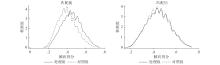
图 2
匹配前后处理组与对照组的倾向得分核密度"
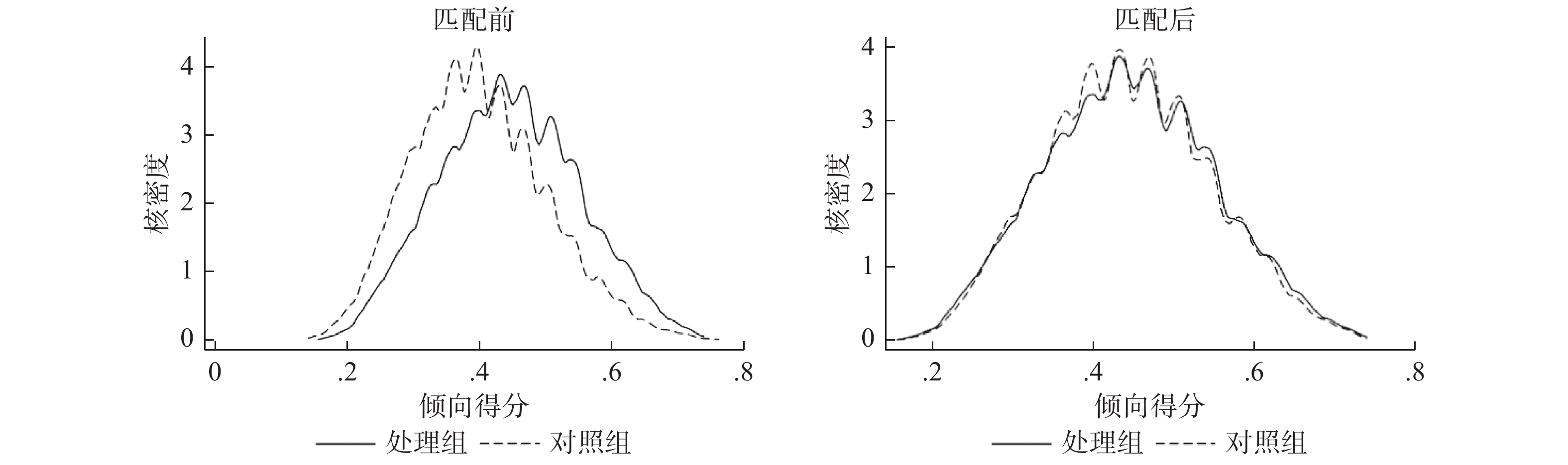
表 7
研究生教育选择对不同家庭经济收入背景大学生婚姻意愿的异质性影响"
| 变量 | ⑴婚姻意愿 | ⑵预期初婚年龄 | |||||
| 低收入家庭 | 中等收入家庭 | 高收入家庭 | 低收入家庭 | 中等收入家庭 | 高收入家庭 | ||
| 读研 | −0.293*** | −0.287*** | 0.018 | 0.433*** | 0.480*** | 0.199 | |
| (0.085) | (0.081) | (0.251) | (0.069) | (0.076) | (0.246) | ||
| 女性 | −0.582*** | −0.425*** | −0.321 | −0.196** | −0.047 | 0.351 | |
| (0.092) | (0.089) | (0.262) | (0.076) | (0.080) | (0.252) | ||
| 求职压力感知 | −0.093 | −0.334*** | 0.116 | 0.116* | −0.061 | −0.106 | |
| (0.075) | (0.079) | (0.224) | (0.067) | (0.070) | (0.220) | ||
| 专业固定效应 | 控制 | 控制 | 控制 | 控制 | 控制 | 控制 | |
| 常数项 | 2.294*** | 2.490*** | 1.269* | — | — | — | |
| (0.235) | (0.241) | (0.679) | — | — | — | ||
| Pseudo R² | 0.017 | 0.019 | 0.005 | 0.007 | 0.009 | 0.007 | |
| Chi-square | 68.04*** | 76.57*** | 2.01 | 56.39*** | 45.96*** | 3.54 | |
| N | 432 | 347 | |||||
表 8
研究生教育选择对不同职业收入预期大学生生育意愿的异质性影响"
| 变量 | ⑴生育意愿 | ⑵预期生育子女数 | |||||
| 低水平 保留工资 | 中等水平 保留工资 | 高水平 保留工资 | 低水平 保留工资 | 中等水平 保留工资 | 高水平 保留工资 | ||
| 读研 | −0.186** | −0.042 | −0.025 | −0.051** | −0.021 | −0.037 | |
| (0.075) | (0.092) | (0.111) | (0.022) | (0.027) | (0.033) | ||
| 女性 | −0.743*** | −0.874*** | −0.857*** | −0.221*** | −0.281*** | −0.285*** | |
| (0.086) | (0.106) | (0.117) | (0.022) | (0.029) | (0.039) | ||
| 生育成本感知 | −0.664*** | −0.563*** | −0.668*** | −0.196*** | −0.119*** | −0.181*** | |
| (0.082) | (0.111) | (0.134) | (0.019) | (0.026) | (0.031) | ||
| 专业固定效应 | 控制 | 控制 | 控制 | 控制 | 控制 | 控制 | |
| 常数项 | 3.457*** | 2.907*** | 3.202*** | 0.723*** | 0.488*** | 0.748*** | |
| (0.255) | (0.351) | (0.401) | (0.059) | (0.087) | (0.098) | ||
| Pseudo R² | 0.039 | 0.051 | 0.050 | 0.011 | 0.013 | 0.014 | |
| Chi-square | 164.71*** | 131.61*** | 94.77*** | 240.63*** | 152.91*** | 102.15*** | |
| N | 1958 | 1958 | |||||
表 9
研究生教育选择对不同性别大学生未来婚育意愿的异质性影响"
| 变量 | ⑴婚姻意愿 | ⑵预期初婚年龄 | ⑶生育意愿 | ⑷预期生育子女数 | |||||||
| 男性 | 女性 | 男性 | 女性 | 男性 | 女性 | 男性 | 女性 | ||||
| 读研 | −0.348*** | −0.238*** | 0.437*** | 0.468*** | 0.008 | −0.162** | −0.018 | −0.058** | |||
| (0.097) | (0.071) | (0.073) | (0.069) | (0.089) | (0.063) | (0.020) | (0.023) | ||||
| 家庭经济收入(对数化) | −0.097* | −0.096** | −0.039 | 0.085** | — | — | — | — | |||
| (0.052) | (0.038) | (0.042) | (0.038) | ||||||||
| 求职压力感知 | −0.225*** | −0.173** | 0.020 | 0.043 | — | — | — | — | |||
| (0.086) | (0.067) | (0.071) | (0.067) | ||||||||
| 保留工资 (对数化) | — | — | — | — | −0.133* | −0.196*** | 0.010 | −0.046* | |||
| (0.071) | (0.065) | (0.017) | (0.025) | ||||||||
| 生育成本感知 | — | — | — | — | −0.354*** | −0.804*** | −0.129*** | −0.223*** | |||
| (0.093) | (0.074) | (0.019) | (0.020) | ||||||||
| 专业固定效应 | 控制 | 控制 | 控制 | 控制 | 控制 | 控制 | 控制 | 控制 | |||
| 常数项 | 2.347*** | 2.062*** | — | — | 1.988*** | 2.920*** | 0.524*** | 0.542*** | |||
| (0.289) | (0.211) | — | — | (0.285) | (0.220) | (0.069) | (0.060) | ||||
| Pseudo R² | 0.014 | 0.007 | 0.007 | 0.009 | 0.013 | 0.026 | 0.003 | 0.006 | |||
| Chi-square | 45.04*** | 34.20*** | 45.94*** | 64.78*** | 44.12*** | 149.15*** | 57.15*** | 150.87*** | |||
| N | |||||||||||
表 10
研究生教育选择对大学生未来婚育意愿的影响效应一览表"
| 变量 | ⑴ 婚姻意愿 | ⑵ 预期初婚年龄 | ⑶ 生育意愿 | ⑷ 预期生育子女数 | |
| 研究生教育选择 | 总体 | − | + | − | − |
| 男 | − | + | × | × | |
| 女 | − | + | − | − | |
| 低收入家庭 | − | + | / | / | |
| 中等收入家庭 | − | + | / | / | |
| 高收入家庭 | × | × | / | / | |
| 低水平保留工资 | / | / | − | − | |
| 中等水平保留工资 | / | / | × | × | |
| 高水平保留工资 | / | / | × | × | |
| 鲍威. (2010). 未完成的转型——普及化阶段首都高等教育的人才培养与学生发展. 北京大学教育评论, 8 (1), 27- 43. | |
| 陈强. (2014). 高级计量经济学及stata应用. 北京: 高等教育出版社. | |
| 陈卫. (2021). 中国的低生育率与三孩政策——基于第七次全国人口普查数据的分析. 人口与经济, (5), 25- 35. | |
| 葛润, 黄家林. (2020). 大学扩招是否影响了结婚与生育?. 经济学报, 3 (3), 168- 201. | |
| 李长安, 李艳. (2024). 教育对生育意愿影响的性别差异及机制分析. 人口与经济, (3), 1- 18. | |
| 李春玲. (2023). 大学生就业选择的趋同与分化——理性选择与社会分化. 北京大学教育评论, 21 (03), 51- 68. | |
| 连玉君, 彭方平, 苏治. (2010). 融资约束与流动性管理行为. 金融研究, (10), 158- 171. | |
| 刘伯凡, 刘叶. (2018). 高等教育的婚姻效应: 推迟结婚还是选择不婚?——来自合成控制法的新证据. 上海财经大学学报, 20 (03), 93- 109. | |
| 孙俊华, 万洋. (2023). 规模扩张下的高等教育机会不平等测度——兼论高校扩招的教育代际流动效应. 教育与经济, 39 (3), 53- 63. | |
| 唐骏瑶. (2024). 高等教育是否降低了个体的生育水平——基于高校扩招的准实验研究. 教育学报, 20 (06), 166- 179. | |
| 汪永涛. (2024). 新家庭主义与当代青年婚育行为研究. 思想战线, 50 (3), 62- 72. | |
| 王军, 李向梅. (2021). 中国三孩政策下的低生育形势、人口政策困境与出路. 青年探索, (4), 50- 61. | |
| 王磊. (2023). 高学历女青年的婚姻、生育与家庭结构研究——基于北京东城区人口普查数据(2010-2020)的比较分析. 扬州大学学报(人文社会科学版), 27 (05), 93- 107. | |
| 王志华, 李夏培, 樊增增. (2024). 收入差距与生育意愿: 促进还是抑制? 人口与发展, 30(06), 13—26. | |
| 巫锡炜, 曹增栋, 武翰涛. (2022). 高等教育扩张与小家庭崛起——来自大学扩招政策的证据. 社会学研究, 37 (03), 92- 114. | |
| 杨菊华. (2019). 生育支持与生育支持政策: 基本意涵与未来取向. 山东社会科学, (10), 98- 107. | |
| 叶华, 吴晓刚. (2011). 生育率下降与中国男女教育的平等化趋势. 社会学研究, (5), 153- 177. | |
| 于欣晔, 冯永琦. (2023). 家庭负债、生育成本与二孩生育决策. 人口学刊, 45 (05), 31- 42. | |
| 育娲人口研究团队. (2024). 中国生育成本报告2024版. 取自: https://news.qq.com/rain/a/20241121A00LN500. | |
| 岳昌君, 冯沁雪, 辛晓佳, 邱文琪. (2023). 中国高校毕业生就业趋势研究报告: 来自2003-2021年调查数据. 华东师范大学学报(教育科学版), 43 (9), 138- 154. | |
| 张银锋, 侯佳伟. (2016). 当前中国高等教育人口现状及发展趋势分析. 中国青年研究, (02), 52- 59. | |
| 张现苓, 盛亦男. (2023). 1990-2020年中国的婚育推迟: 变化趋势与典型特征. 人口研究, 47 (5), 88- 101. | |
| 中共中央国务院. (2021). 中共中央国务院关于优化生育政策促进人口长期均衡发展的决定. 取自: http://www.gov.cn/zhengce/2021-07/20/content_5626727.htm. | |
| 周晓蒙, 裴星童. (2022). 高等教育对女性生育水平的影响机制研究. 人口与发展, 28 (06), 46- 58. | |
| Arnett, J. J. (2000). Emerging adulthood: A theory of development from the late teens through the twenties. American Psychologist, 55 (5), 469. | |
| Axinn, W. G., & Thornton, A. (1992). The influence of parental resources on the timing of the transition to marriage. Social Science Research, 21 (3), 261- 285. | |
| Becker, G. S. (1991). A treatise on the family. Cambridge: Harvard University Press. | |
| Becker, G. S., & Lewis, H. G. (1973). On the interaction between the quantity and quality of children. Journal of Political Economy, 81 (2), S279- S288. | |
| Becker, G. S., Murphy, K. M., & Tamura, R. (1990). Human capital, fertility, and economic growth. Journal of Political Economy, 98 (5), S12- S37. | |
| Black, S. E., Devereux, P. J., & Salvanes, K. G. (2008). Staying in the classroom and out of the maternity ward? The effect of compulsory schooling laws on teenage births. The Economic Journal, 118 (530), 1025- 1054. | |
| Bloom, D. E., & Bennett, N. G. (1990). Modeling American marriage patterns. Journal of the American Statistical Association, 85 (412), 1009- 1017. | |
| Brady, S., Miller, J. B., et al. (2019). Retiring and caregiving in the age of student loans: The impact of student debt on retirement and longevity planning. Innovation in Aging, 3 (S1), 42. | |
| Choi, S. (2018). Fewer mothers with more colleges? The impacts of expansion in higher education on first marriage and first childbirth. Demographic Research, 39, 593- 634. | |
| Dhami, M. V., Ogbo, F. A., Diallo, T. M. O., et al. (2021). Infant and young child feeding practices among adolescent mothers and associated factors in India. Nutrients, 13 (7), 2376. | |
| Goldscheider, F., Bernhardt, E., & Lappegård, T. (2014). The gender revolution: A framework for understanding changing family and demographic behavior. Population and Development Review, 40 (1), 105- 130. | |
| Gottard, A., Mattei, A., & Vignoli, D. (2015). The relationship between education and fertility in the presence of a time varying frailty component. Journal of the Royal Statistical Society, 178 (4), 863- 881. | |
| Goyal, B., & Jain, C. (2022). Post COVID-19 effect on the working ability of women with reference to Indore City. Central European Management Journal, 30 (4), 982- 989. | |
| Hall, D. B. (2000). Zero‐inflated Poisson and binomial regression with random effects: a case study. Biometrics, 56 (4), 1030- 1039. | |
| Harvard Medical School. (2018). Housing for Married Students or Students with Children. Retrieved from https://medstudenthandbook.hms.harvard.edu/805-housing-married-students-or-students-children. | |
| Hoem, J. M. (1986). The impact of education on modern family-union initiation. European Journal of Population, 2 (2), 113- 133. | |
| Karney, B. R. (2021). Socioeconomic status and intimate relationships. Annual Review of Psychology, 72 (1), 391- 414. | |
| Kasarda, J. D. (1971). Economic structure and fertility: A comparative analysis. Demography, 8 (3), 307- 317. | |
| Kallio, R. E. (1993). The college choice decision of graduate students (Doctoral dissertation, University of Michigan). Retrieved from https://deepblue.lib.umich.edu/handle/2027.42/129129. | |
| Kravdal, Ø., & Rindfuss, R. R. (2008). Changing relationships between education and fertility: A study of women and men born 1940 to 1964. American Sociological Review, 73 (5), 854- 873. | |
| Lakomý, M. (2017). The role of values and of socioeconomic status in the education-fertility link among men and women. Vienna Yearbook of Population Research, 15, 121- 141. | |
| Lundberg, S., Pollak, R. A., & Stearns, J. (2016). Family inequality: Diverging patterns in marriage, cohabitation, and childbearing. Journal of Economic Perspectives, 30 (2), 79- 102. | |
| Lundborg, P., Plug, E., & Rasmussen, A. W. (2017). Can women have children and a career? IV evidence from IVF treatments. The American Economic Review, 107 (6), 1611- 1637. | |
| Mortensen, D. T. (2003). Wage dispersion: Why are similar workers paid differently? Journal of Economic Perspectives, 17(1), 163—180. | |
| Neyer, G. , & Andersson, G. (2008). Consequences of family policies on childbearing behavior: Effects or artifacts? Population and Development Review, 34(4), 699—724. | |
| Oppenheimer, V. K. (1988). Women's employment and the gain to marriage: The specialization and trading model. American Journal of Sociology, 94 (3), 431- 453. | |
| Oppenheimer, V. K. (1994). Women’s rising employment and the future of the family in industrial societies. Population and Development Review, 20 (2), 293- 342. | |
| Oreopoulos, P., & Salvanes, K. G. (2011). Priceless: The nonpecuniary benefits of schooling. Journal of Economic Perspectives, 25 (1), 159- 184. | |
| QAA. (2020). Characteristics statement-masters degrees. Retrieved from https://www.qaa.ac.uk/en/the-quality-code/characteristics-statements/characteristics-statement-masters-degrees. | |
| Rindfuss, R. R., Morgan, S. P., & Offutt, K. (1996). Education and the changing age pattern of American fertility: 1963–1989. Demography, 33 (3), 277- 290. | |
| Sohn, H., & Lee, S. W. (2019). Causal impact of having a college degree on women’s fertility: Evidence from regression kink designs. Demography, 56, 969- 990. | |
| Spandorfer, S. D., Avrech, O. M., Colombero, L. T., et al. (1998). Effect of parental age on fertilization and pregnancy characteristics in couples treated by intracytoplasmic sperm injection. Human Reproduction, 13 (2), 334- 338. | |
| Stivers, A., & Berman, E. P. (2020). Parents, partners, plans and promises: The relational work of student loan borrowing. Socius: Sociological Research for a Dynamic World, 6, 1- 13. | |
| Thornton, A., Axinn, W. G., & Teachman, J. D. (1995). The influence of school enrollment and accumulation on cohabitation and marriage in early adulthood. American Sociological Review, 60 (5), 762- 774. | |
| University of California, Berkeley. (2025). Family Student Housing and Financial Support Policies. Retrieved from https://housing.berkeley.edu/family-housing. | |
| Van Bavel, J. (2012). The reversal of gender inequality in education, union formation and fertility in Europe. Vienna Yearbook of Population Research, 10, 127- 154. | |
| Woo, H. B. (2009). The impact of educational attainment on first marriage formation: Marriage delayed or marriage forgone? Korea Journal of Population Studies, 32(1), 25—50. |
| [1] | 陈祥梅, 宁本涛. “双减”政策影响家长再生育意愿吗?——基于全国29个省份的调查[J]. 华东师范大学学报(教育科学版), 2024, 42(6): 75-85. |
| [2] | 鲍威, 陈得春, 佟琳楠. 美德是否可教?高等教育对学生道德认知发展的影响研究[J]. 华东师范大学学报(教育科学版), 2023, 41(4): 56-71. |
| [3] | 熊猛,叶一舵. 心理资本:理论、测量、影响因素及作用*[J]. 华东师范大学学报(教育科学版), 2014, 32(3): 84-92. |
| 阅读次数 | ||||||
|
全文 |
|
|||||
|
摘要 |
|
|||||
