
 中国人文社会科学核心期刊
华东师范大学学报(教育科学版) ›› 2026, Vol. 44 ›› Issue (2): 112-126.doi: 10.16382/j.cnki.1000-5560.2026.02.007
• 基础教育 • 上一篇
姜怡, 陈书雨, 施昕奕
出版日期:2026-02-01
发布日期:2026-01-26
Yi Jiang, Shuyu Chen, Xinyi Shi
Online:2026-02-01
Published:2026-01-26
摘要:
近年来义务教育改革不断深入,但学生学习动力不足的现象仍普遍存在并且有低龄化倾向,依旧是教育领域面临的重大挑战。为有效提升学生的智育水平,首先需深入了解学生学习动机的特性及发展规律。本研究基于情境期望价值理论,通过潜在转变分析探索了小学生学习动机的潜在类别转变及性别、家庭经济状况和父母养育方式对类别转变的影响。通过三轮共一年期的追踪调查,本研究发现小学生的学习能力信念、价值和成本认知能够形成动机平均组、适应良好组、适应不良组和高成本组四种典型的动机类别。各类别在一年内总体保持稳定,但不同类别之间也存在相互转变轨迹。在影响因素上,本研究结果显示女生在学习动机上的转变方向更积极,而家庭经济状况对学生的动机转变没有显著影响。此外,父母的自主支持对动机转变具有积极影响,而父母的心理控制则会对转变产生消极影响。这些发现为深入理解我国小学生的学习动机模式及其发展趋势提供了科学依据。
姜怡, 陈书雨, 施昕奕. 小学生学习动机的群体差异及发展演变:一项潜在转变分析[J]. 华东师范大学学报(教育科学版), 2026, 44(2): 112-126.
Yi Jiang, Shuyu Chen, Xinyi Shi. Group Differences and Developmental Changes in Primary School Students' Learning Motivation: A Latent Transition Analysis[J]. Journal of East China Normal University(Educationa, 2026, 44(2): 112-126.
表 1
模型纵向测量等值性拟合指数"
| 模型 | RMSEA [90% CI] | CFI | TLI | SRMR | χ2 | df |
| 形态等值 | 0.037 [0.035, 0.038] | 0.896 | 0.886 | 0.052 | ||
| 弱等值 | 0.037 [0.035, 0.038] | 0.896 | 0.887 | 0.054 | ||
| 强等值 | 0.037 [0.036, 0.039] | 0.891 | 0.883 | 0.055 |
表 2
各时间点内变量的描述性统计及相关分析矩阵"
| 1 | 2 | 3 | 4 | 5 | 6 | 7 | 8 | 9 | |
| 1自我 效能感 | --- | ||||||||
| 2有用价值 | .63/.55/.60 | --- | |||||||
| 3成就价值 | .63/.60/.49 | .64/.55/.63 | --- | ||||||
| 4兴趣价值 | .51/.65/.59 | .40/.51/.48 | .47/.57/.39 | --- | |||||
| 5努力成本 | −.05/.02/−.16 | .09/.02/−.10 | .13/.15/.06 | −.11/−.08/−.25 | --- | ||||
| 6机会成本 | −.16/−.17/−.27 | −.09/−.19/−.26 | .01/.03/-.05 | −.22/−.19/−.31 | .32/.46/.51 | --- | |||
| 7自我成本 | −.14/−.22/−.29 | −.10/−.17/−.21 | .04/−.03/−.03 | −.28/−.33/−.35 | .29/.37/.42 | .42/.57/.63 | --- | ||
| 8情绪成本 | −.30/−.39/−.35 | −.25/−.32/−.33 | −.22/−.33/−.19 | −.55/−.60/−.55 | .30/.31/.43 | .40/.45/.61 | .49/.56/.68 | --- | |
| 9父母自主 支持 | .46/.47/.44 | .33/.40/.48 | .31/.34/.39 | .48/.43/.46 | −.04/−.08/−.11 | −.20/−.26/−.24 | −.17/−.23/−.29 | −.38/−.35/−.36 | --- |
| 10父母 心理控制 | −.05/−.27/−.28 | −.07/−.28/−.25 | .04/−.18/−.14 | −.11/−.38/−.24 | .23/.26/.33 | .30/.43/.49 | .28/.38/.46 | .32/.48/.49 | −.09/−.40/−.35 |
| M | 4.82 /5.07 /5.29 | 5.04 /5.43 /5.52 | 5.01 /5.13 /5.27 | 4.67 /4.83 /5.01 | 3.72 /3.79 /3.49 | 2.47 /2.44 /2.38 | 2.93 /2.72 /2.70 | 2.32 /2.23 /2.11 | 5.13 /5.29 /5.32 |
| SD | 0.96 /0.89 /0.82 | 0.96 /0.78 /0.72 | 0.92 /0.88 /0.81 | 1.28 /1.21 /1.27 | 1.23 /1.30 /1.44 | 1.32 /1.57 /1.55 | 1.45 /1.65 /1.63 | 1.31 /1.42 /1.39 | 1.08 /0.98 /0.97 |
表 3
三个时间点潜在剖面模型的拟合指标"
| 时间点 | 类别数 | LL | AIC | BIC | aBIC | Entropy | VLMR | 最小组人数 |
| T1 | 2 | − | .88 | .02 | 185 | |||
| 3 | − | .90 | .36 | 55 | ||||
| 4 | − | .89 | .68 | 53 | ||||
| 5 | − | .91 | .48 | 15 | ||||
| T2 | 2 | − | .92 | .06 | 126 | |||
| 3 | − | .90 | .27 | 81 | ||||
| 4 | − | .90 | .46 | 48 | ||||
| 5 | − | .92 | .24 | 27 | ||||
| T3 | 2 | − | .90 | .09 | 157 | |||
| 3 | − | .92 | .59 | 43 | ||||
| 4 | − | .92 | .25 | 32 | ||||
| 5 | − | .94 | .04 | 2 |
表 4
动机信念在3个时间点的潜在剖面的分类准确概率"
| 时间点 | 潜在类别 | 平均归属各类的概率 | |||
| 第1类 | 第2类 | 第3类 | 第4类 | ||
| T1 | 第1类 | 0.98 | 0.00 | 0.00 | 0.02 |
| 第2类 | 0.00 | 0.93 | 0.02 | 0.05 | |
| 第3类 | 0.00 | 0.01 | 0.96 | 0.03 | |
| 第4类 | 0.01 | 0.03 | 0.07 | 0.90 | |
| T2 | 第1类 | 0.96 | 0.00 | 0.03 | 0.00 |
| 第2类 | 0.00 | 0.96 | 0.04 | 0.01 | |
| 第3类 | 0.01 | 0.03 | 0.91 | 0.06 | |
| 第4类 | 0.00 | 0.01 | 0.04 | 0.96 | |
| T3 | 第1类 | 0.98 | 0.01 | 0.00 | 0.00 |
| 第2类 | 0.00 | 0.93 | 0.05 | 0.02 | |
| 第3类 | 0.00 | 0.04 | 0.96 | 0.00 | |
| 第4类 | 0.00 | 0.03 | 0.00 | 0.97 | |
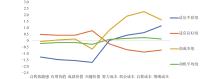
图 1
潜在转变分析动机类别"
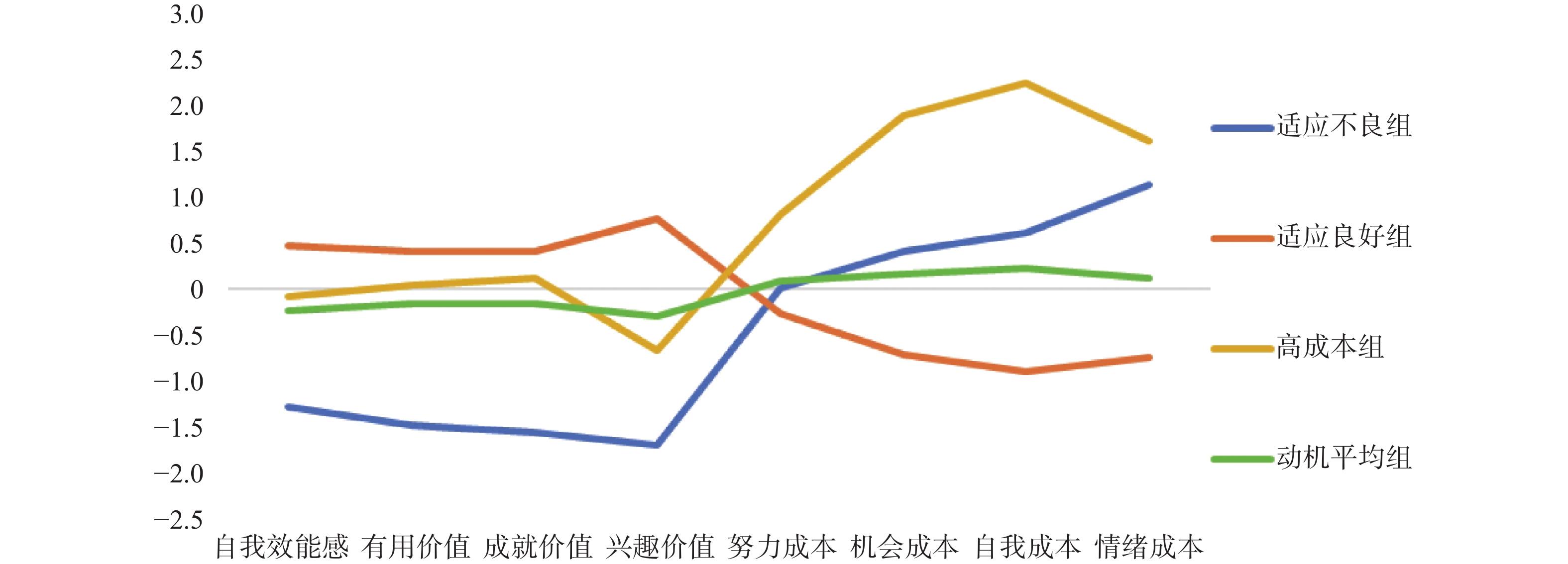
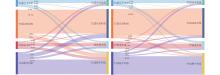
图 2
三个时间点转移路径与两阶段各聚类转变人数占总体人数比例"
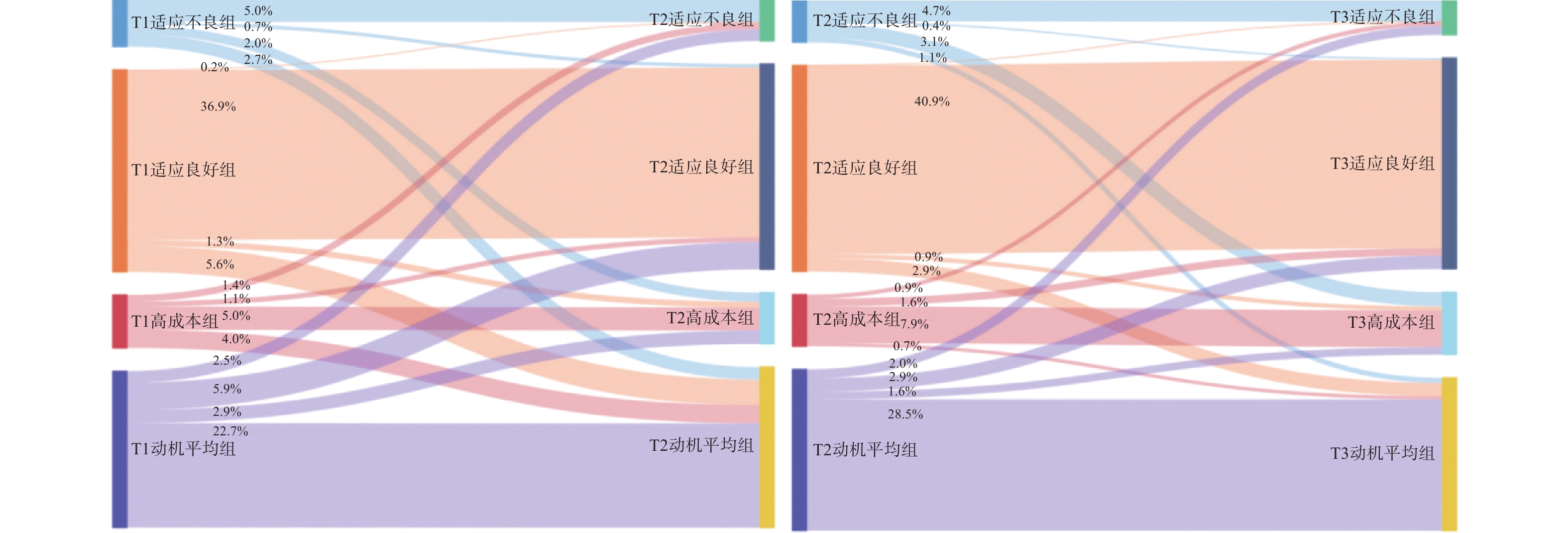
表 5
T1-T3动机类别的潜在转变概率"
| 适应不良组 | 适应良好组 | 高成本组 | 动机平均组 | |
| T1到T2转变概率 | ||||
| 适应不良组 | 0.47 | 0.08 | 0.20 | 0.26 |
| 适应良好组 | 0.01 | 0.83 | 0.03 | 0.13 |
| 高成本组 | 0.13 | 0.09 | 0.45 | 0.32 |
| 动机平均组 | 0.07 | 0.18 | 0.09 | 0.66 |
| T2到T3转变概率 | ||||
| 适应不良组 | 0.51 | 0.04 | 0.33 | 0.12 |
| 适应良好组 | 0.00 | 0.91 | 0.02 | 0.07 |
| 高成本组 | 0.08 | 0.14 | 0.71 | 0.08 |
| 动机平均组 | 0.06 | 0.09 | 0.06 | 0.80 |
表 6
协变量影响下动机类别转变概率的发生比"
| 潜在类别 | 影响因素 | 适应不良组 | 适应良好组 | 高成本组 | 动机平均组 | |||||||
| OR | 95%CI | OR | 95%CI | OR | 95%CI | OR | 95%CI | |||||
| T1到T2 | ||||||||||||
| 适应不良组 | 性别 | -- | -- | 2.50 | [1.12, 5.54] | 1.98 | [0.82, 4.81] | 2.30 | [1.08, 4.91] | |||
| 家庭经济状况 | -- | -- | 0.98 | [0.38, 2.53] | 0.97 | [0.31, 3.08] | 0.80 | [0.33, 1.95] | ||||
| 父母自主支持 | -- | -- | 5.55 | [3.28, 9.41] | 1.48 | [0.97, 2.25] | 1.79 | [1.27, 2.51] | ||||
| 父母心理控制 | -- | -- | 0.52 | [0.36, 0.75] | 1.51 | [0.99, 2.30] | 0.86 | [0.62, 1.21] | ||||
| 适应良好组 | 性别 | 0.40 | [0.18, 0.89] | -- | -- | 0.79 | [0.39, 1.61] | 0.92 | [0.57, 1.50] | |||
| 家庭经济状况 | 1.02 | [0.40, 2.64] | -- | -- | 0.99 | [0.36, 2.73] | 0.81 | [0.43, 1.56] | ||||
| 父母自主支持 | 0.18 | [0.11, 0.31] | -- | -- | 0.27 | [0.16, 0.45] | 0.32 | [0.21, 0.51] | ||||
| 父母心理控制 | 1.93 | [1.34, 2.78] | -- | -- | 2.92 | [2.05, 4.17] | 1.67 | [1.33, 2.10] | ||||
| 高成本组 | 性别 | 0.51 | [0.21, 1.23] | 1.26 | [0.62, 2.56] | -- | -- | 1.16 | [0.60, 2.26] | |||
| 家庭经济状况 | 1.03 | [0.32, 3.27] | 1.01 | [0.37, 2.77] | -- | -- | 0.82 | [0.31, 2.18] | ||||
| 父母自主支持 | 0.68 | [0.44, 1.03] | 3.76 | [2.21, 6.40] | -- | -- | 1.21 | [0.84, 1.75] | ||||
| 父母心理控制 | 0.66 | [0.43, 1.01] | 0.34 | [0.24, 0.49] | -- | -- | 0.57 | [0.41, 0.80] | ||||
| 动机平均组 | 性别 | 0.43 | [0.20, 0.93] | 1.08 | [0.67, 1.77] | 0.86 | [0.44, 1.68] | -- | -- | |||
| 家庭经济状况 | 1.25 | [0.51, 3.06] | 1.23 | [0.64, 2.35] | 1.22 | [0.46, 3.23] | -- | -- | ||||
| 父母自主支持 | 0.56 | [0.40, 0.79] | 3.11 | [1.98, 4.89] | 0.83 | [0.57, 1.20] | -- | -- | ||||
| 父母心理控制 | 1.16 | [0.83, 1.62] | 0.60 | [0.48, 0.76] | 1.75 | [1.25, 2.45] | -- | -- | ||||
| T2到T3 | ||||||||||||
| 适应不良组 | 性别 | -- | -- | 2.29 | [1.05, 5.02] | 1.27 | [0.53, 3.02] | 2.13 | [0.99, 4.59] | |||
| 家庭经济状况 | -- | -- | 0.90 | [0.35, 2.35] | 0.76 | [0.28, 2.05] | 0.61 | [0.25, 1.51] | ||||
| 父母自主支持 | -- | -- | 3.97 | [2.43, 6.49] | 1.23 | [0.85, 1.79] | 1.58 | [1.14, 2.19] | ||||
| 父母心理控制 | -- | -- | 0.51 | [0.37, 0.70] | 1.14 | [0.81, 1.62] | 0.75 | [0.56, 1.00] | ||||
| 适应良好组 | 性别 | 0.44 | [0.20, 0.96] | -- | -- | 0.55 | [0.29, 1.06] | 0.93 | [0.58, 1.49] | |||
| 家庭经济状况 | 1.11 | [0.43, 2.90] | -- | -- | 0.85 | [0.35, 2.08] | 0.68 | [0.35, 1.34] | ||||
| 父母自主支持 | 0.25 | [0.15, 0.41] | -- | -- | 0.31 | [0.19, 0.50] | 0.40 | [0.26, 0.61] | ||||
| 父母心理控制 | 1.98 | [1.43, 2.73] | -- | -- | 2.26 | [1.66, 3.07] | 1.48 | [1.18, 1.85] | ||||
| 高成本组 | 性别 | 0.79 | [0.33, 1.87] | 1.81 | [0.95, 3.44] | -- | -- | 1.68 | [0.89, 3.16] | |||
| 家庭经济状况 | 1.31 | [0.49, 3.52] | 1.18 | [0.48, 2.90] | -- | -- | 0.81 | [0.35, 1.88] | ||||
| 父母自主支持 | 0.81 | [0.56, 1.18] | 3.22 | [2.01, 5.16] | -- | -- | 1.28 | [0.93, 1.78] | ||||
| 父母心理控制 | 0.88 | [0.62, 1.24] | 0.44 | [0.33, 0.60] | -- | -- | 0.66 | [0.49, 0.87] | ||||
| 动机平均组 | 性别 | 0.47 | [0.22, 1.01] | 1.08 | [0.67, 1.72] | 0.60 | [0.32, 1.12] | -- | -- | |||
| 家庭经济状况 | 1.63 | [0.66, 4.00] | 1.47 | [0.75, 2.88] | 1.24 | [0.53, 2.90] | -- | -- | ||||
| 父母自主支持 | 0.63 | [0.46, 0.88] | 2.51 | [1.65, 3.83] | 0.78 | [0.56, 1.08] | -- | -- | ||||
| 父母心理控制 | 1.34 | [1.00, 1.80] | 0.68 | [0.54, 0.85] | 1.53 | [1.14, 2.04] | -- | -- | ||||
| 陈友华, 苗国. (2021). 升学锦标赛、教育内卷化与学区分层. 江苏行政学院学报, (03), 55- 63. | |
| 司继伟, 郭凯玥, 赵晓萌, 张明亮, 李红霞, 黄碧娟, 徐艳丽. (2022). 小学儿童数学焦虑的潜在类别转变及其父母教育卷入效应: 3年纵向考察. 心理学报, 54 (04), 355- 370. | |
| 王碧瑶, 张敏强, 张洁婷, 胡俊. (2015). 基于转变矩阵描述的个体阶段性发展: 潜在转变模型. 心理研究, 8 (04), 36- 43. | |
| 温忠麟, 谢晋艳, 王惠惠. (2023). 潜在类别模型的原理、步骤及程序. 华东师范大学学报(教育科学版), 41 (01), 1- 15. | |
| 徐明津, 杨新国. (2017). 家庭经济困难对青少年不良适应的影响: 父母支持与心理韧性的链式中介效应. 中国特殊教育, (02), 72- 77. | |
| 杨德广. (2023). 关于“双减”的重要性、成效及问题、对策——从义务教育阶段的“内卷”谈起. 上海师范大学学报(哲学社会科学版), 52 (03), 108- 115. | |
| 臧宏运, 郑德伟, 郎芳, 刘军, 张增国, 朱丽娜. (2018). 有留守经历大学生自我效能感自尊在领悟社会支持和心理健康间的中介作用. 中国学校卫生, 39 (09), 1332- 1335. | |
| 周浩, 龙立荣. (2004). 共同方法偏差的统计检验与控制方法. 心理科学进展, (06), 942- 950. | |
| 周丽华, 张晓贤. (2023). 小学生学习动机的潜在类型: 基于潜在剖面分析. 心理研究, (03), 280- 288. | |
| Asparouhov, T. , & Muthén, B. (2021). Auxiliary variables in mixture modeling: Using the BCH method in Mplus to estimate a distal outcome model and an arbitrary secondary model. Mplus Web Notes: 21, Version 11. | |
| Bandura, A. (1993). Perceived self-efficacy in cognitive development and functioning. Educational Psychologist, 28 (2), 117- 148. | |
| Barber, B. K. (1996). Parental psychological control: Revisiting a neglected construct. Child Development, 67 (6), 3296- 3319. | |
| Brislin, R. W. (1970). Back-translation for cross-cultural research. Journal of Cross-Cultural Psychology, 1 (3), 185- 216. | |
| Butler, Y., & Le, V. (2017). A longitudinal investigation of parental social-economic status (SES) and young students’ learning of English as a foreign language. System, 73, 1- 12. | |
| Chen, F. F. (2007). Sensitivity of goodness of fit indexes to lack of measurement invariance. Structural Equation Modeling: A Multidisciplinary Journal, 14 (3), 464- 504. | |
| Cheung, G. W., & Rensvold, R. B. (2002). Evaluating goodness-of-fit indexes for testing measurement invariance. Structural Equation Modeling: A Multidisciplinary Journal, 9 (2), 233- 255. | |
| Cooper, K. S. (2014). Eliciting engagement in the high school classroom: A mixed-methods examination of teaching practices. American Educational Research Journal, 51 (2), 363- 402. | |
| Crede, J. , Wirthwein, L. , McElvany, N. , & Steinmayr, R. (2015). Adolescents’ academic achievement and life satisfaction: The role of parents’ education. Frontiers in Psychology, 6, Article 52. | |
| Eccles, J. S. , Adler, T. F. , Futterman, R. , Goff, S. B. , Kaczala, C. M. , Meece, J. L. , et al. (1983). Expectancies, values and academic behaviors. In J. T. Spence (Ed. ), Achievement and achievement motives (pp. 75–146). Freeman. | |
| Eccles, J. S., Midgley, C., Wigfield, A., Buchanan, C. M., Reuman, D., Flanagan, C., et al. (1993). Development during adolescence: The impact of stage-environment fit on young adolescents’ experiences in schools and in families. The American Psychologist, 48 (2), 90- 101. | |
| Eccles, J. S., & Wigfield, A. (2020). From expectancy-value theory to situated expectancy-value theory: A developmental, social cognitive, and sociocultural perspective on motivation. Contemporary Educational Psychology, 61, 101859. | |
| Flake, J. K., Barron, K. E., Hulleman, C., McCoach, B. D., & Welsh, M. E. (2015). Measuring cost: The forgotten component of expectancy-value theory. Contemporary Educational Psychology, 41, 232- 244. | |
| Gaspard, H., Wille, E., Wormington, S. V., & Hulleman, C. S. (2019). How are upper secondary school students’ expectancy-value profiles associated with achievement and university STEM major? A cross-domain comparison. Contemporary Educational Psychology, 58, 149- 162. | |
| Grolnick, W. S., & Pomerantz, E. M. (2009). Issues and challenges in studying parental control: Toward a new conceptualization. Child Development Perspectives, 3 (3), 165- 170. | |
| Hsieh, T. Y., Simpkins, S. D., & Eccles, J. S. (2021). Gender by racial/ethnic intersectionality in the patterns of adolescents’ math motivation and their math achievement and engagement. Contemporary Educational Psychology, 66, 101974. | |
| Jiang, Y., Kim, S., & Bong, M. (2020). The role of cost in adolescent students’ maladaptive academic outcomes. Journal of School Psychology, 83, 1- 24. | |
| Jiang, Y., Rosenzweig, E. Q., & Gaspard, H. (2018). An expectancy-value-cost approach in predicting adolescent students’ academic motivation and achievement. Contemporary Educational Psychology, 54, 139- 152. | |
| Jiang, Y., & Zhang, L. (2023). High school students’ expectancy, value, and cost profiles and their relations with engagement and achievement in Math and English. Learning and Individual Differences, 101, 102252. | |
| Jung, T., & Wickrama, A. S. (2008). An introduction to latent class growth analysis and growth mixture modeling. Social and Personality Psychology Compass, 2 (1), 302- 317. | |
| Lam, S. F., Jimerson, S., Kikas, E., Cefai, C., Veiga, F. H., Nelson, B., Hatzichristou, C., Polychroni, F., Basnett, J., Duck, R., Farrell, P., Liu, Y., Negovan, V., Shin, H., Stanculescu, E., Wong, B. P., Yang, H., & Zollneritsch, J. (2012). Do girls and boys perceive themselves as equally engaged in school? The results of an international study from 12 countries. Journal of School Psychology, 50 (1), 77- 94. | |
| Lamote, C., Speybroeck, S., Van den Noortgate, W., & Van Damme, J. (2013). Different pathways towards dropout: The role of engagement in early school leaving. Oxford Review of Education, 39, 739- 760. | |
| Lee, S. Y., Friedman, S., Christiaans, E., & Robinson, K. A. (2022). Valuable but costly? University students’ expectancy-value-cost profiles in introductory chemistry courses. Contemporary Educational Psychology, 69, 102056. | |
| Lerner, R. M. (2002). Concepts and theories of human development (3rd ed). London: Lawrence Erlbaum Associates. | |
| Lerner, R. E., Grolnick, W. S., Caruso, A. J., & Levitt, M. R. (2022). Parental involvement and children’s academics: The roles of autonomy support and parents’ motivation for involvement. Contemporary Educational Psychology, 68, 1- 23. | |
| Lubke, G. H., & Muthén, B. (2005). Investigating population heterogeneity with factor mixture models. Psychological Methods, 10 (1), 21- 39. | |
| Nadon, L. , Morin, A. J. , Olivier, E. , Archambault, I. , Smodis McCune, V. , & Tóth‐Király, I. (2023). A longitudinal person-centered representation of elementary students’ motivation: Do perceptions of parent and teacher achievement goals matter? Journal of school psychology, 100, 101228. | |
| Oppermann, E., Vinni-Laakso, J., Juuti, K., Loukomies, A., & Salmela‐Aro, K. (2021). Elementary school students’ motivational profiles across Finnish language, mathematics and science: Longitudinal trajectories, gender differences and STEM aspirations. Contemporary Educational Psychology, 64, 101927. | |
| Organization for Economic Co-operation and Development (OECD). (2012). PISA 2009 technical report. Retrieved from OECD iLibrary. | |
| Pintrich, P. R. , Smith, D. , García, T. , & McKeachie, W. J. (1991). A manual for the use of the Motivated Strategies for Learning Questionnaire (MSLQ). University of Michigan. | |
| Pinquart, M. (2016). Associations of parenting styles and dimensions with academic achievement in children and adolescents: A meta-analysis. Educational Psychology Review, 28 (3), 475- 493. | |
| Raufelder, D., Hoferichter, F., Hirvonen, R., & Kiuru, N. (2022). How students’ motivational profiles change during the transition from primary to lower secondary school. Contemporary Educational Psychology, 71, 102117. | |
| Ryan, R. M. , & Deci, E. L. (2017). Self-determination theory: Basic psychological needs in motivation, development, and wellness. The Guilford Press. | |
| Ryan, R. M. , Deci, E. L. , Grolnick, W. S. , & La Guardia, J. G. (2006). The significance of autonomy and autonomy support in psychological development and psychopathology. In D. Cicchetti & D. J. Cohen (Eds. ), Developmental psychopathology: Theory and method (2nd ed. , pp. 795–849). John Wiley & Sons, Inc. | |
| Sanders, M. R. , & Turner, K. M. T. (2018). The Importance of Parenting in Influencing the Lives of Children. In: Sanders, M. , Morawska, A. (eds) Handbook of Parenting and Child Development Across the Lifespan. Springer, Cham. | |
| Schafer, J. L., & Graham, J. W. (2002). Missing data: Our view of the state of the art. Psychological Methods, 7 (2), 147- 177. | |
| Shek, D. T. L. (2008). Perceived parental control in Chinese adolescents in Hong Kong: A three-year longitudinal study. Open Family Studies Journal, 1 (1), 7- 16. | |
| Simpkins, S. D., Fredricks, J. A., & Eccles, J. S. (2015). The role of parents in the ontogeny of achievement-related motivation and behavioral choices: IV. Child factors and parent belief models. Monographs of the Society for Research in Child Development, 80 (2), 65- 84. | |
| Skinner, E., Johnson, S., & Snyder, T. (2005). Six Dimensions of Parenting: A Motivational Model. Parenting: Science and Practice, 5 (2), 175- 235. | |
| Skinner, O. D. , McHale, S. M. (2022). Family Gender Socialization in Childhood and Adolescence. In: VanderLaan, D. P. , Wong, W. I. (eds) Gender and Sexuality Development. Focus on Sexuality Research. Springer, Cham. | |
| Soenens, B., & Vansteenkiste, M. (2010). A theoretical upgrade of the concept of parental psychological control: Proposing new insights on the basis of self-determination theory. Developmental Review, 30 (1), 74- 99. | |
| Sorgente, A. , Lanz, M. , Serido, J. , Tagliabue, S. , & Shim, S. (2019). Latent transition analysis: Guidelines and an application to emerging adults’ social development. TPM-Testing, Psychometrics, Methodology in Applied Psychology, 26(1), 39—72. | |
| Spurk, D., Hirschi, A., Wang, M., Valero, D., & Kauffeld, S. (2020). Latent profile analysis: A review and “how to” guide of its application within vocational behavior research. Journal of Vocational Behavior, 120, 103445. | |
| Tuominen-Soini, H., Salmela-Aro, K., & Niemivirta, M. (2012). Achievement goal orientations and academic well-being across the transition to upper secondary education. Learning and Individual Differences, 22 (3), 290- 305. | |
| Vasquez, A. C., Patall, E. A., Fong, C. J. et al. (2016). Parent Autonomy Support, Academic Achievement, and Psychosocial Functioning: a Meta-analysis of Research. Educational Psychology Review, 28, 605- 644. | |
| Viljaranta, J., Aunola, K., & Hirvonen, R. (2016). Motivation and academic performance among first-graders: A person-oriented approach. Learning and Individual Differences, 49, 366- 372. | |
| Vinni-Laakso, J. , Upadyaya, K. , & Salmela-Aro, K. (2022). Associations between adolescent students’ multiple domain task value-cost profiles and STEM aspirations. Frontiers in Psychology, 13. | |
| Watt, H. M. G., Bucich, M., & Dacosta, L. (2019). Adolescents’ Motivational Profiles in Mathematics and Science: Associations With Achievement Striving, Career Aspirations and Psychological Wellbeing. Frontiers in psychology, 10, 990. | |
| Widlund, A., Tuominen, H., & Korhonen, J. (2024). Motivational Profiles in Mathematics - Stability and Links with Educational and Emotional Outcomes. Contemporary Educational Psychology, 76, 102256. | |
| Widodo, H. P., Elyas, T. (2020). Introduction to Gender in Language Education. Sexuality & Culture, 24, 1019- 1027. | |
| Wigfield, A. , & Eccles, J. S. (2002). The development of competence beliefs, expectancies for success, and achievement values from childhood through adolescence. In A. Wigfield, & J. S. Eccles (Eds. ), Development of achievement motivation (pp. 91–120). Academic Press. |
| [1] | 王晓杰, 宋乃庆. 我国小学生劳动素养现状及其影响因素研究[J]. 华东师范大学学报(教育科学版), 2024, 42(2): 78-91. |
| [2] | 李健, 宋乃庆, 王诗梦, 孙小坚. 一项工具开发:如何才能测评学生美术素养?[J]. 华东师范大学学报(教育科学版), 2023, 41(6): 118-132. |
| [3] | 吴旻, 宋文琦, 梁丽婵. 农村小学生同伴攻击受侵害类型及其学校适应:基于潜在剖面分析[J]. 华东师范大学学报(教育科学版), 2023, 41(1): 40-49. |
| [4] | 何妍, 袁柯曼, 张明明, 边玉芳. 父母控制亚型及其对青少年适应的影响:基于潜在转变分析[J]. 华东师范大学学报(教育科学版), 2023, 41(1): 25-39. |
| [5] | 温忠麟, 谢晋艳, 王惠惠. 潜在类别模型的原理、步骤及程序[J]. 华东师范大学学报(教育科学版), 2023, 41(1): 1-15. |
| [6] | 雷浩, 李雪. 数字工具支持的教学对学生学习结果有何影响?——来自137项实验与准实验的元分析证据[J]. 华东师范大学学报(教育科学版), 2022, 40(11): 92-109. |
| [7] | 姜怡. 高中生学习动机发展模态及其对学业成绩的影响[J]. 华东师范大学学报(教育科学版), 2022, 40(11): 80-91. |
| [8] | 李佳哲, 胡咏梅. 家长学习参与和中小学生学业成绩的关系研究——基于亲子关系和学习自信心的有中介的调节模型分析[J]. 华东师范大学学报(教育科学版), 2021, 39(7): 72-83. |
| [9] | 王田, 刘启蒙, 罗海风, 刘坚. 高中生学习动机、学习压力与主观幸福感的阈值研究——以我国东部S省的测评结果为例[J]. 华东师范大学学报(教育科学版), 2021, 39(3): 59-70. |
| [10] | 李化侠, 宋乃庆, 杨涛, 辛涛. 学习进阶测评工具研发:以小学生统计思维为例[J]. 华东师范大学学报(教育科学版), 2020, 38(4): 72-82. |
| [11] | 贾米琪, 高秋风, 彭兰晰, 聂景春, 王欢, 周倩. 我国农村小学阅读教学现状——基于贵州省和江西省150所农村小学PIRLS测试问卷分析[J]. 华东师范大学学报(教育科学版), 2020, 38(12): 121-129. |
| [12] | 张家军. 小学生公民素养的调查研究[J]. 华东师范大学学报(教育科学版), 2017, 35(6): 42-49+154. |
| [13] | 鞠玉翠, 梁磊. 学校道德氛围量表的编制与验证[J]. 华东师范大学学报(教育科学版), 2017, 35(3): 80-93+170+171. |
| [14] | 魏珂. 近代中国小学生身体形塑研究[J]. 华东师范大学学报(教育科学版), 2016, 34(4): 29-35. |
| [15] | 杨欣,宋乃庆. 中小学生课业负担内涵的多视角分析——基于九省市学生、家长与教师的调查[J]. 华东师范大学学报(教育科学版), 2016, 34(2): 52-61. |
| 阅读次数 | ||||||
|
全文 |
|
|||||
|
摘要 |
|
|||||
