
 中国人文社会科学核心期刊
华东师范大学学报(教育科学版) ›› 2025, Vol. 43 ›› Issue (10): 44-63.doi: 10.16382/j.cnki.1000-5560.2025.10.004
刘徽1, 蔡小瑛2, 徐亚萱1, 韩雪3, 朱德江4, 张朋5
出版日期:2025-10-01
发布日期:2025-10-09
Hui Liu1, Xiaoying Cai2, Yaxuan Xu1, Xue Han3, Dejiang Zhu4, Peng Zhang5
Online:2025-10-01
Published:2025-10-09
摘要:
大概念教学是落实素养的教学范式,素养的内核是创造性地解决现实世界的问题,因此其形成更符合高通路迁移的机制。在设计实验研究的方法论指导下,以小学数学“优化”单元为例开展研究。首先,通过课例研究等对大概念教学的理论原型进行迭代,从单元教学的各个不同维度对大概念教学与常规教学进行了比较,分别提取了要素及特征,明确了大概念教学的模型并予以实例化呈现。然后,通过对比实验研究对大概念教学模型进行成效检验。多元回归分析结果显示,大概念教学能提升学生的素养,体现为高通路迁移能力的增强。进一步分析不同数学基础的学生数据则发现,大概念教学能在短期内明显提升基础较好学生的素养,并潜在提升基础较弱学生的素养。
刘徽, 蔡小瑛, 徐亚萱, 韩雪, 朱德江, 张朋. 大概念教学能提升学生的素养吗?——基于小学数学“优化”单元的设计实验研究[J]. 华东师范大学学报(教育科学版), 2025, 43(10): 44-63.
Hui Liu, Xiaoying Cai, Yaxuan Xu, Xue Han, Dejiang Zhu, Peng Zhang. Can Big Idea-based Teaching Enhance Students’ Competencies?A Design Experiment Based on the “Optimization” Unit in Elementary Mathematics[J]. Journal of East China Normal University(Educationa, 2025, 43(10): 44-63.

图 1
设计实验研究的构成"

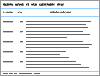
表 1
大概念教学与常规教学的比较"
| 维度 | 要素 | 常规教学的特征 | 大概念教学的特征 |
| 单元结构 | 线索 | 主题 | 大概念 |
| 序列 | 并行 | 进阶 | |
| 单元目标 | 层次 | 低阶 | 高阶 |
| 形态 | 分列 | 整合 | |
| 单元评价 | 总结性评价 | 相似 | 多元 |
| 形成性评价 | 封闭 | 开放 | |
| 单元过程 | 组织 | 相加 | 相乘 |
| 行为 | 验证 | 理解 |
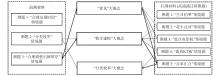
图 2
前后测材料及其与大概念的对应关系"
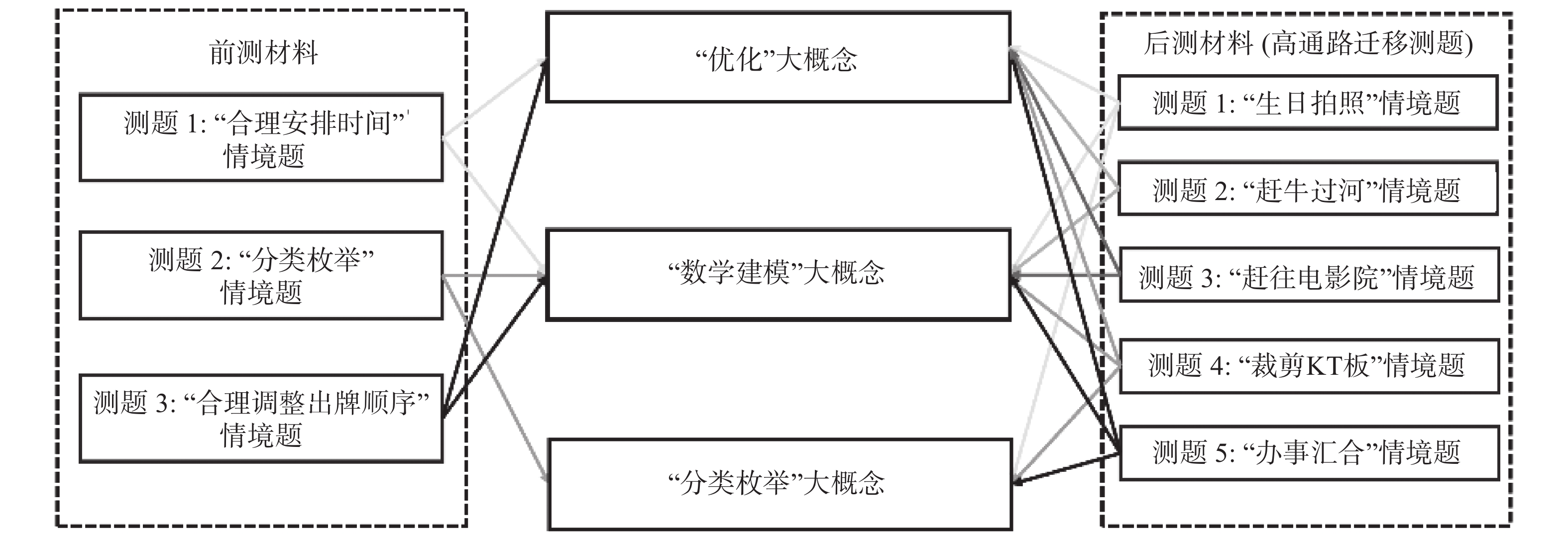
表 2
后测成绩回归分析的主效应模型和交互效应模型"
| 常数项 | 期末成绩 | 前测成绩 | 实验组别 | 迁移类型 | 前测成绩 实验组别 | 迁移类型 实验组别 | F | df | ||
| 主效应 模型 | −12.81(3.97)** | 0.26(0.05)*** | 0.22(0.13) | 1.79(0.85)* | 5.72(0.84)*** | — | — | 23.72 | 4,151 | 0.39 |
| 交互效应 模型 | −11.29(3.86)** | 0.28(0.05)*** | −0.18(0.17) | −4.77(2.82) | 7.87(1.12)*** | 0.79(0.23)*** | −4.31(1.59)*** | 20.69 | 6,149 | 0.45 |
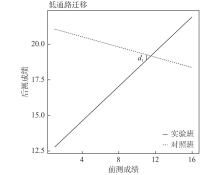
图 3
前测成绩和实验组别对低通路迁移后测成绩的影响"
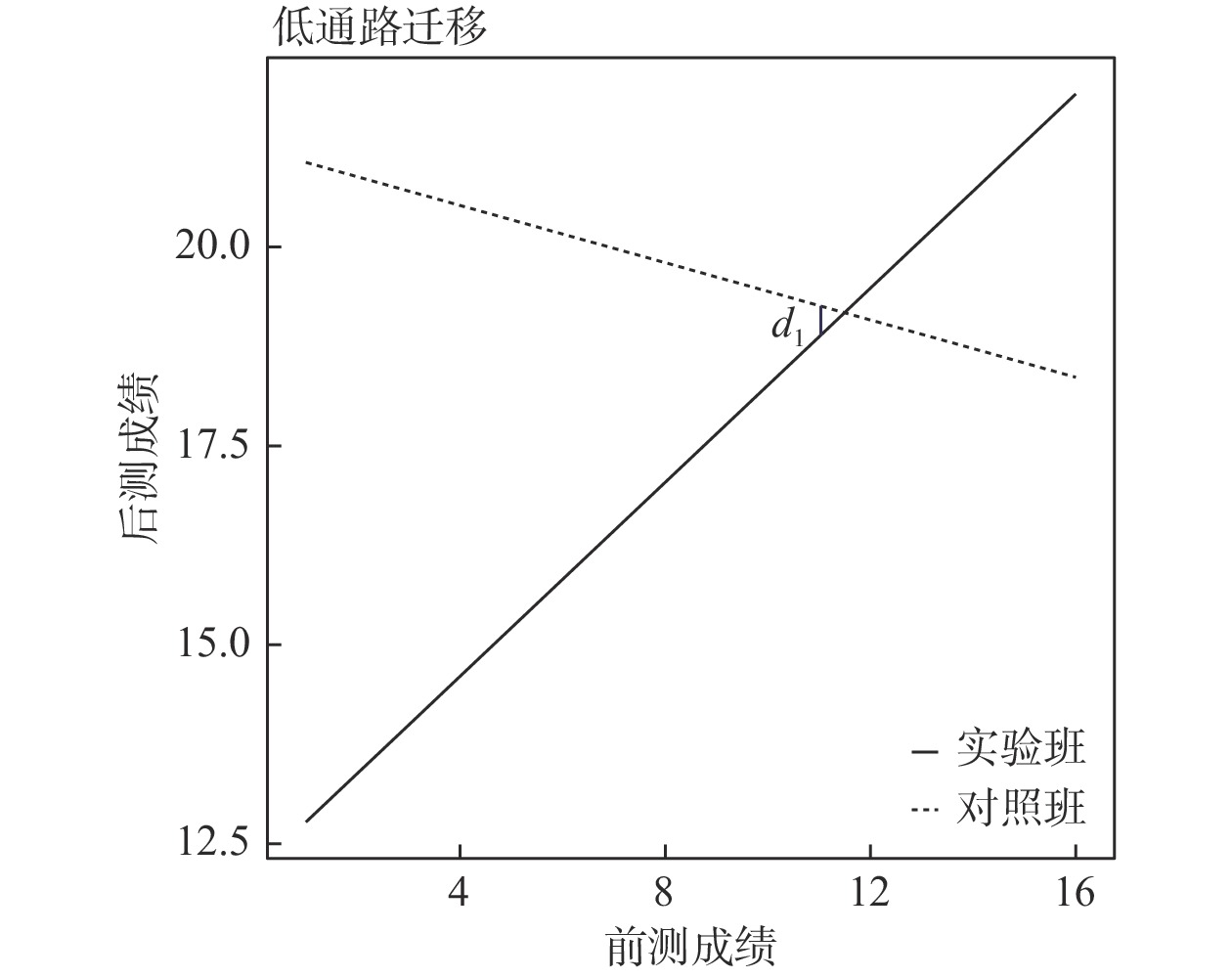
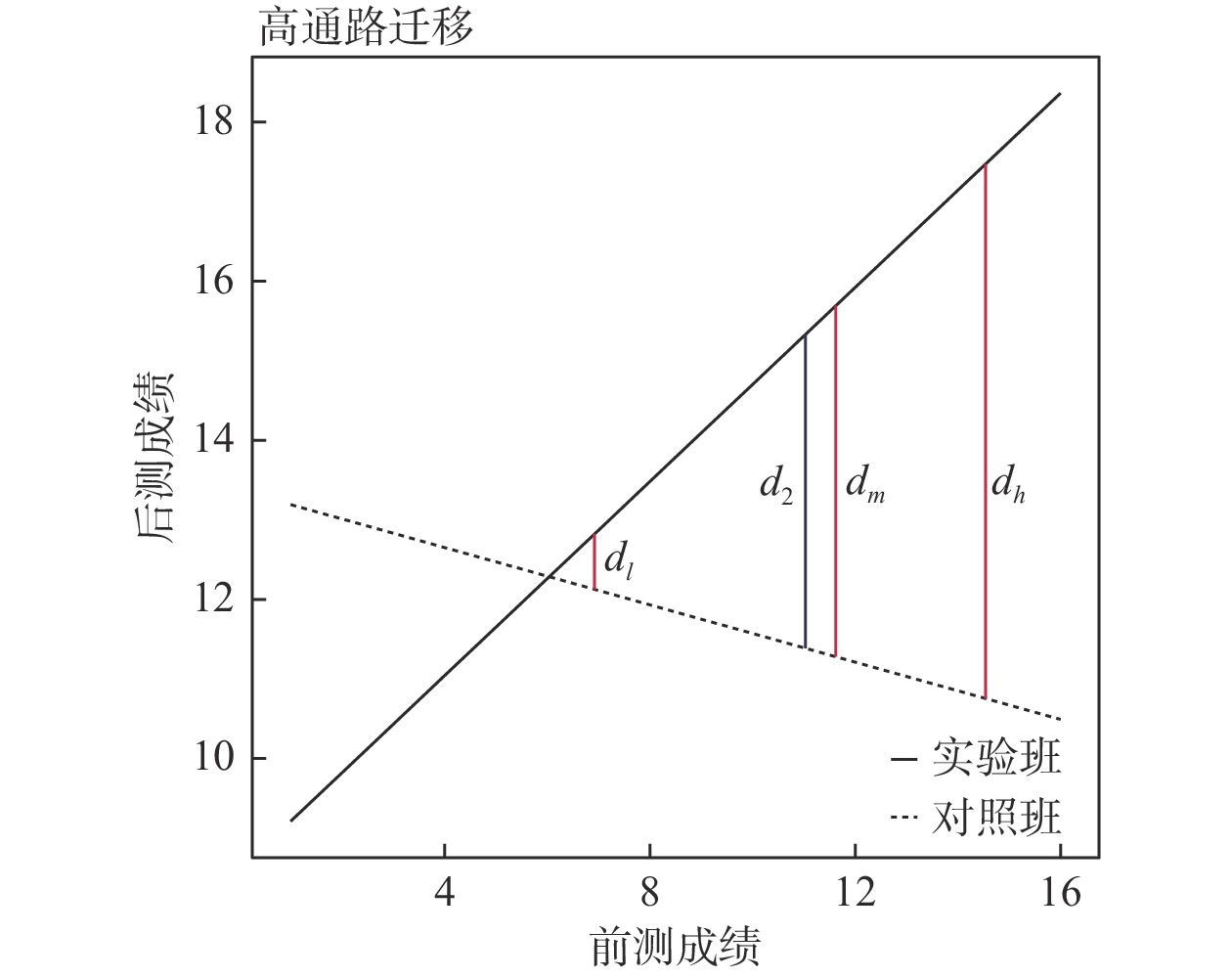
图 4
前测成绩和实验组别对高通路迁移后测成绩的影响"
| 埃里克森, 兰宁. (2018). 以概念为本的课程与教学: 培养核心素养的绝佳实践(鲁效孔译). 上海: 华东师范大学出版社. | |
| 安桂清. (2013). 以学为中心的课例研究. 教师教育研究, 25 (02), 72- 77. | |
| 奥苏贝尔. (2018). 意义学习新论——获得与保持知识的认知观(毛伟译). 杭州: 浙江教育出版社. | |
| 珀金斯. (2015). 为未知而教, 为未来而学(杨彦捷译). 杭州: 浙江人民出版社. | |
| 布兰思福特等. (2013). 人是如何学习的: 大脑、心理、经验及学校(扩展版)(程可拉等译). 上海: 华东师范大学出版社. | |
| 崔允漷. (2019). 学科核心素养呼唤大单元教学设计. 上海教育科研, (04), 1. | |
| 杜威. (2015). 我们如何思维(伍中友译). 北京: 新华出版社. | |
| 焦尔当. (2015). 学习的本质(杭零译). 上海: 华东师范大学出版社. | |
| 李刚, 吕立杰. (2018). 大概念课程设计: 指向学科核心素养落实的课程架构. 教育发展研究, 38 (Z2), 35- 42. | |
| 李凯, 吴刚平. (2022). 为素养而教: 大概念教学理论指向与教学意蕴. 比较教育研究, 44 (04), 62- 71. | |
| 刘徽. (2020). “大概念”视角下的单元整体教学构型——兼论素养导向的课堂变革. 教育研究, 41 (06), 64- 77. | |
| 刘徽. (2022). 大概念教学: 素养导向的单元整体设计. 北京: 教育科学出版社. | |
| 罗日叶. (2010). 为了整合学业获得: 情境的设计和开发(汪凌译). 上海: 华东师范大学出版社. | |
| 吕立杰. (2020). 大概念课程设计的内涵与实施. 教育研究, 41 (10), 53- 61. | |
| 麦克泰, 西尔维. (2021). 为深度学习而教: 促进学生参与意义建构的思维工具(丁旭译). 北京: 教育科学出版社. | |
| 斯特恩, 费拉多, 邓肯, 阿莱奥. (2023). 可迁移的学习: 为变化的世界设计课程(屠莉娅等译). 杭州: 浙江科学技术出版社. | |
| 索耶. (2010). 剑桥学习科学手册(徐晓东等译). 北京: 教育科学出版社. | |
| 汤蕾. (2016). 学习迁移理论在高中化学教学中的实践研究. 武汉: 华中师范大学硕士学位论文. | |
| 王宽明. (2021). 基于差异化教学的课程设计探索. 教育科学研究, (01), 48- 53. | |
| 威金斯, 麦克泰. (2018). 理解为先模式——单元教学设计指南(一)(盛群力等译). 福州: 福建教育出版社. | |
| 威金斯, 麦克泰. (2021). 理解为先模式——单元教学设计指南(二)(沈祖芸等译). 福州: 福建教育出版社. | |
| 威金斯, 麦克泰格. (2017). 追求理解的教学设计(第二版)(闫寒冰等译). 上海: 华东师范大学出版社. | |
| 威金斯, 麦克泰格. (2022). 基于设计的学校教育: 使命、行动与成就(闫寒冰主译). 上海: 华东师范大学出版社. | |
| 威廉. (2021). 融于教学的形成性评价(王少非译). 南京: 江苏凤凰科学技术出版社. | |
| 谢尔, 布鲁克斯, 特赖宁, 威尔逊, 考夫曼, 赫尔. (2021). 统一学习模式——从动机、认知及神经生物科学层面理解最佳教学(毛伟译). 杭州: 浙江大学出版社. | |
| 许玮, 陈航, 刘晓. (2023). 融入设计思维的科学大概念单元教学模式构建及应用研究. 全球教育展望, 52 (08), 13- 29. | |
| 于泽元, 那明明. (2023). 情境化学习: 内涵、价值及实施. 华东师范大学学报(教育科学版), 41 (01), 89- 97. | |
| 张华. (2023). 论课程核心素养: 走向“新三维目标”. 教育研究, 44 (09), 76- 85. | |
| 张良, 罗生全. (2021). 论“用以致学”: 指向素养发展的教学认识论. 华东师范大学学报(教育科学版), 39 (02), 40- 49. | |
| 张奇, 张庆翔, 张笑笑, 高超. (2023). 规则变型推理对远迁移问题解决的促进. 心理学报, 55 (01), 117- 128. | |
| 张侨平. (2021). 数学开放性问题和平行任务的设计: 处理数学学习差异的一种途径. 课程. 教材. 教法, 41 (01), 105- 109+137. | |
| 中华人民共和国教育部. (2020). 普通高中课程方案(2017年版2020年修订). 北京: 人民教育出版社. | |
| 中华人民共和国教育部. (2022). 义务教育课程方案(2022年版). 北京: 北京师范大学出版社. | |
| 佐藤学. (2010). 学校的挑战: 创建学习共同体(钟启泉译). 上海: 华东师范大学出版社. | |
| Anmarkrud, Ø., Andresen, A., & Bråten, I. (2019). Cognitive load and working memory in multimedia learning: Conceptual and measurement issues. Educational Psychologist, 54 (2), 61- 83. | |
| Bakker, A. (2018). Design Research in Education: A Practical Guide for Early Career Researchers. New York: Routledge. | |
| Brown, A. L. (1992). Design experiments: Theoretical and methodological challenges in creating complex interventions in classroom settings. The Journal of the Learning Sciences, 2 (2), 141- 178. | |
| Brünken, R. , Seufert, T. , & Paas, F. (2010). Measuring cognitive load, In J. L. Plass, R. Moreno & R. Brunken(Eds. ), Cognitive Load Theory (pp. 181-202). New York: Cambridge University Press. | |
| Chalmers, C., Carter, M., Cooper, T., & Nason, R. (2017). Implementing “big ideas” to advance the teaching and learning of Science, Technology, Engineering, and Mathematics(STEM). International Journal of Science and Mathematics Education, 15 (S1), 25- 43. | |
| Cobb, P. (2001). Supporting the improvement of learning and teaching in social and institutional context. In S. Carver & D. Klahr (Eds. ), Cognition and Instruction: Twenty-five Years of Progress (pp. 455–478). Mahwah: Lawrence Erlbaum Associates. | |
| Cobb, P., Confrey, J., diSessa, A., Lehrer, R., & Schauble, L. (2003). Design experiments in educational research. Educational Researcher, 32 (1), 9- 13. | |
| Collins, A. (1992). Toward a design science of education. In E. Scanlon & T. O’Shea (Eds. ), New Directions in Educational Technology (pp. 15-22). Berlin: Springer-Verlag. | |
| Collins, A., Joseph, D., & Bielaczyc, K. (2004). Design research: Theoretical and methodological issues. The Journal of the Learning Sciences, 13 (1), 15- 42. | |
| Confrey, J. , & Lachance, A. (2000). Transformative teaching experiments through conjecture-driven research design. In A. E. Kelly & R. A. Lesh (Eds. ), Handbook of Research Design in Mathematics and Science Education(pp. 231-265). Mahwah: Lawrence Erlbaum Associates. | |
| Fan, L., Qi, C., Liu, X., Wang, Y., & Lin, M. (2017). Does a transformation approach improve students’ ability in constructing auxiliary lines for solving geometric problems? An intervention-based study with two Chinese classrooms. Educational Studies in Mathematics, 96, 229- 248. | |
| Fosnot, C. T. (2007). Our teaching and learning philosophy. In C. T. Fosnot (Ed. ), Investigating Multiplication and Division Grade 3–5 (pp. 13–15). Portsmouth: Heinemann. | |
| Jaccard, J. , & Turrisi, R. (2003). Interaction Effects in Multiple Regression (2nd Ed.). Thousand Oaks: Sage Publications. | |
| Kali, Y. , & Hoadley, C. (2021). Design-based research methods in CSCL: Calibrating our epistemologies and ontologies. In U. Cress, C. Rose, A. Wise, & J. Oshima (Eds. ), International Handbook of Computer-supported Collaborative Learning(pp. 479-496). Switzerland: Springer Nature Switzerland AG. | |
| Kalyuga, S., & Singh, A. (2016). Rethinking the boundaries of cognitive load theory in complex learning. Educational Psychology Review, 28 (4), 831- 852. | |
| Kapur, M. (2012). Productive failure in learning the concept of variance. Instructional Science, 40 (4), 651- 672. | |
| Keller, J. M. (1987). Development and use of the ARCS model of instructional design. Journal of Instructional Development, 10 (3), 2- 10. | |
| Lewis, D. R. , Carlson, S. , Riesbeck, C. , Lu, K. , Gerber, E. , & Easterday, M. (2020). The logic of effective iteration in design-based research. In M. Gresalfi & I. S. Horn (Eds. ), The Interdisciplinarity of the Learning Sciences, 14th International Conference of the Learning Sciences (ICLS) 2020, Volume 2 (pp. 1149-1156). Nashville: International Society of the Learning Sciences. | |
| Marschall, C. & French, R. (2018). Concept-based Inquiry in Action: Strategies to Promote Transferable Understanding. Thousand Oaks: Corwin. | |
| McTighe, J. , & Wiggins, G. (2013). Essential Questions: Opening Doors to Student Understanding. Alexandria: ASCD. | |
| Oakes, J. (1985). Keeping Track: How Schools Structure Inequality. New Haven: Yale University Press. | |
| Olson, J. K. (2008). Concept-focused teaching: Using big ideas to guide instruction in science. Science and Children, 46 (4), 45- 49. | |
| Perkins, D. N., & Salomon, G. (1988). Teaching for transfer. Educational Leadership, 46 (1), 22- 32. | |
| Perkins, D. N. , & Salomon, G. (1992). Transfer of learning. In T. Husén & T. N. Postlethwaite (Eds. ), International Encyclopedia of Education (2nd ed. , pp. 1–13). Oxford: Pergamon Press. | |
| Roumell, E. (2019). Priming adult learners for learning transfer: Beyond content and delivery. Adult Learning, 30 (1), 15- 22. | |
| Sandoval, W. A. (2004). Developing learning theory by refining conjectures embodied in educational designs. Educational Psychologist, 39 (4), 213- 223. | |
| Seel, N. M. , Lehmann, T. , Blumschein, P. , & Podolskiy, O. A. (2017). Instructional Design for Learning: Theoretical Foundations. Rotterdam: Sense Publishers. | |
| Simon, H. A. (1969). The Sciences of the Artificial. Cambridge: MIT Press. | |
| Silverman, H. (2015). Designerly ways for action research. In H. Bradbury (Ed. ), The Sage Handbook of Action Research (pp. 716–723). Thousand Oaks: Sage Publications. | |
| Soderstrom, N. C., & Bjork, R. A. (2015). Learning versus performance: An integrative review. Psychological Science, 10 (2), 176- 199. | |
| Stylianides, A. J., & Stylianides, G. J. (2013). Seeking research-grounded solutions to problems of practice: Classroom-based interventions in mathematics education. ZDM, 45, 333- 341. | |
| Sweller, J., Van Merriënboer, J. J. & Paas, F. G. (1998). Cognitive architecture and instructional design. Educational Psychology Review, 10 (3), 251- 296. | |
| Tomlinson, C. A. (2017). How to Differentiate Instruction in Academically Diverse Classrooms. Alexandria: ASCD. | |
| Tomlinson, C. A. , & McTighe, J. (2006). Integrating Differentiated Instruction & Understanding by Design: Connecting Content and Kids. Alexandria: ASCD. | |
| Van Merriënboer, J. J. G., & Kirschner, P. A. (2018). Ten Steps to Complex Learning: A Systematic Approach to Four-component Instructional Design (3rd Ed.). New York: Routledge. |
| [1] | 于金申, [法]瑞尔•米勒(Riel Miller). 从世界到中国:未来素养何以有必要成为未来教育研究的新视点——于金申与未来学家瑞尔•米勒的对话[J]. 华东师范大学学报(教育科学版), 2024, 42(3): 115-126. |
| [2] | 王晓杰, 宋乃庆. 我国小学生劳动素养现状及其影响因素研究[J]. 华东师范大学学报(教育科学版), 2024, 42(2): 78-91. |
| [3] | 崔允漷, 周文叶, 雷浩, 郭洪瑞, 张紫红, 王少非, 安桂清, 吴刚平. 中国基础教育课程改革学术话语体系的自主建构[J]. 华东师范大学学报(教育科学版), 2024, 42(11): 154-170. |
| [4] | 钟柏昌, 刘晓凡, 杨明欢. 何谓人工智能素养:本质、构成与评价体系[J]. 华东师范大学学报(教育科学版), 2024, 42(1): 71-84. |
| [5] | 宋萑, 林敏. ChatGPT/生成式人工智能时代下教师的工作变革:机遇、挑战与应对[J]. 华东师范大学学报(教育科学版), 2023, 41(7): 78-90. |
| [6] | 李健, 宋乃庆, 王诗梦, 孙小坚. 一项工具开发:如何才能测评学生美术素养?[J]. 华东师范大学学报(教育科学版), 2023, 41(6): 118-132. |
| [7] | 赵伶俐, 经刚. 美育评价智能化平台与实验教室建构——基于美育教学与美感体验过程[J]. 华东师范大学学报(教育科学版), 2023, 41(6): 92-107. |
| [8] | 郑永和, 杨宣洋, 王晶莹, 李佳, 卢阳旭, 李书惠, 杨玉静, 张晓琳. 我国小学科学教师队伍现状、影响与建议:基于31个省份的大规模调研[J]. 华东师范大学学报(教育科学版), 2023, 41(4): 1-21. |
| [9] | 靳彤, 李亚芬. 理解数字化时代的学校公共空间——教育数字化转型的实践难题[J]. 华东师范大学学报(教育科学版), 2023, 41(3): 45-51. |
| [10] | 朱德全, 彭洪莉. 教师跨学科教学素养测评模型实证研究[J]. 华东师范大学学报(教育科学版), 2023, 41(2): 1-13. |
| [11] | 刘宝存, 黄秦辉. PISA高绩效地区学生的全球素养:个体和学校因素的影响[J]. 华东师范大学学报(教育科学版), 2023, 41(2): 38-52. |
| [12] | 沈伟, 陈莞月. 教育与生态文明:基于经合组织教育功能的视角变迁[J]. 华东师范大学学报(教育科学版), 2023, 41(12): 34-45. |
| [13] | 黄声华, 尹弘飚, 靳玉乐. 家长教育卷入类型与中学生学科素养:基于PISA 2018中国香港及澳门数据的潜在类别分析[J]. 华东师范大学学报(教育科学版), 2023, 41(1): 50-59. |
| [14] | 于泽元, 那明明. 情境化学习:内涵、价值及实施[J]. 华东师范大学学报(教育科学版), 2023, 41(1): 89-97. |
| [15] | 李小红, 王杉, 陈晨, 杨婕, 唐向黎. 家庭文化资本对学生阅读素养的影响:基于多层logistic模型的实证研究[J]. 华东师范大学学报(教育科学版), 2022, 40(8): 57-66. |
| 阅读次数 | ||||||
|
全文 |
|
|||||
|
摘要 |
|
|||||
