
 中国人文社会科学核心期刊
华东师范大学学报(教育科学版) ›› 2025, Vol. 43 ›› Issue (2): 49-65.doi: 10.16382/j.cnki.1000-5560.2025.02.005
郑东辉1, 叶盛楠2
出版日期:2025-02-01
发布日期:2025-01-18
基金资助:Donghui Zheng1, Shengnan Ye2
Online:2025-02-01
Published:2025-01-18
摘要:
澄清课堂评价对深度学习的影响,有助于探明新时期学生评价改革和学习方式变革的方向。基于文献梳理,建构促进深度学习的课堂评价理论框架,强调课堂评价的融学性、导学性、伦理性。依据理论框架,自编“基于学生视角的课堂评价行为问卷”“中小学生深度学习问卷”,抽样调查一个县
郑东辉, 叶盛楠. 课堂评价促进学生的深度学习吗?——基于县域中小学
Donghui Zheng, Shengnan Ye. Does Classroom Assessment Promote Deeper Learning among Students? Analysis Based on 16,758 Data from Primary and Secondary Schools in a County[J]. Journal of East China Normal University(Educationa, 2025, 43(2): 49-65.

图 1
促进深度学习的课堂评价框架"

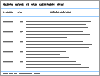
表 1
样本分布情况(n=16758)"
| 项目 | 人数 | 比例 | |
| 性别 | 男 | 50% | |
| 女 | 50% | ||
| 年级 | 四年级 | 14.8% | |
| 五年级 | 14.5% | ||
| 六年级 | 14.5% | ||
| 初一 | 14.2% | ||
| 初二 | 14.1% | ||
| 初三 | 7.5% | ||
| 高一 | 8.3% | ||
| 高二 | 7.5% | ||
| 高三 | 781 | 4.7% | |
| 学校所在地 | 城区 | 46.1% | |
| 乡镇 | 53.9% | ||
表 2
课堂评价行为及三因子的均值水平(n=16758)"
| 项目 | 均分 | 标准差 | 检验值 | t值 |
| 课堂评价总体行为 | 3.84 | 0.67 | 3 | 162.668*** |
| 教师课堂评价行为 | 4.00 | 0.72 | 3 | 177.859*** |
| 学生自我评价行为 | 3.84 | 0.79 | 3 | 138.957*** |
| 学生同伴评价行为 | 3.53 | 0.82 | 3 | 83.398*** |
表 3
课堂评价行为三因子各指标的均值水平(n=16758)"
| 因子 | 指标 | 均分 | 标准差 | t值 |
| 教师课堂评价行为 | 课堂提问 | 4.04 | 0.80 | 169.910*** |
| 课堂练习 | 3.95 | 0.80 | 153.376*** | |
| 课外作业 | 3.92 | 0.76 | 157.856*** | |
| 测验 | 4.15 | 0.86 | 172.309*** | |
| 表现性评价 | 3.94 | 0.91 | 134.666*** | |
| 学生自我评价行为 | 自我计划 | 3.84 | 0.84 | 129.589*** |
| 自我反思 | 3.86 | 0.82 | 136.437*** | |
| 自我调节 | 3.81 | 0.88 | 118.348*** | |
| 学生同伴评价行为 | 同伴建议 | 3.46 | 0.94 | 63.057*** |
| 同伴评级 | 3.35 | 0.91 | 48.880*** | |
| 同伴鼓励 | 3.90 | 0.96 | 121.742*** |
表 4
深度学习行为及三因子的均值水平(n=16758)"
| 项目 | 均分 | 标准差 | t值 |
| 深度学习总体 | 3.56 | 0.74 | 97.197*** |
| 深度投入 | 3.65 | 0.78 | 107.283*** |
| 深入认知 | 3.62 | 0.77 | 104.741*** |
| 深层结果 | 3.40 | 0.81 | 64.030*** |
表 5
深度学习三因子各指标的均值水平(n=16758)"
| 因子 | 指标 | 均分 | 标准差 | t值 |
| 深度投入 | 活力 | 3.69 | 0.83 | 108.137*** |
| 奉献 | 3.77 | 0.83 | 119.439*** | |
| 专注 | 3.48 | 0.88 | 69.729*** | |
| 深入认知 | 关联策略 | 3.61 | 0.85 | 92.612*** |
| 整合策略 | 3.72 | 0.85 | 110.469*** | |
| 反思策略 | 3.58 | 0.82 | 91.465*** | |
| 深层结果 | 理解与迁移能力 | 3.48 | 0.85 | 73.134*** |
| 批判与创造能力 | 3.31 | 0.91 | 43.713*** | |
| 协作与沟通能力 | 3.38 | 0.95 | 51.133*** |
表 6
课堂评价对深度学习及其三因子的线性回归方程(n=16758)"
| 自变量 | 因变量 | |||
| 深度学习(β) | 深度投入(β) | 深入认知(β) | 深层结果(β) | |
| 课堂评价 | 0.775*** | 0.720*** | 0.749*** | 0.724*** |
| R2 | 0.601 | 0.518 | 0.560 | 0.525 |
| F值 | ||||

图 2
课堂评价影响深度学习的结构方程模型"


图 3
课堂评价影响深度学习三因子的结构方程模型"

表 7
教师课堂评价影响深度学习及其三因子的线性回归方程(n=16758)"
| 自变量 | 因变量 | |||
| 深度学习(β) | 深度投入(β) | 深入认知(β) | 深层结果(β) | |
| 教师课堂评价 | 0.535*** | 0.518*** | 0.523*** | 0.474*** |
| R2 | 0.287 | 0.269 | 0.273 | 0.225 |
| F值 | ||||

图 4
教师课堂评价影响深度学习的结构方程模型"


图 5
教师课堂评价影响深度学习三因子的结构方程模型"

表 8
学生自我评价对深度学习及其三因子的线性回归方程(n=16758)"
| 自变量 | 因变量 | |||
| 深度学习(β) | 深度投入(β) | 深入认知(β) | 深层结果(β) | |
| 学生自我评价 | 0.807*** | 0.760*** | 0.785*** | 0.737*** |
| R2 | 0.651 | 0.578 | 0.616 | 0.543 |
| F值 | ||||

图 6
学生自我评价影响深度学习的结构方程模型"


图 7
学生自我评价影响深度学习三因子的结构方程模型"

表 9
学生同伴评价对深度学习及其三因子的线性回归方程(n=16758)"
| 自变量 | 因变量 | |||
| 深度学习(β) | 深度投入(β) | 深入认知(β) | 深层结果(β) | |
| 学生同伴评价 | 0.693*** | 0.614*** | 0.658*** | 0.686*** |
| R2 | 0.480 | 0.377 | 0.433 | 0.471 |
| F值 | ||||

图 8
学生同伴评价影响深度学习的结构方程模型"


图 9
学生同伴评价影响深度学习三因子的结构方程模型"

表 10
不同成绩水平下课堂评价与深度学习的相关系数(n=16758)"
| 项目 | 深度学习 | ||
| 低分组 | 中等组 | 高分组 | |
| 课堂评价 | 0.746** | 0.765** | 0.759** |
表 11
课堂评价对不同成绩水平学生深度学习的线性回归方程(n=16758)"
| 学习成绩 | R2 | F值 | β值 |
| 高分组 | 0.577 | 0.814 | |
| 中等组 | 0.586 | 0.807 | |
| 低分组 | 0.557 | 0.772 |
表 12
不同成绩水平组课堂评价三因子影响深度学习的线性回归方程(n=16758)"
| 学习 成绩 | 教师评价 | 自我评价 | 同伴评价 | |||||
| F值 | β值 | F值 | β值 | F值 | β值 | |||
| 高分组 | 0.495 | 0.773 | 0.566 | |||||
| 中等组 | 0.541 | 0.734 | 0.582 | |||||
| 低分组 | 0.471 | 0.691 | 0.614 | |||||
表 13
不同学段组课堂评价与深度学习水平的方差分析(n=16758)"
| 学段 | 课堂评价 | 深度学习 |
| 小学 | 3.99 | 3.76 |
| 初中 | 3.76 | 3.43 |
| 高中 | 3.68 | 3.36 |
| F值 | 334.247*** | 498.711*** |
表 14
不同学段组课堂评价影响深度学习的线性回归方程(n=16758)"
| 学段 | R2 | F值 | β值 |
| 小学 | 0.595 | 0.772 | |
| 初中 | 0.593 | 0.770 | |
| 高中 | 0.533 | 0.730 |
表 15
不同学校地域组课堂评价与深度学习水平的独立样本t检验(n=16758)"
| 地域 | 课堂评价 | 深度学习 |
| 城区 | 3.90 | 3.65 |
| 乡镇 | 3.80 | 3.48 |
| t值 | 9.191*** | 14.997*** |
表 16
不同学校地域组课堂评价影响深度学习的线性回归方程(n=16758)"
| 学校地域 | R2 | F值 | β值 |
| 城区 | 0.586 | 0.766 | |
| 乡镇 | 0.610 | 0.781 |
表 17
不同学习环境组课堂评价与深度学习水平的独立样本t检验(n=16758)"
| 学习环境 | 课堂评价 | 深度学习 |
| 有书房 | 3.85 | 3.57 |
| 无书房 | 3.76 | 3.41 |
| t值 | 4.586*** | 7.828*** |
表 18
不同学习环境组课堂评价影响深度学习的线性回归方程(n=16758)"
| 学习环境 | R2 | F值 | β值 |
| 有书房 | 0.602 | 0.776 | |
| 无书房 | 0.589 | 0.768 |
| 崔允漷, 雷浩. (2015). 教-学-评一致性三因素理论模型的建构. 华东师范大学学报(教育科学版), (4), 15- 22. | |
| 崔允漷, 等. (2023). 新课程关键词. 北京: 教育科学出版社. | |
| 郭华. (2016). 深度学习及其意义. 课程•教材•教法, (11), 25- 32. | |
| 姬国君, 范韵婧. (2022). 课堂评价: 促进学生高质量学习与发展的关键路径. 中国教育学刊, (09), 21- 26. | |
| 教育部. (2022). 义务教育课程方案(2022年版本). 北京: 北京师范大学出版社. | |
| 康德. (2003). 实践理性批判(邓晓芒, 杨祖陶, 译). 北京: 人民出版社. | |
| 林瑾娜, 许明. (2007). 评价促进学习——英国KMOFAP形成性评价个案分析. 全球教育展望, (06), 44- 47. | |
| 刘月霞, 郭华. (2018). 深度学习: 走向核心素养. 北京: 教育科学出版社. | |
| 刘志军. (2002). 课堂评价论. 南宁: 广西师范大学出版社. | |
| 沈玉顺. (2006). 课堂评价. 北京: 北京师范大学出版社. | |
| 王少非. (2018). 促进学习的课堂评价. 上海: 华东师范大学出版社. | |
| 王同顺, 朱晓彤, 许莹莹. (2018). 促学性评价对中国大学英语学习者学习动机及写作能力的影响研究. 外语研究, (03), 46- 53+112. | |
| 杨向东. (2009). 谈课堂评价的地位与重建. 全球教育展望, (09), 42- 46. | |
| 郑东辉, 叶盛楠. (2022). 多维视角的中小学生深度学习问卷编制. 全球教育展望, (11), 103- 119. | |
| 郑东辉, 叶盛楠. (2023). 基于学生视角的课堂评价行为问卷编制与调查. 全球教育展望, (5), 63- 80. | |
| 郑东辉. (2014). 试论课堂评价与教学的关系. 课程•教材•教法, (12), 33- 38. | |
| 郑东辉. (2019). 促进深度学习的课堂评价: 内涵与路径. 课程•教材•教法, (2), 59- 65. | |
| 郑东辉. (2023). 评价任务驱动的课堂教学改革. 现代教育, (5), 3- 4. | |
| 曾文婕, 黄甫全, 余璐. (2015). 评估促进学习何以可能——论新兴学本评估的价值论原理. 教育研究, (12), 79- 88. | |
| Andersson, C. & Palm, T. (2017). The impact of formative assessment on student achievement: A study of the effects of changes to classroom practice after a comprehensive professional development programme. Learning and Instruction, 49 (1), 92- 102. | |
| Andrade, H. & Valtcheva, A. (2009). Promoting learning and achievement through self-assessment. Theory Into Practice, 48 (1), 12- 19. | |
| Andrade, H. L. & Brookhart, S. M. (2020). Classroom assessment as the co-regulation of learning. Assessment in Education: Principles, Policy & Practice, 27(4), 350—372. | |
| Beattie, V., Collins, B. & McInnes, B. (1997). Deep and surface learning: A simple or simplistic dichotomy?. Accounting Education, 6 (1), 1- 12. | |
| Berry, R. (2008). Assessment for learning. Hong Kong: Hong Kong University Press. | |
| Black, P. & William, D. (1998). Inside the black box: Raising standards through classroom assessment. Phi Delta Kappan, 80 (2), 139- 148. | |
| Brookhart, S. M. (1997). A theoretical framework for the role of classroom assessment in motivating student effort and achievement. Assessment Measurement in Education, 10 (2), 161- 180. | |
| Careless, D. (2007). Learning-oriented assessment: Conceptual bases and practical implications. Innovations in Education and Teaching International, 44 (1), 57- 66. | |
| Chappuis, J. & Stiggins, R. J. (2016). An introduction to student-involved assessment for learning(7 th). New York, NY: Perason. | |
| Earl, L. (2013). Assessment as learning: Using classroom assessment to maximize student learning(2nd). Thousand Oak, CA: Corwin Press. | |
| Gan, Z. D., Hoi, C. & Schumacker, R. (2019). Investigating influence of assessment for learning practice on student learning approaches in Chinese higher education. Measurement: Interdisciplinary Research and Perspectives, 17 (1), 23- 37. | |
| JCSEE. (2003). The student evaluation standards. Thousand Oaks, CA: Corwin. | |
| Klinger, D., et al. (2015). Classroom assessment standards for preK-12 teachers[EB/OL]. https://evaluationstandards.org. | |
| Lannone, P., et al. (2020). The impact of high stakes oral performance assessment on students’ approaches to learning: A case study. Educational Studies in Mathematic, 103 (3), .313- 337. | |
| Li, H. L., et al. (2021). The effect of peer assessment on non-cognitive outcomes: A meta-analysis. Applied Measurement In Education, 34 (3), 179- 203. | |
| Lynch, R., McNamara, P. & Seery, N. (2012). Promoting deep learning in a teacher education programme through self- and peer-assessment and feedback. European Journal of Teacher Education, 35 (2), 179- 197. | |
| McDonald, B. & Boud, D. (2003). The impact of self-assessment on achievement: The effects of self- assessment training on performance in external examinations. Assessment in Education: Principles, Policy & Practice, 10(2), 209—220. | |
| Miller, M. D. , Linn, R. L. & Gronlund, N. E. (2013). Measurement and assessment in teaching(11th). Upper Saddle River, NJ: Pearson Education. | |
| Mok, M. M. C. (2013). Self-directed learning oriented assessments in the Asia-Pacific. New York, NY: Springer. | |
| Papanthymou, A. & Darra, M. (2019). The contribution of learner self-assessment for improvement of learning and teaching process: A review. Journal of Education and Learning, 8 (1), 48. | |
| Pellegrino, J. W. & Hilton, M. L. (2012). Education for Life and Work: Developing Transferable Knowledge and Skills in the 21st Century. Washington, DC: The National Academies Press. | |
| Peng, J. (2014). A Study on effects of primary English teachers’ classroom assessment on students’ English learning interest. Studies in Foreign Language Education, 28 (2), 369- 388. | |
| Rogers, W. T. (1993). Principles for fair student assessment practices for education in Canada. Canadian Journal of School Psychology, 9 (1), 110- 127. | |
| Stiggins, R. J. (1992). High quality classroom assessment: What does it really mean?. Educational Measurement Issues and Practice, 11 (2), 35- 39. | |
| Stiggins, R. (2005). From Formative Assessment to Assessment for Learning: A path to success in standards-based school. Phi Delta Kappan, 87 (4), 324- 328. | |
| Topping, K. J. (2018). Using peer assessment to inspire reflection and learning. New York, NY: Routledge. | |
| Veldhuis, M. & Heuvel-Panhuizen, M. (2020). Supporting primary school teachers’ classroom assessment in mathematics education: Effects on student achievement. Mathematics Education Research Journal, 32 (3), 449. | |
| William and Flora Hewlett Foundation. (2013). Deeper learning competencies[EB/OL]. http://www.hewlet.org/uploads/documents/Deper Learning Defined April 2013.pdf. | |
| Yan, Z. & Brown, G. T. L. (2017). A cyclical self-assessment process: Towards a model of how students engage in self-assessment. Assessment & Evaluation in Higher Education, 42 (8), 1247- 1262. |
| [1] | 黄昌勤, 钟益华, 王希哲, 韩中美, 魏同权. 从单智能体到多智能体:大模型智能体支持下的激励型学习活动设计与实证研究[J]. 华东师范大学学报(教育科学版), 2025, 43(5): 44-56. |
| [2] | 盛小敏, 石中英. 学校价值观调查中的社会称许性反应:表现、成因与控制[J]. 华东师范大学学报(教育科学版), 2024, 42(6): 51-60. |
| [3] | 李新, 郭元祥, 容翠, [加]吉莉安•贾德森(Gillian Judson). 知识、想象力与深度学习——与吉莉安•贾德森教授关于基兰•伊根的研究的对话[J]. 华东师范大学学报(教育科学版), 2024, 42(6): 125-136. |
| [4] | 刘海峰, 韦骅峰. 不同利益相关主体对高考制度评价的实证研究[J]. 华东师范大学学报(教育科学版), 2024, 42(3): 1-11. |
| [5] | 杨道宇. 什么是学科实践?——基于本体论视角[J]. 华东师范大学学报(教育科学版), 2024, 42(12): 73-81. |
| [6] | 陈明选, 周亮. 数智化时代的深度学习:从浅层记忆走向深度理解[J]. 华东师范大学学报(教育科学版), 2023, 41(8): 53-62. |
| [7] | 高等教育满意度研究课题组. 高等教育发展现状与问题的实证研究——基于2021年全国高等教育满意度调查分析[J]. 华东师范大学学报(教育科学版), 2023, 41(5): 16-25. |
| [8] | 翟雪松, 许家奇, 王永固. 在线教育中的学习情感计算研究——基于多源数据融合视角[J]. 华东师范大学学报(教育科学版), 2022, 40(9): 32-44. |
| [9] | 姚佳佳, 李艳, 潘金晶, 程萌萌. 同伴对话反馈对大学生在线深度学习的影响研究[J]. 华东师范大学学报(教育科学版), 2022, 40(3): 112-126. |
| [10] | 杨帆, 何雨璇, 夏之晨. 反思会持续改善教师的课堂行为吗?——基于对不同教学理念教师的追踪调查[J]. 华东师范大学学报(教育科学版), 2022, 40(10): 17-28. |
| [11] | 胡航, 米雪, 李雅馨, 郎启娥. 深度学习品质刻画:评测工具的开发与应用——基于四城市小学生数学学习的实证研究[J]. 华东师范大学学报(教育科学版), 2021, 39(11): 73-85. |
| [12] | 黄雨恒, 周溪亭, 史静寰. 我国本科课程教学质量怎么样?——基于“中国大学生学习与发展追踪研究”的十年探索[J]. 华东师范大学学报(教育科学版), 2021, 39(1): 116-126. |
| [13] | 席玮, 李莹. 青少年影子教育参与:学校群体与先赋差异——基于CEPS数据的多水平分析[J]. 华东师范大学学报(教育科学版), 2020, 38(11): 56-68. |
| [14] | 郭菲, 赵琳, 连志鑫. 大学生自我报告的学习投入可靠吗——大学生群体的社会称许性反应及对自陈式问卷调查的影响[J]. 华东师范大学学报(教育科学版), 2018, 36(4): 53-61+163. |
| [15] | 杨福义. 我国中小学教师教育信息技术的应用状况及其影响因素——基于全国数据库的实证分析[J]. 华东师范大学学报(教育科学版), 2017, 35(6): 116-125+157. |
| 阅读次数 | ||||||
|
全文 |
|
|||||
|
摘要 |
|
|||||
