华东师范大学学报(教育科学版) ›› 2025, Vol. 43 ›› Issue (8): 78-88.doi: 10.16382/j.cnki.1000-5560.2025.08.006

• • 上一篇    下一篇

国家重大科技基础设施牵引高校学科交叉会聚机制研究

吴伟1, 王怡文2, 冯家浩1   

  1. 1. 浙江大学公共管理学院, 杭州,310058
    2. 北京航空航天大学宁波创新研究院, 宁波,315832
  • 出版日期:2025-08-01 发布日期:2025-07-31
  • 基金资助:
    全国教育科学规划重大项目“大科学时代高校高层次人才集聚模式创新研究”(VFA240009)。

Research on the Interdisciplinary Convergence Mechanism in University Driven by Major National Science and Technology Infrastructure

Wei Wu1, Yiwen Wang2, Jiahao Feng1   

  1. 1. School of Public Affairs, Zhejiang University, Hangzhou 310058, China
    2. Ningbo Institute of Technology, Beihang University, Ningbo, 116024, China
  • Online:2025-08-01 Published:2025-07-31

摘要:

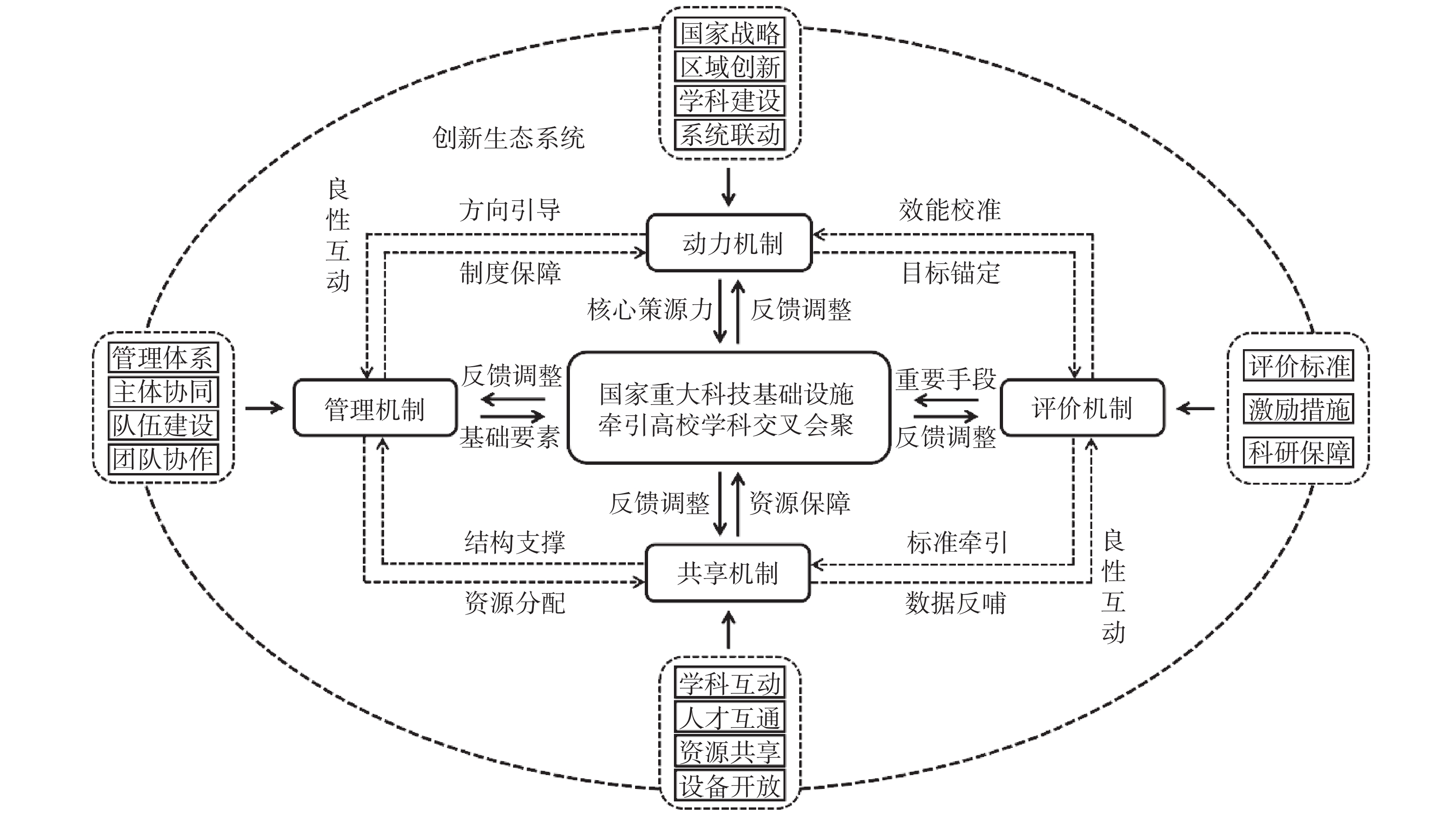
国家重大科技基础设施是实施国家重大创新任务、拓展科技前沿的基础条件,学科交叉会聚体现在其目标设定-设计论证-建设维护的全过程。因高水平创新资源集聚和跨学科研究任务牵引特征,重大科技基础设施具备突破传统学科组织壁垒与制度惰性的天然条件,学科交叉会聚应是其建设、运行的基本诉求和必然结果。高校作为设施的重要组织方与建设方,如何协同学科发展与设施建设运营,已成为“双一流”建设管理实践中不容忽视的重大议题。本文采用扎根理论研究法提取设施运行要素,并基于高校参与建设的6个典型设施案例,补充验证与总结要素间关系,最终搭建了重大科技基础设施牵引学科交叉会聚机制模型。设施建设与学科建设互动机制的研究发现,为推动高校知识生产范式转型提供了理论新视角和实践新路径。

关键词: 大科学, 国家重大科技基础设施, 学科交叉会聚, “双一流”建设

Abstract:

Major national science and technology infrastructure serves as the foundational platform for implementing major national innovation tasks and advancing the frontiers of science and technology. Interdisciplinary convergence manifests throughout its entire lifecycle—from goal-setting and design justification to construction and maintenance. Characterized by the aggregation of high-level innovation resources and the coordination of cross-disciplinary research missions, such infrastructure inherently possesses the capacity to transcend traditional disciplinary barriers and institutional inertia. Consequently, interdisciplinary convergence should constitute both a fundamental requirement and a natural outcome of its construction and operation. As primary organizers and builders of these facilities, universities face a critical challenge in coordinating disciplinary development with infrastructure construction/operation—a pivotal issue in the management practice of the Double First-Class Initiative. This study employs grounded theory methodology to extract operational elements of such infrastructure, supplemented by case studies of six representative facilities involving university participation to validate and synthesize inter-element relationships. Ultimately, a mechanism model is constructed to elucidate how major science and technology infrastructure drives interdisciplinary convergence. The paper reveals the interaction mechanisms between infrastructure development and disciplinary construction, offering novel theoretical perspectives and practical pathways for transforming knowledge production paradigms in higher education institutions.

Key words: Big Science, major national science and technology infrastructure, interdisciplinary convergence, Double First-Class Initiative