
 中国人文社会科学核心期刊
华东师范大学学报(教育科学版) ›› 2026, Vol. 44 ›› Issue (1): 65-79.doi: 10.16382/j.cnki.1000-5560.2026.01.006
马莉萍1, 郑翔睿2, 周雪涵1
出版日期:2026-01-01
发布日期:2025-12-31
基金资助:Liping Ma1, Xiangrui Zheng2, Xuehan Zhou1
Online:2026-01-01
Published:2025-12-31
摘要:
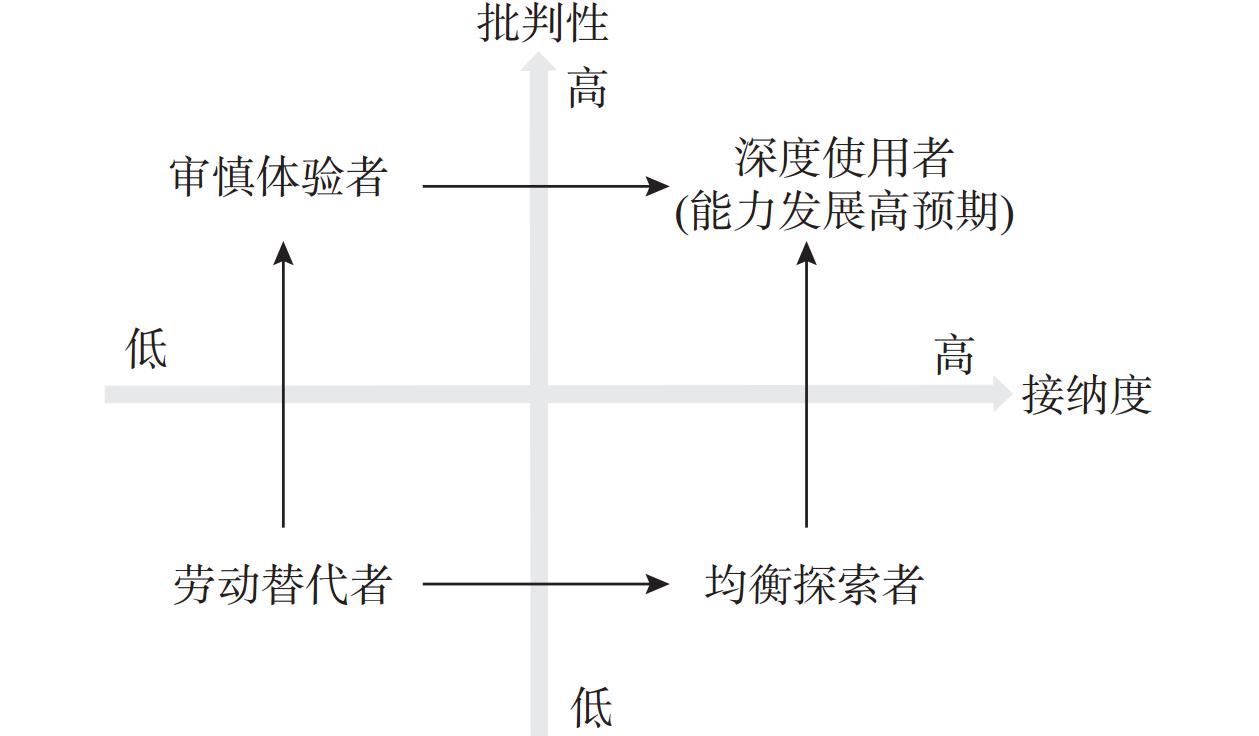
基于对全国20所高校12678名本科生的调查和实证分析发现:大部分学生在利用GenAI开展思辨性和创造性活动等高阶思维活动时会具有较高的批判使用态度,并预期GenAI辅助学习将对问题解决能力的发展具有积极影响;进一步基于潜在剖面分析和计量回归分析发现,学生使用GenAI辅助学习呈现出4种差异化类型,反映出大学生在人工智能使用中技术接纳度与自我调节学习能力的双向互动:审慎体验者(占42%),具有“低接纳度-高批判性使用-能力发展低预期”的特点;劳动替代者(占24%),具有“低接纳度-低批判性使用-能力发展较高预期”的特点;均衡探索者(占21.2%),具有“高接纳度-低批判性使用--能力发展较高预期”的特点;深度使用者(占12.8%),具有“高接纳度-高批判性使用-能力发展高预期”的特点。基于上述研究发现本文进一步指出高校引导本科生正确使用生成式人工智能工具的必要性和有效策略,包括提供有针对性的教育干预、培养学生的人工智能素养等,使各类学生逐步向“高接纳度-高批判性使用-能力发展高预期”类型转化。
马莉萍, 郑翔睿, 周雪涵. 使用生成式人工智能辅助学习的学生类型画像——基于全国20所高校本科生调查的实证研究[J]. 华东师范大学学报(教育科学版), 2026, 44(1): 65-79.
Liping Ma, Xiangrui Zheng, Xuehan Zhou. Portraits of College Student Types Using Generative AI for Learning: An Empirical Study Based on a Survey of Undergraduates from 20 Universities Nationwide[J]. Journal of East China Normal University(Educationa, 2026, 44(1): 65-79.
表 1
大学生GenAI应用场景分类"
| 思维活动层次 | 活动类型 | 举例 |
| 低阶 | 知识性活动 | 使用GenAI认识、理解、掌握知识或技能,如概念解释、解题步骤、语法纠错等 |
| 机械性活动 | 使用GenAI从事重复性高、较少需要深度思考和创造的工作,如数据录入、文献检索、 文章翻译等 | |
| 高阶 | 思辨性活动 | 使用GenAI分析、概括、评价、批判相关材料,如学术辩论、案例研究、论文分析、理论探讨等 |
| 创造性活动 | 使用GenAI生产原创性成果,如研究思路、实验设计、论文写作、软件设计、艺术创作等 |
表 2
大学生GenAI使用模式各潜在类别模型拟合度比较表"
| AIC | BIC | aBIC | Entropy | LMR p值 | BLRT p值 | 类别概率 | |
| 2 | − | − | − | 0.879 | <0.001 | <0.001 | 0.626/0.374 |
| 3 | − | − | − | 0.852 | <0.001 | <0.001 | 0.455/0.404/0.141 |
| 4 | − | − | − | 0.999 | <0.001 | <0.001 | 0.420/0.212/0.128/0.240 |
| 5 | − | − | − | 0.999 | >0.001 | <0.001 | 0.177/0.243/0.240/0.212/0.128 |
| 6 | − | − | − | 0.981 | >0.001 | <0.001 | 0.172/0.215/0.240/0.212/0.128/0.033 |
图 1
四类GenAI使用模式的潜在类别图"
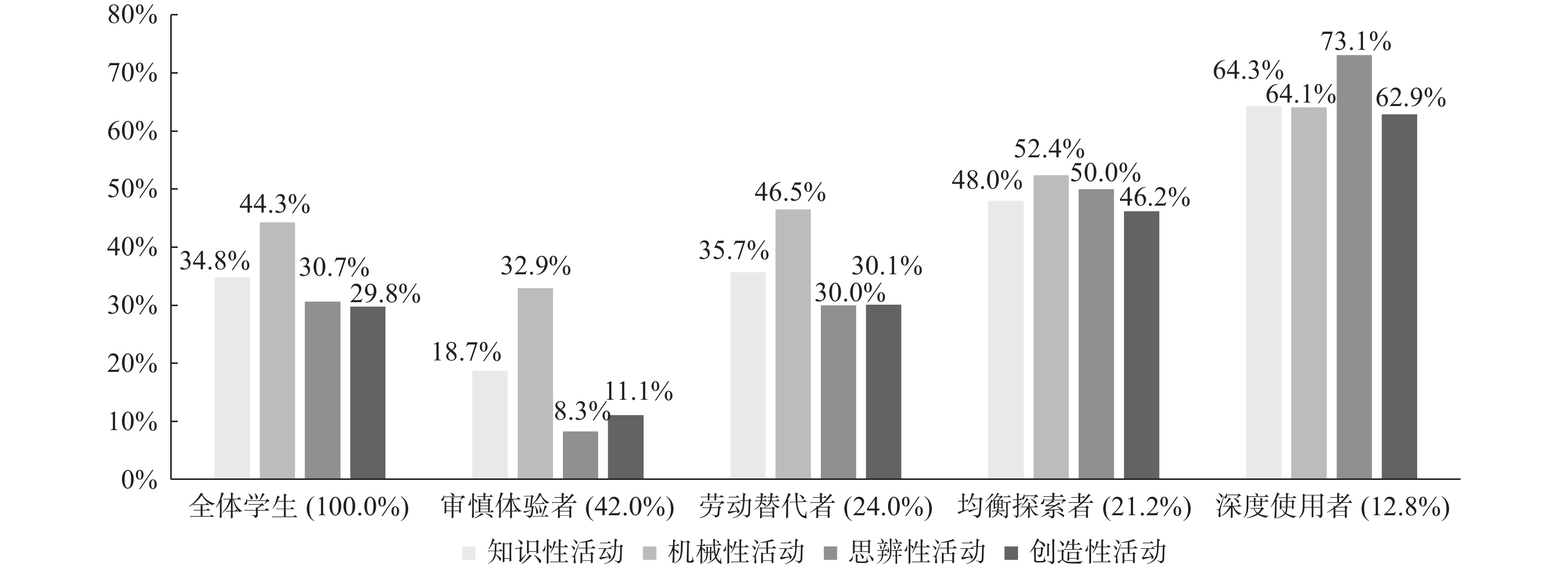
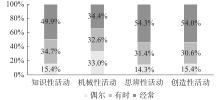
图 2
对GenAI进行批判性使用的情况"
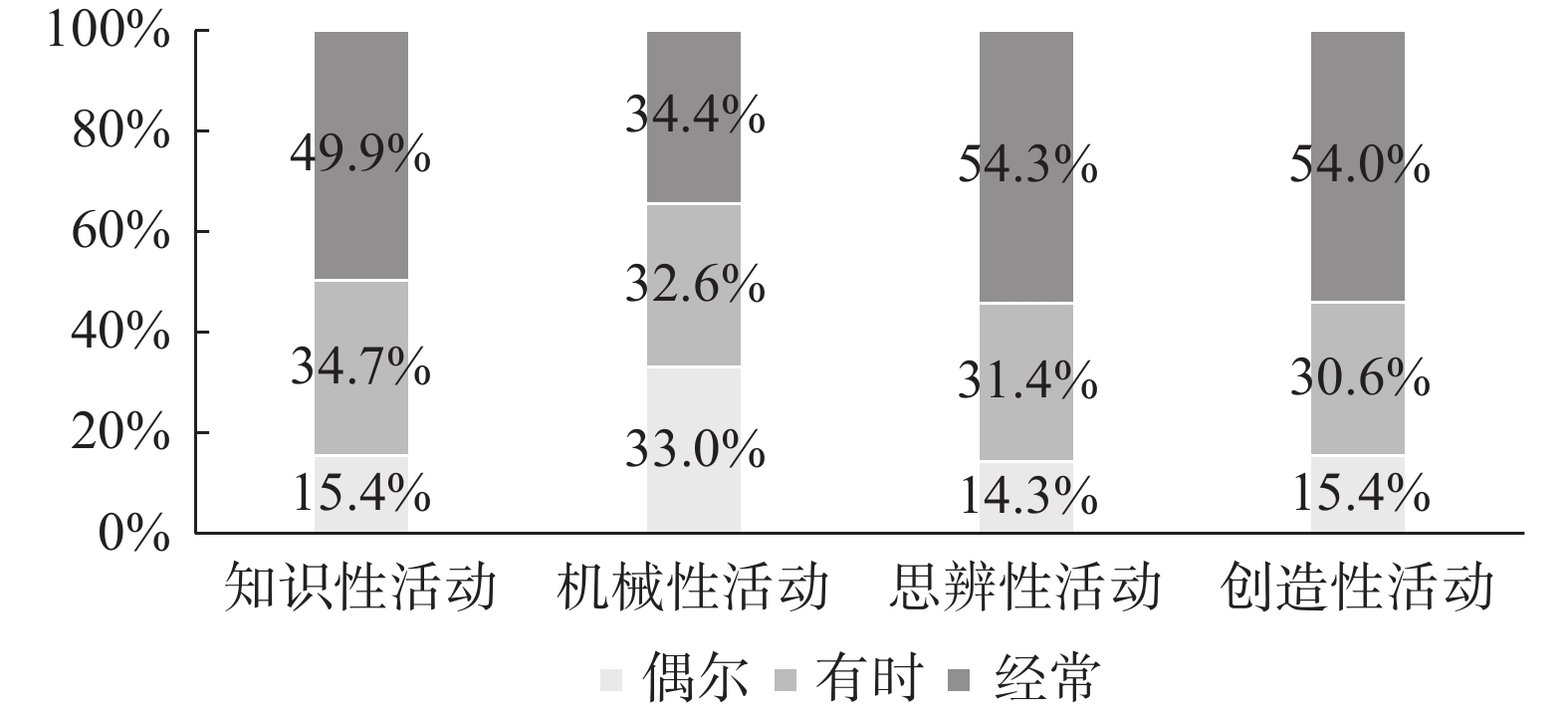
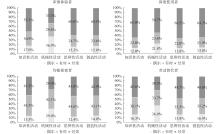
图 3
四类学生的GenAI批判性使用情况"
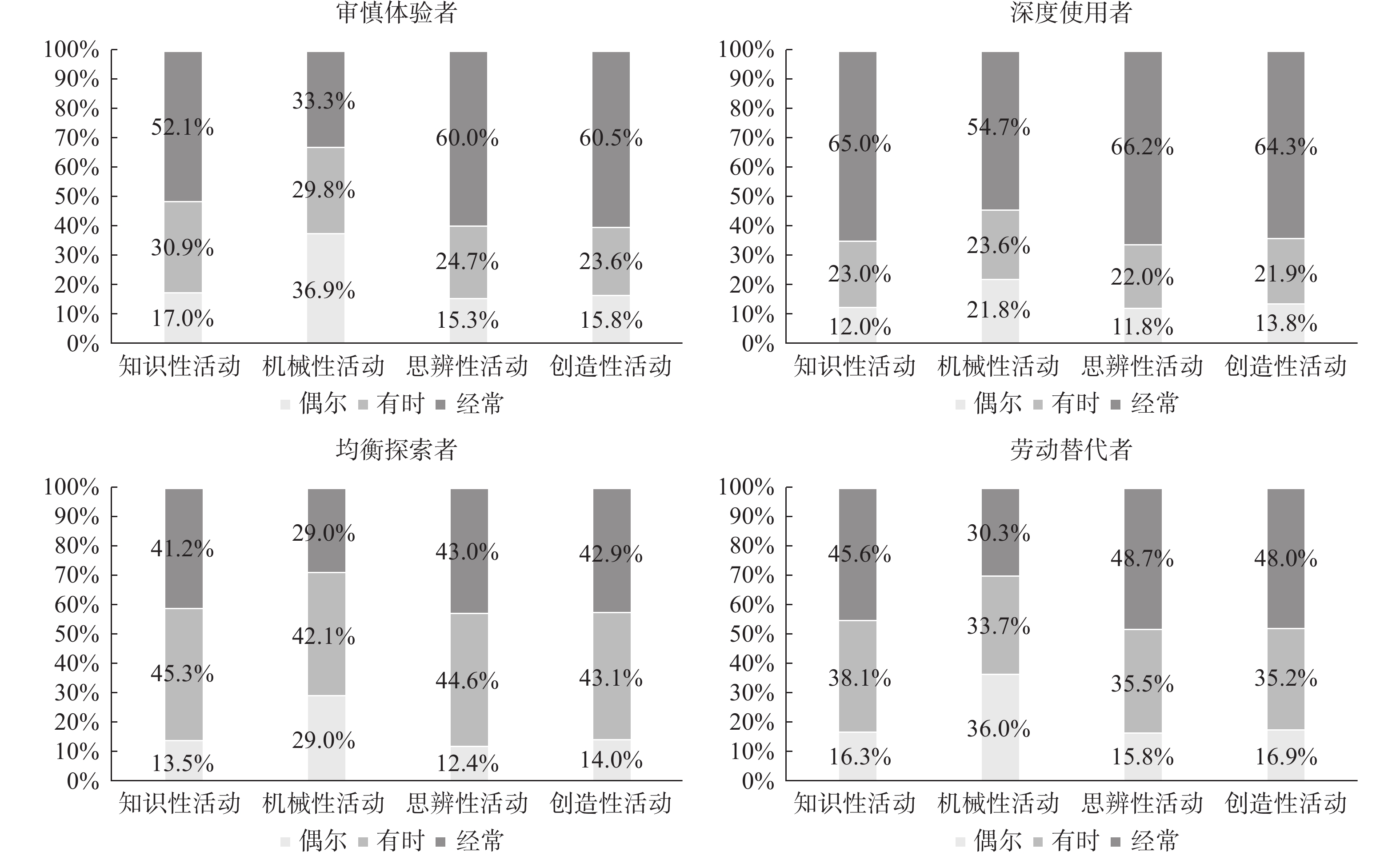
表 3
四类学生的批判性使用情况差异"
| (1) | (2) | (3) | (4) | |
| 知识性活动 | 机械性活动 | 思辨性活动 | 创造性活动 | |
| 对照组:均衡探索者 | ||||
| 审慎体验者 | 0.224*** | −0.054 | 0.436*** | 0.466*** |
| (0.046) | (0.044) | (0.047) | (0.047) | |
| 深度使用者 | 0.780*** | 0.802*** | 0.758*** | 0.663*** |
| (0.066) | (0.064) | (0.066) | (0.066) | |
| 劳动替代者 | 0.057 | −0.110** | 0.082* | 0.065 |
| (0.049) | (0.048) | (0.049) | (0.049) | |
| 控制变量 | 是 | 是 | 是 | 是 |
| N | 11,213 | 11,193 | 10,992 | 10,853 |
图 4
使用GenAI辅助学习影响能力发展的预期"
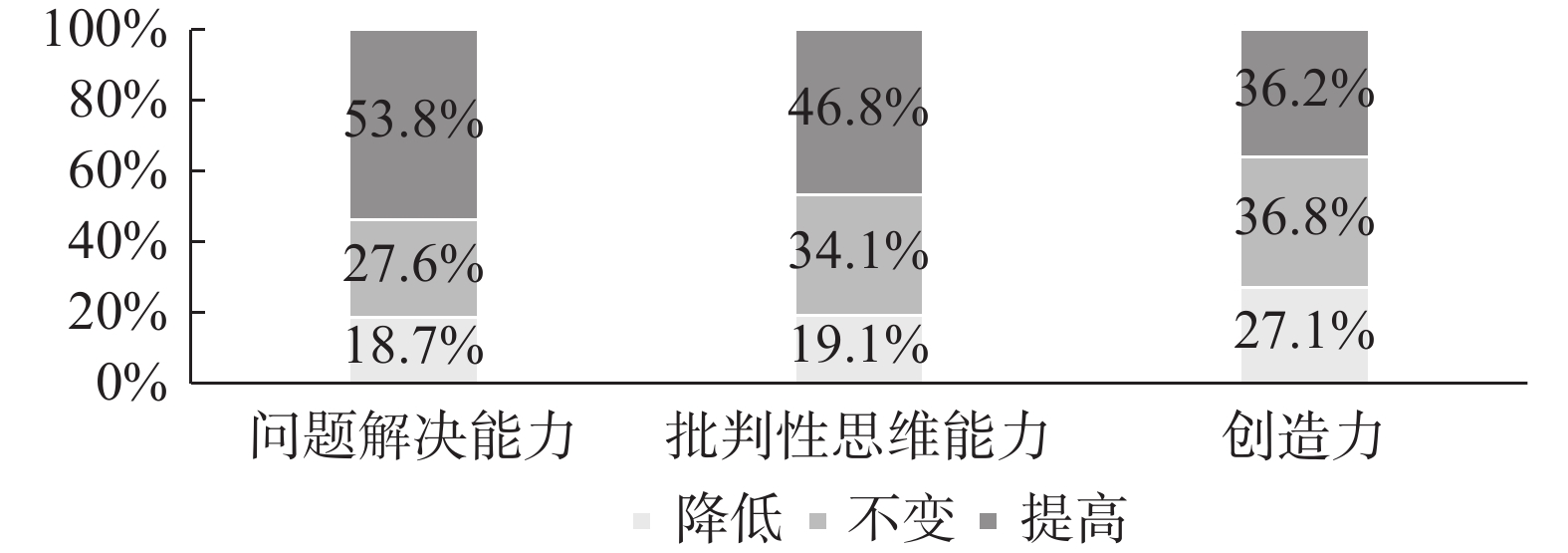
图 5
四类学生的高阶思维能力发展预期"
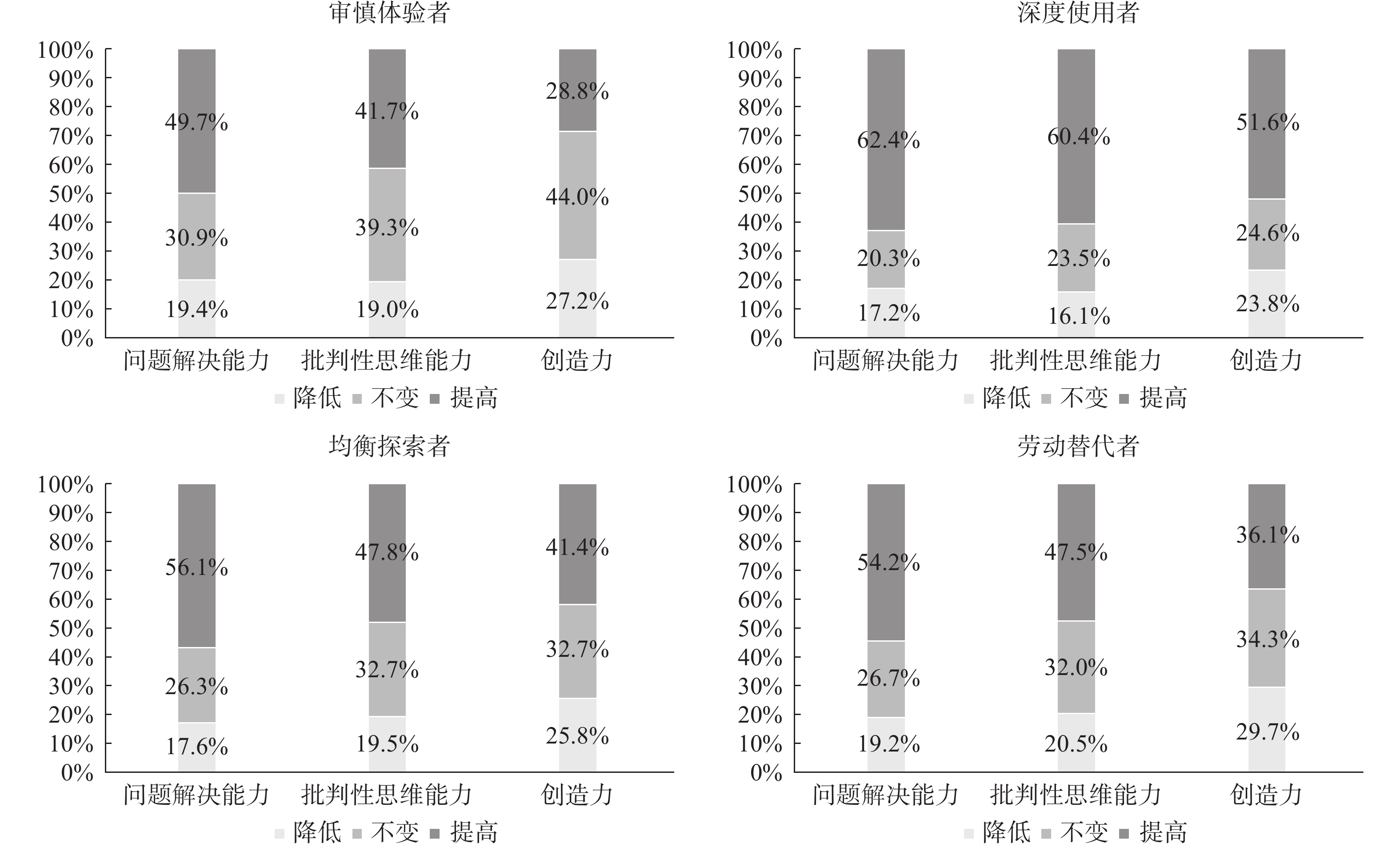
表 4
四类学生的自评高阶思维能力发展差异"
| (1) | (2) | (3) | |
| 问题解决能力 | 批判性思维能力 | 创造力 | |
| 对照组:均衡探索者 | |||
| 审慎体验者 | −0.245*** | −0.159*** | −0.335*** |
| (0.048) | (0.047) | (0.047) | |
| 深度使用者 | 0.196*** | 0.458*** | 0.325*** |
| (0.068) | (0.068) | (0.069) | |
| 劳动替代者 | −0.099* | −0.026 | −0.220*** |
| (0.052) | (0.052) | (0.053) | |
| 控制变量 | 是 | 是 | 是 |
| N | 11,566 | 11,566 | 11,566 |
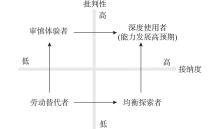
图 6
四类学生对GenAI的接纳度与批判性"
| 1 |
毕文轩. (2023). 生成式人工智能对教育行业的挑战与回应——以ChatGPT为分析对象. 江苏高教, 8, 13- 22.
doi: 10.13236/j.cnki.jshe.2023.08.002 |
| 2 | 段世飞, 钱跳跳. (2024). ChatGPT浪潮下的高阶能力培养: 可为、难为、何为? 河北师范大学学报(教育科学版), 26(4), 80—88. https://doi.org/10.13763/j.cnki.jhebnu.ese.2024.04.011. |
| 3 | 高海燕, 张优良. (2024). 英美著名高校的生成式人工智能政策及其启示. 现代教育技术, 34 (7), 42- 50. |
| 4 |
高琳琦. (2023). 生成式人工智能在个性化学习中的应用模式. 天津师范大学学报(基础教育版), 24 (4), 36- 40.
doi: 10.16826/j.cnki.1009-7228.2023.04.007 |
| 5 |
姜华, 王春秀, 杨暑东. (2023). 生成式AI在教育领域的应用潜能、风险挑战及应对策略. 现代教育管理, 7, 66- 74.
doi: 10.16697/j.1674-5485.2023.07.007 |
| 6 | 怀进鹏. (2025). 怀进鹏在2025世界数字教育大会作主旨演讲. 取自教育部网站: http://www.moe.gov.cn/jyb_xwfb/gzdt_gzdt/moe_1485/202505/t20250515_1190601.html. |
| 7 |
李会春. (2023). ChatGPT技术热潮下教育变革的挑战和对策. 复旦教育论坛, 21 (2), 13- 23.
doi: 10.13397/j.cnki.fef.2023.02.006 |
| 8 | 李曼丽, 乔伟峰, 李睿淼. (2025). 大语言模型工具能促进高校学生的高阶思维能力发展吗?——基于12所双一流大学学生问卷调查的实证分析. 现代教育技术, 35 (1), 34- 43. |
| 9 |
李艳, 许洁, 贾程媛, 翟雪松. (2024). 大学生生成式人工智能应用现状与思考——基于浙江大学的调查. 开放教育研究, 30 (1), 89- 98.
doi: 10.13966/j.cnki.kfjyyj.2024.01.010 |
| 10 | 刘盛. (2023). 美国一流大学在教育教学实践中应用ChatGPT的划界及其启示. 高等教育研究, 44 (10), 89- 98. |
| 11 | 马银琦, 黄恒等. (2024). “技术赋能”还是“工具依赖”: 生成式人工智能对研究生科研创新力的影响研究. 电化教育研究, 12, 58- 66. |
| 12 |
王思遥, 黄亚婷. (2024). 促进或抑制: 生成式人工智能对大学生创造力的影响. 中国高教研究, 11, 29- 36.
doi: 10.16298/j.cnki.1004-3667.2024.11.05 |
| 13 |
吴青, 刘毓文. (2023). ChatGPT时代的高等教育应对: 禁止还是变革. 高校教育管理, 17 (3), 32- 41.
doi: 10.13316/j.cnki.jhem.20230504.004 |
| 14 |
荀渊. (2023). ChatGPT/生成式人工智能与高等教育的价值和使命. 华东师范大学学报(教育科学版), 41 (7), 56- 63.
doi: 10.16382/j.cnki.1000-5560.2023.07.006 |
| 15 |
张艳丽, 杨颉. (2024). ChatGPT在高等教育应用中的“科林格里奇困境”及其对知识生产与人才培养的影响. 上海交通大学学报(哲学社会科学版), 32 (10), 99- 109.
doi: 10.13806/j.cnki.issn1008-7095.2024.10.008 |
| 16 |
Abdaljaleel, M., Barakat, M., Alsanafi, M., Salim, N. A., Abazid, H., Malaeb, D., Mohammed, A. H., Hassan, B. A. R., Wayyes, A. M., Farhan, S. S., Khatib, S. E., Rahal, M., Sahban, A., Abdelaziz, D. H., Mansour, N. O., AlZayer, R., Khalil, R., Fekih-Romdhane, F., Hallit, R., … Sallam, M. (2024). A multinational study on the factors influencing university students’ attitudes and usage of ChatGPT. Scientific Reports, 14 (1), 1983.
doi: 10.1038/s41598-024-52549-8 |
| 17 |
Ahmad, S. F., Han, H., Alam, M. M., Rehmat, Mohd. K., Irshad, M., Arraño-Muñoz, M., & Ariza-Montes, A. (2023). Impact of artificial intelligence on human loss in decision making, laziness and safety in education. Humanities and Social Sciences Communications, 10 (1), 311.
doi: 10.1057/s41599-023-01787-8 |
| 18 | Anderson, L. W. , & Bloom, B. S. (2001). A taxonomy for learning, teaching, and assessing: A revision of Bloom’s taxonomy of educational objectives (Complete ed). Longman. |
| 19 |
Budhathoki, T., Zirar, A., Njoya, E. T., & Timsina, A. (2024). ChatGPT adoption and anxiety: A cross-country analysis utilising the unified theory of acceptance and use of technology (UTAUT). Studies in Higher Education, 49 (5), 831- 846.
doi: 10.1080/03075079.2024.2333937 |
| 20 |
Essien, A., Bukoye, O. T., O’Dea, X., & Kremantzis, M. (2024). The influence of AI text generators on critical thinking skills in UK business schools. Studies in Higher Education, 49 (5), 865- 882.
doi: 10.1080/03075079.2024.2316881 |
| 21 |
Farrokhnia, M., Banihashem, S. K., Noroozi, O., & Wals, A. (2024). A SWOT analysis of ChatGPT: Implications for educational practice and research. Innovations in Education and Teaching International, 61 (3), 460- 474.
doi: 10.1080/14703297.2023.2195846 |
| 22 | Fauzi, F. , Tuhuteru, L. , Sampe, F. , Ausat, A. M. A. , & Hatta, H. R. (2023). Analysing the Role of ChatGPT in Improving Student Productivity in Higher Education. Journal on Education, 5(4), Article 4. https://doi.org/10.31004/joe.v5i4.2563. |
| 23 | Habib, S. , Vogel, T. , Anli, X. , & Thorne, E. (2024). How does generative artificial intelligence impact student creativity? Journal of Creativity, 34(1), 100072. https://doi.org/10.1016/j.yjoc.2023.100072. |
| 24 |
Hitsuwari, J., Ueda, Y., Yun, W., & Nomura, M. (2023). Does human–AI collaboration lead to more creative art? Aesthetic evaluation of human-made and AI-generated haiku poetry. Computers in Human Behavior, 139, 107502.
doi: 10.1016/j.chb.2022.107502 |
| 25 | Hwang, G. -J. , Lai, C. -L. , Liang, J. -C. , Chu, H. -C. , & Tsai, C. -C. (2018). A long-term experiment to investigate the relationships between high school students’ perceptions of mobile learning and peer interaction and higher-order thinking tendencies. Educational Technology Research and Development, 66(1), 75—93. https://doi.org/10.1007/s11423-017-9540-3. |
| 26 | Kabir, S. , Udo-Imeh, D. N. , Kou, B. , & Zhang, T. (2024). Is Stack Overflow Obsolete? An Empirical Study of the Characteristics of ChatGPT Answers to Stack Overflow Questions. Proceedings of the CHI Conference on Human Factors in Computing Systems, 1—17. https://doi.org/10.1145/3613904.3642596. |
| 27 |
Kasneci, E., Sessler, K., Küchemann, S., Bannert, M., Dementieva, D., Fischer, F., Gasser, U., Groh, G., Günnemann, S., Hüllermeier, E., Krusche, S., Kutyniok, G., Michaeli, T., Nerdel, C., Pfeffer, J., Poquet, O., Sailer, M., Schmidt, A., Seidel, T., … Kasneci, G. (2023). ChatGPT for good? On opportunities and challenges of large language models for education. Learning and Individual Differences, 103, 102274.
doi: 10.1016/j.lindif.2023.102274 |
| 28 |
Lo, C. K., Hew, K. F., & Jong, M. S. (2024). The influence of ChatGPT on student engagement: A systematic review and future research agenda. Computers & Education, 219, 105100.
doi: 10.1016/j.compedu.2024.105100 |
| 29 | Michel-Villarreal, R. , Vilalta-Perdomo, E. , Salinas-Navarro, D. E. , Thierry-Aguilera, R. , & Gerardou, F. S. (2023). Challenges and Opportunities of Generative AI for Higher Education as Explained by ChatGPT. Education Sciences, 13(9), Article 9. https://doi.org/10.3390/educsci13090856. |
| 30 | Minh, A. N. (2024). Leveraging ChatGPT for Enhancing English Writing Skills and Critical Thinking in University Freshmen. Journal of Knowledge Learning and Science Technology ISSN: 2959-6386 (Online), 3(2), Article 2. https://doi.org/10.60087/jklst.vol3.n2.p62. |
| 31 | Nguyen, A. , Hong, Y. , Dang, B. , & Huang, X. (2024). Human-AI collaboration patterns in AI-assisted academic writing. Studies in Higher Education. https://www.tandfonline.com/doi/abs/10.1080/03075079.2024.2323593. |
| 32 |
Noy, S., & Zhang, W. (2023). Experimental evidence on the productivity effects of generative artificial intelligence. Science, 381 (6654), 187- 192.
doi: 10.1126/science.adh2586 |
| 33 | Opara, E. , Mfon-Ette Theresa, A. , & Aduke, T. C. (2023). ChatGPT for Teaching, Learning and Research: Prospects and Challenges (SSRN Scholarly Paper No. 4375470). https://papers.ssrn.com/abstract=4375470. |
| 34 | Ruiz-Rojas, L. I. , Salvador-Ullauri, L. , & Acosta-Vargas, P. (2024). Collaborative Working and Critical Thinking: Adoption of Generative Artificial Intelligence Tools in Higher Education. Sustainability, 16(13), Article 13. https://doi.org/10.3390/su16135367. |
| 35 |
Stojanov, A., Liu, Q., & Koh, J. H. L. (2024). University students’ self-reported reliance on ChatGPT for learning: A latent profile analysis. Computers and Education: Artificial Intelligence, 6, 100243.
doi: 10.1016/j.caeai.2024.100243 |
| 36 |
Strzelecki, A. (2023). To use or not to use ChatGPT in higher education? A study of students’ acceptance and use of technology. Interactive Learning Environments, 32 (9), 5142- 5155.
doi: 10.1080/10494820.2023.2209881 |
| 37 |
Suriano, R., Plebe, A., Acciai, A., & Fabio, R. A. (2025). Student interaction with ChatGPT can promote complex critical thinking skills. Learning and Instruction, 95, 102011.
doi: 10.1016/j.learninstruc.2024.102011 |
| 38 | Urban, M., Děchtěrenko, F., Lukavský, J., Hrabalová, V., Svacha, F., Brom, C., & Urban, K. (2024). ChatGPT improves creative problem-solving performance in university students: An experimental study. Computers & Education, 215, 105031 |
| 39 |
Von Garrel, J., & Mayer, J. (2023). Artificial Intelligence in studies—Use of ChatGPT and AI-based tools among students in Germany. Humanities and Social Sciences Communications, 10 (1), 799.
doi: 10.1057/s41599-023-02304-7 |
| 40 |
Yilmaz, H., Maxutov, S., Baitekov, A., & Balta, N. (2023). Student Attitudes towards Chat GPT: A Technology Acceptance Model Survey. International Educational Review, 1 (1), 57- 83.
doi: 10.58693/ier.114 |
| 41 | Zimmerman, B. J. (2002). Becoming a Self-Regulated Learner: An Overview. Theory into Practice. https://doi.org/10.1207/s15430421tip4102_2. |
| [1] | 钟柏昌, 林小红. 生成式人工智能时代“学习的革命”:生成式自我调节学习[J]. 华东师范大学学报(教育科学版), 2026, 44(1): 44-55. |
| [2] | 高盼望, 路书红. 生成式人工智能时代的“课程”概念重建[J]. 华东师范大学学报(教育科学版), 2025, 43(6): 50-60. |
| [3] | 顾小清, 郝祥军. 悟空的毫毛:正在重塑学习技术系统的多智能体[J]. 华东师范大学学报(教育科学版), 2025, 43(5): 16-29. |
| [4] | 杨茂庆, 黄茂林. 青少年价值观类型与家庭背景的关系:基于潜在剖面分析[J]. 华东师范大学学报(教育科学版), 2025, 43(4): 41-52. |
| [5] | 何珊云, 沈演. 学会提问:大学生与生成式人工智能协同学习模式的研究[J]. 华东师范大学学报(教育科学版), 2025, 43(2): 34-48. |
| [6] | 宋萑, 林敏. ChatGPT/生成式人工智能时代下教师的工作变革:机遇、挑战与应对[J]. 华东师范大学学报(教育科学版), 2023, 41(7): 78-90. |
| [7] | 徐国庆, 蔡金芳, 姜蓓佳, 李政, 杨惠, 郑杰. ChatGPT/生成式人工智能与未来职业教育[J]. 华东师范大学学报(教育科学版), 2023, 41(7): 64-77. |
| [8] | 荀渊. ChatGPT/生成式人工智能与高等教育的价值和使命[J]. 华东师范大学学报(教育科学版), 2023, 41(7): 56-63. |
| [9] | 李政涛. ChatGPT/生成式人工智能对基础教育之“基础”的颠覆与重置[J]. 华东师范大学学报(教育科学版), 2023, 41(7): 47-55. |
| [10] | 周洪宇, 李宇阳. 生成式人工智能技术ChatGPT与教育治理现代化——兼论数字化时代的教育治理转型[J]. 华东师范大学学报(教育科学版), 2023, 41(7): 36-46. |
| [11] | 杨宗凯, 王俊, 吴砥, 陈旭. ChatGPT/生成式人工智能对教育的影响探析及应对策略[J]. 华东师范大学学报(教育科学版), 2023, 41(7): 26-35. |
| [12] | 陈静远, 胡丽雅, 吴飞. ChatGPT/生成式人工智能促进以知识点为核心的教学模式变革研究[J]. 华东师范大学学报(教育科学版), 2023, 41(7): 177-186. |
| [13] | 倪闽景. 从学习进化的视角看ChatGPT/生成式人工智能对学习的影响[J]. 华东师范大学学报(教育科学版), 2023, 41(7): 151-161. |
| [14] | 余南平, 张翌然. ChatGPT/生成式人工智能对教育的影响:大国博弈新边疆[J]. 华东师范大学学报(教育科学版), 2023, 41(7): 15-25. |
| [15] | 张治. ChatGPT/生成式人工智能重塑教育的底层逻辑和可能路径[J]. 华东师范大学学报(教育科学版), 2023, 41(7): 131-142. |
| 阅读次数 | ||||||
|
全文 |
|
|||||
|
摘要 |
|
|||||
