
 中国人文社会科学核心期刊
华东师范大学学报(教育科学版) ›› 2026, Vol. 44 ›› Issue (2): 1-31.doi: 10.16382/j.cnki.1000-5560.2026.02.001
• 特稿 •
戴耘1, 雷维娜2, 朱琳3
出版日期:2026-02-01
发布日期:2026-01-26
基金资助:Yun Dai David1, Weina Lei2, Lin Zhu3
Online:2026-02-01
Published:2026-01-26
摘要:
创新人才培养在基础教育和高等教育中正如火如荼地展开,但是,从识别方法到培养效果,测评和评价如何有效进行,依然缺乏一种坚实的理论支撑和方法论指导。本文提出一个在发展科学基础上建立的创新人才发展的三阶段理论框架,它的特点是用“近侧过程”理论和“动态发展”测评方法论指导测评和评价实践。本文进一步提出五种“测评场景”(选拔,诊断,培养,咨询,自测),每种场景都有自己的情境、目标、测评重点和手段。本文的基本观点是,测评和评价应该和人才培养相辅相成,直接参与培养过程,直接助力人才的成长。为此,本文展望在人工智能的加持下,建立一个辅助个人自主学习、自我提升的测评/培养技术平台的前景,并提出实现这一平台与人才培养手段的良性互动,形成闭环的可能途径。
戴耘, 雷维娜, 朱琳. 走向科学的和多用途的“创新人才识别/培养测评体系”:理论架构与策略分析[J]. 华东师范大学学报(教育科学版), 2026, 44(2): 1-31.
Yun Dai David, Weina Lei, Lin Zhu. Toward a Scientific, Multi-Purpose System of Assessment for Identifying and Nurturing Creative Talent[J]. Journal of East China Normal University(Educationa, 2026, 44(2): 1-31.
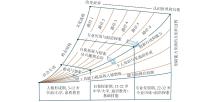
图 1
创新人才成长的时空-心理动态系统观和人才的复杂演进 (戴耘,2025)"
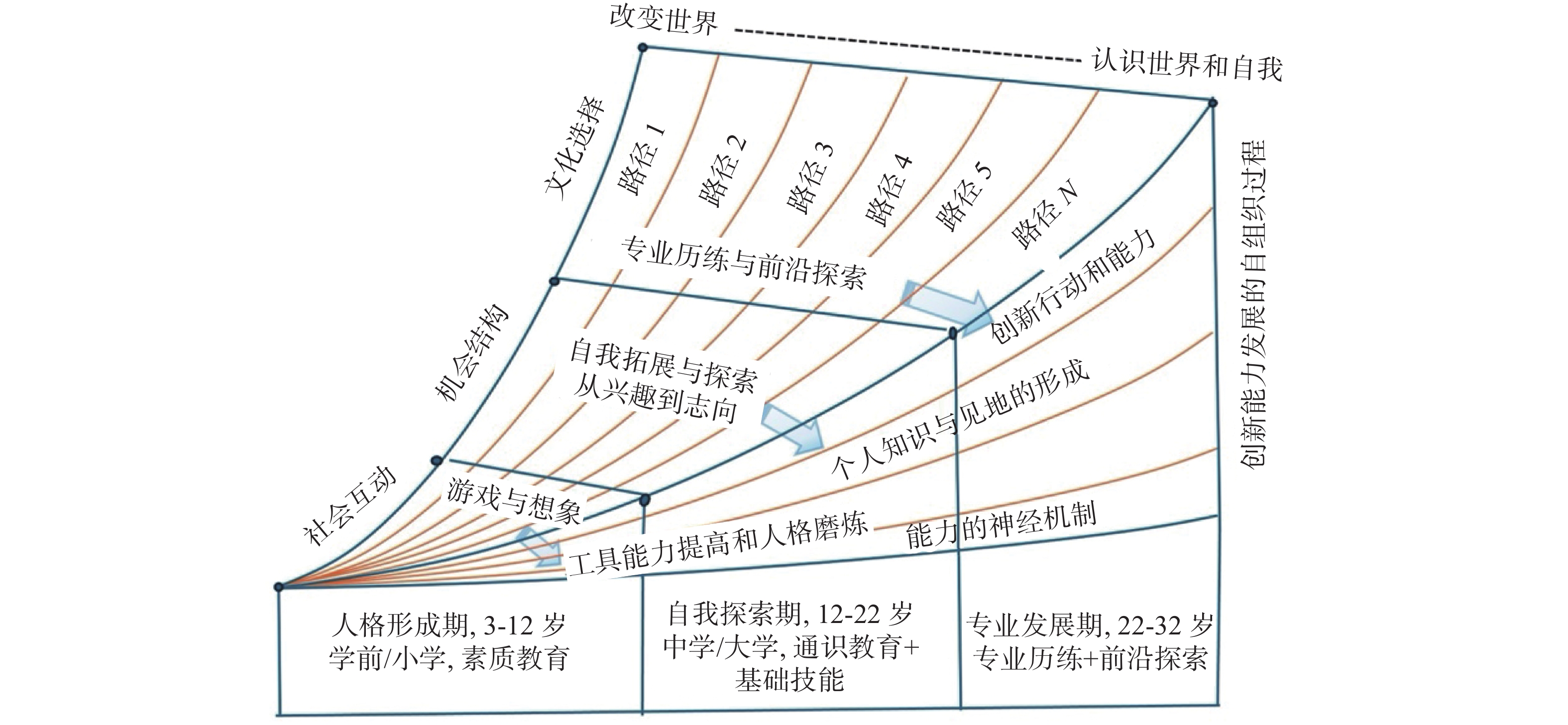
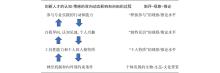
图 2
创新人才测评的几个基本认知-情感水平和心理-社会过程 注:上下箭头代表自下而上和自上而下的认知-情感自组织发展过程"
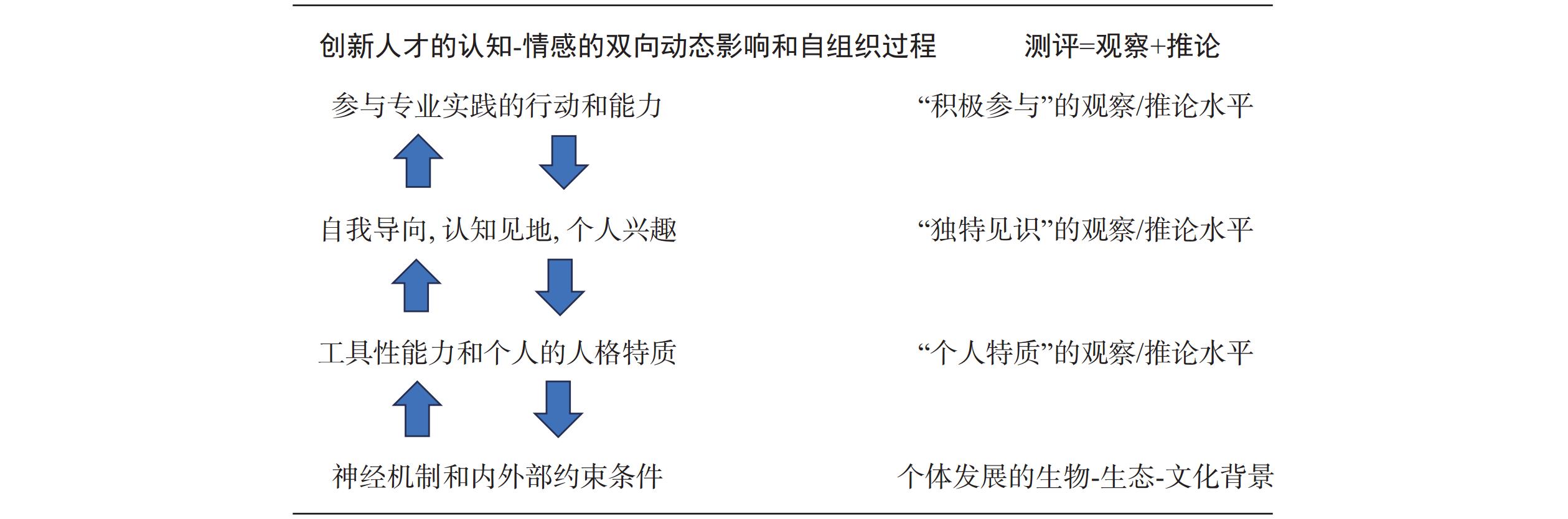
图 3
跟踪样本中各专业的学士、硕士、博士在13岁时的语文、空间、数学能力 注:横轴为各专业的三种能力(V=语文,S=空间,M=数学)的比较,纵轴为三个成绩水平高低。在本图右侧可观察到,数学/计算机、物理科学、工程学(右侧)的博士学位获得者在13岁时数学上(粗实线)远高于其他组。来源:Lubinski, 2010。"
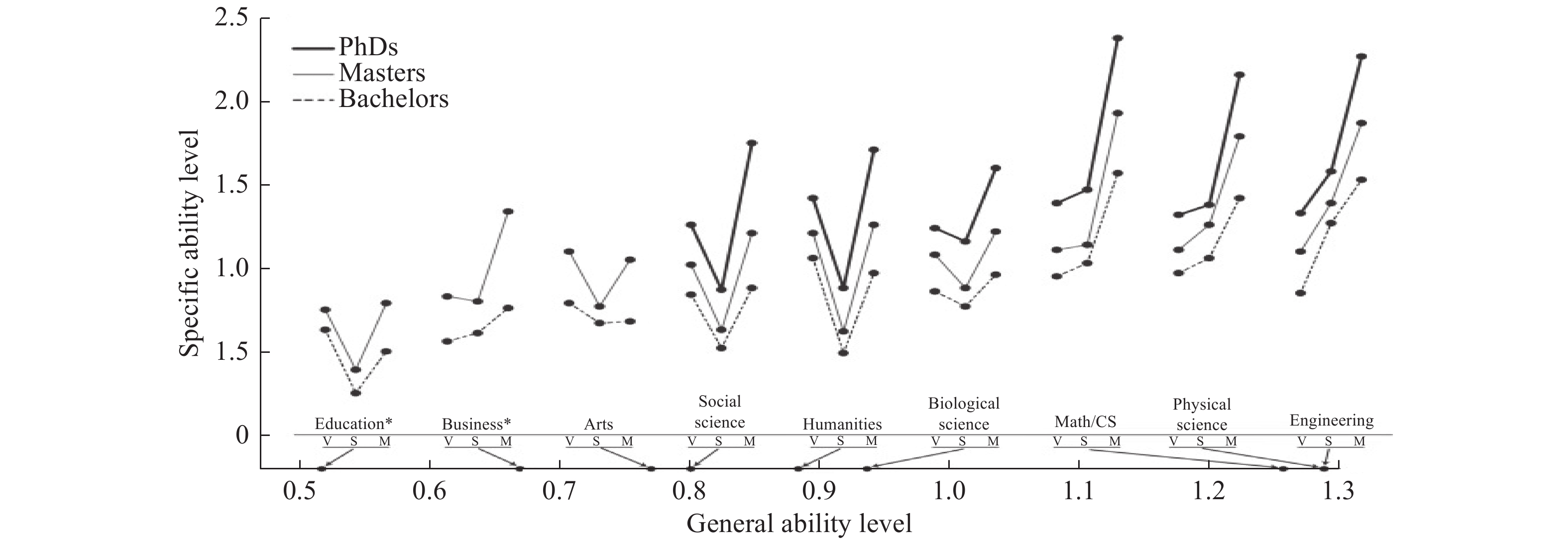
图 4
“复杂演进理论”的人类生态-文化效能的个体发展结构 注:参见“复杂演进理论”ECT(Dai, 2024);最初发表于Sternberg & Ambrose(2021)。"
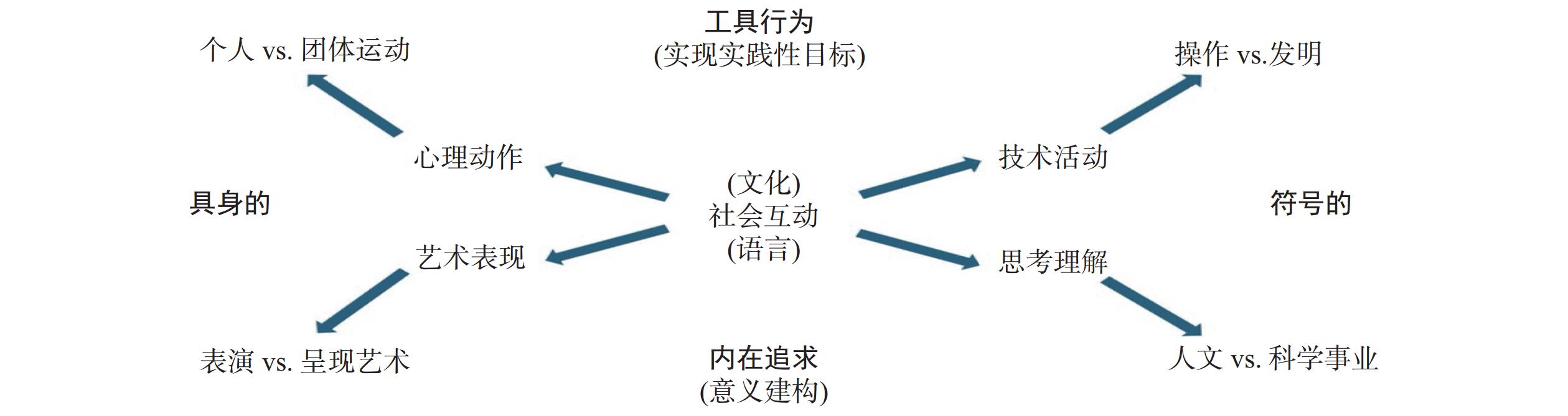
表 1
人才发展前三阶段的活动,任务,里程碑事件"
| 起步-探索(学前/小学) 人格形成期 | 探索-入门(中学/大学) 自我探索期 | 入门-出道(职业生涯) 专业发展期 | |
| 介入程度 | 尝试性、探索性的 | 积极的、深入的 | 专业的、自我超越的 |
| 教育活动和发展目 标 | 活动:校内校外的各种尝试、学习、体验、观摩 目标:提高素养,开阔眼界 | 活动:专业技能的训练,有产出活动,如创作、演出、比赛、演讲 目标:掌握技术,提升效能 | 活动:参与一线的实践;积极与同行互动;发现问题并进行新尝试 目标:成为专业共同体的重要成员 |
| 对自己的 认识 | 了解自己的长处、兴趣;对自己的“比较优势”有自觉 | 确定人生方向;兴趣到志趣,内在价值与影响受众的社会价值 | 对自己在领域中的作用、贡献的定位日益清晰 |
| 对领域的 认识 | 有粗浅的感性了解;理解是主题性的,不是专业性的 | 对领域的本质和主题、专业的期待有相当的认识,尤其和其他领域比较 | 对领域的重大课题、领域的进展、存在的问题有深入认识(元知识) |
| 领域的个人意义 | 领域的个人意义限于有趣,时尚,有社会价值 | 领域的性质和个人的价值观和个人特长有高度吻合 | 能看到自己在领域发展中的价值;能发现领域本身的魅力和内在价值 |
| 发展的里程碑事件 | 在一些领域有出众的表现(可以校内、校外,如作文受到老师 表扬) | 竞赛得奖,入围; 作品发表,成为有关的学校社团的领头人 | 重要发明、发现、作品 重要表彰、奖项 进入重点实验室,等等 |
图 5
伦祖利和阿玛贝里的创新人才的动态vs. 静态模型比较 注:左为阿玛贝里的三要素创新人才模型,右为伦祖利的三环创新人才理论"
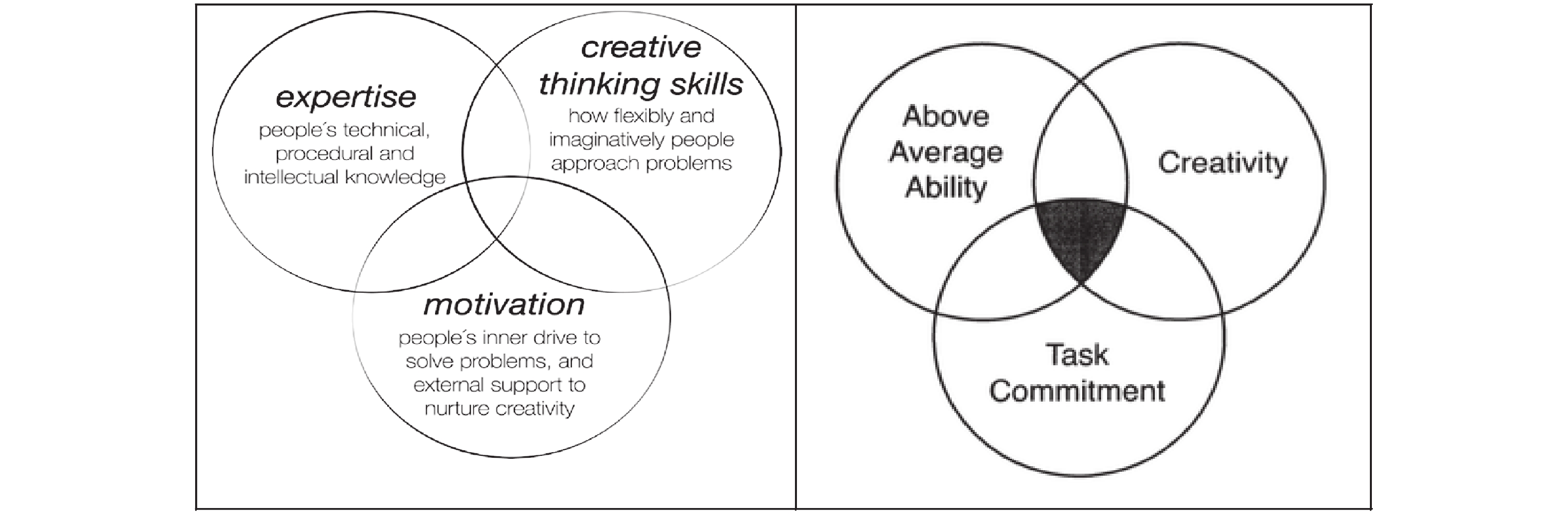

图 6
创新人才选拔的两个维度和选拔策略 注:原载于戴耘(2024)"
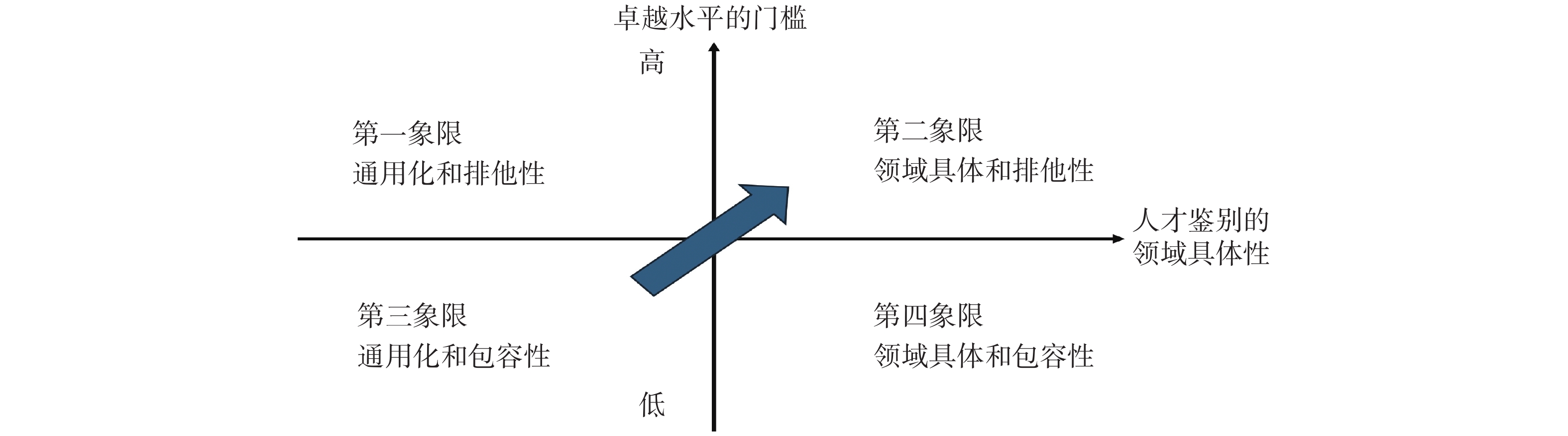
表 2
每个领域的人才培养的三个阶段和每个阶段中人才动态评价的三组指标"
| 发展阶段/过程 | 初级阶段 | 中级阶段 | 高级阶段 |
| 教育/培养活动 | • 真实的学习任务 • 主题讨论 • 解决问题的表现 • 沟通和自我表达 | • 学科知识的系统引入 • 项目式学习/探究式学习 • 参与真实的实践、实习 • 专业课程系列 | • 深度介入专业实践活动 • 个人或合作研究项目 • 学术/专业共同体的参与 • 高层次学术和专业发展 |
| 能力的在线 | • 展示出色能力和学习易度 • 展示鲜明的认知个性 | • 展示实质进展和成就 • 展示独特的认知和见地 | • 展示思想和技术的成熟 • 展示知识和技术前沿的独特思考和探索 |
| 兴趣的在线 | • 自发、积极的态度 • 兴趣的坚持 • 兴趣的个人特点(好奇心、不惧陌生环境,社会性兴奋) | • 兴趣的个人性(选择亲和性;不是从众反应) • 兴趣的认知深度和延展性(兴趣沉淀为问题,问题激发探究意向;一个问题引向另一个的问题) | • 意义驱动工作热情 • 对问题本身的执着 • 解决问题的愉悦感 |
| 承诺的在线 | • 个人与对象或任务的认同感 • 虽苦犹乐的自发性 • 为长期目标愿意牺牲当下满足 | • 对学习和工作价值的认同 • 理解自己需要为此付出的努力 • 理解自己工作对社会的价值和 意义 | • 追求卓越成为一种使命 • 个人目的自足性 • 知性逐渐达到统一 |
表 3
对五种测评场景的总结:评价对象/标准、方法、目的"
| 测评场景 | 测评对象/标准 | 测评和评价方法 | 评价目的 |
| 选拔场景 | 初级阶段/早期能力和倾向 中级阶段/独特认知和见地 | 选拔性和领域特殊性原则; 群体依据“常模” 测评,推荐/自荐等筛选和个体的情境测评相结合; | 建立一个和个体的年龄和经历相应,和计划培养的人才类型适配的人才池。 |
| 培养场景 | 初级阶段/效能的提高,个人参与意愿的增强 中级阶段/里程碑成就、对某一特定领域的能力、兴趣和承诺 高级阶段/里程碑成就、前沿探索,使命感 | 以情境性、动态性、发展性为主要原则; 形成性评价:及时发现教学和学习中的问题,积极调整培养策略 结果性评价:“打分标准提示”(rubric)学生在相关领域的表现是否有实质性提高 | 对学生的学习状况进行及时评估和提出改进意见 对项目的培养效能进行监测,对项目的改进提出建议。 |
| 诊断场景 | 中级阶段/非常规特殊人才; 高级阶段/个人定位分析 | 个性化原则 建立基本的个人描述(individual profiling) 分析优势和短板,根据教育需求 制定匹配的教育方案 | 分析、诊断有特殊才能的创新人才,回应他们的个性化成长需求 |
| 咨询场景 | 中级阶段和高级阶段/ 创新人才在的各种教育中遇到的教育、社会、个人问题 | 学生主体原则 谈话和沟通 专业心理测评 建立个人历史档案 | 明晰自我认识 分析选择利弊 提供情感支持 助力生涯规划 |
| 自测场景 | 中级和高级阶段/检验个人的学习效能、进步空间、发展方向,等等 | 非中心化和非标准化测评原则:灵活性和个人定制 自主监测学习效果 AI辅助自主评价 | 促进自我意识、自我评价,自主学习和发展,对独辟蹊径的创新追求提供直接支持 |
| 戴耘. (2013). “创造力、教育、社会发展” 译丛(戴耘、申继亮, 主编)总序. 上海: 华东师范大学出版社. | |
| 戴耘. (2022). 教育心理学的危机: 挑战与定位. 华东师范大学学报(教育科学版), (11), 4- 24. | |
| 戴耘. (2024). 拔尖创新人才的理论基础和实践思路. 华东师范大学学报(教育科学版), (01), 1- 23. | |
| 戴耘. (2025). 通向卓越之路: 人才学导论. 上海: 华东师范大学出版社. | |
| 戴耘, 张万里. (2000). 译者序. 兰祖利, 里斯. 丰富教学模式(华华、戴耘、包容, 译). 上海: 华东师范大学出版社. | |
| 兰祖利, 里斯. (2000). 丰富教学模式(华华、戴耘、包容, 译). 上海: 华东师范大学出版社. | |
| Acar, S. (2025). Creativity assessment, research, and practice in the age of artificial intelligence. Creativity Research Journal, 37 (2), 181- 187. | |
| Ackerman, P. L. (2014). Nonsense, common sense, and science of expert performance: Talent and individual differences. Intelligence, 45, 6- 17. | |
| Ackerman, P. L., & Heggestad, E. D. (1997). Intelligence, personality, and interests: Evidence for overlapping traits. Psychological Bulletin, 121 (2), 219- 245. | |
| Akkari, A., & Wentzel, B. (2014). Debates in educational research. In An Introduction to the Study of Education (pp. 384—396). Routledge. | |
| Allport, G. W. (1937). Patterns and growth in personality. Holt, Rinehart & Winston. | |
| Amabile, T. (2011). Componential theory of creativity (pp. 538—559). Harvard Business School. | |
| Assouline, S. G., & Lupkowski-Shoplik, A. (2012). The talent search model of gifted identification. Journal of Psychoeducational Assessment, 30 (1), 45- 59. | |
| Barron, B. (2006). Interest and self-sustained learning as catalysts of development: A learning ecology perspective. Human Development, 49 (4), 193- 224. | |
| Belsky, et al. (2016). The genetics of success: How single-nucleotide polymorphisms associated with educational attainment relate to life-course development. Psychological Science, 27, 957- 972. | |
| Bilalić, M., Graf, M., & Vaci, N. (2024). Computers and chess masters: The role of AI in transforming elite human performance. British Journal of Psychology. | |
| Bloom, B. S. (1985). Developing talent in young people. Ballantine Books. | |
| Bredo, E. (2009). Comments on Howe: Getting over the methodology wars. Educational Researcher, 38 (6), 441- 448. | |
| Bronfenbrenner, U., & Ceci, S. J. (1994). Nature-nurture reconceptualized in developmental perspective: A bio-ecological model. Psychological Review, 101, 568- 586. | |
| Bruner, J. (1996). The culture of education. Harvard University Press. | |
| Ceci, S. J., & Liker, J. (1986). A day at the races: A study of IQ, expertise, and cognitive complexity. Journal of Experimental Psychology: General, 115, 255- 266. | |
| Cramond, B., Matthews-Morgan, J., Bandalos, D., & Zuo, L. (2005). A report on the 40-year follow-up of the Torrance Tests of Creative Thinking: Alive and well in the new millennium. Gifted Child Quarterly, 49 (4), 283- 291. | |
| Dai, D. Y. (2005). Reductionism versus emergentism: A framework for understanding conceptions of giftedness. Roeper Review, 144—151. | |
| Dai, D. Y. (2021). Evolving Complexity Theory (ECT) of talent development: A new vision for gifted and talented education. In R. J. Sternberg, & D. Ambrose (Eds. ). Conceptions of giftedness and talent (pp. 99—121). Palgrave. | |
| Dai, D. Y. (2023). Talent development from the perspective of developmental science: A guide to use-inspired research on excellence. (with contributions by Y. Xue, & Q. Sun). Springer. | |
| Dai, D. Y. (2024). The nature and nurture of talent: A new foundation for human excellence. Cambridge University Press. | |
| Dai, D. Y. & Chen, F. (2014, 2021). Paradigms of gifted education: A guide to theory-based, practice-focused research. Routledge (originally by Prufrock in 2014). | |
| Dai, D. Y., Cheng, H., & Yang, P.. (2019). QEOSA: A pedagogy that harnesses cultural resources to foster creative problem solving. Frontiers in Psychology, 10 (Article 433) | |
| Dai, D. Y., & Steenbergen-Hu, S. (2015). Special Class for the Gifted Young: A 34-year experimentation with early college entrance programs in China. Roeper Review, 37, 9- 18. | |
| Duckworth, A. (2016). Grit: The power of passion and perseverance. Scribner. | |
| Dweck, C. S. (2006). Mindset: The new psychology of success. Random House. | |
| Ericsson, K. A. (2006). Protocol analysis and expert thought: Concurrent verbalizations of thinking during expert’s performance on representative tasks. In K. A. Ericsson et al (Eds.). The Cambridge handbook of expertise and expert performance(pp. 223-241). Cambridge University Press. | |
| Feldman, D. H. (1980). Beyond universals in cognitive development. Ablex. | |
| Feldman, D. H. (1986). Nature's gambit: Child prodigies and the development of human potential. Basic Books. | |
| Feldman, D. H. (1994). Beyond universals in cognitive development (second ed. ). Ablex. | |
| Feldman, D. H. (2003). A developmental, evolutionary perspective on giftedness. In J. H. Borland (Ed. ), Rethinking gifted education (pp. 9—33). Teachers College Press, Columbia University. | |
| Gee, J. P. (2007). What video games have to teach us about learning and literacy. Palgrave/ Mamillan. | |
| Glăveanu, V. P. (2010). Paradigms in the study of creativity: Introducing the perspective of cultural psychology. New ideas in psychology, 28 (1), 79- 93. | |
| Glăveanu, V. P. (2015). Creativity as a sociocultural act. The Journal of Creative Behavior, 49 (3), 165- 180. | |
| Glăveanu, V., Lubart, T., Bonnardel, N., Botella, M., De Biaisi, P. M., Desainte-Catherine, M., . . & Zenasni, F. (2013). Creativity as action: Findings from five creative domains. Frontiers in psychology, 4, 40417. | |
| Granott, N., & Parziale, J. (2002). Microdevelopment: A process-oriented perspective for studying development and learning. In N. Granott & J. Parziale (Eds. ), Microdevelopment: Transition processes in development and learning (pp. 1—28). Cambridge University Press. | |
| Gruber, H. E. (1981). Darwin on man: A psychological study of scientific creativity (Rev. ed. ). University of Chicago Press. | |
| Guilford, J. P. (1950). Creativity. American Psychologist, 5, 444- 454. | |
| Horowitz, F. D. (2000). Child development and the PITS: Simple questions, complex answers, and developmental theory. Child Development, 71, 1- 10. | |
| Kagan, J. (2002). Surprise, uncertainty, and mental structures. Harvard University Press. | |
| Kenworthy, J. B., Doboli, S., Alsayed, O., Choudhary, R., Jaed, A., Minai, A. A., & Paulus, P. B. (2023). Toward the development of a computer-assisted, real-time assessment of ideational dynamics in collaborative creative groups. Creativity Research Journal, 35 (3), 396- 411. | |
| Lagemann, E. C. (2000). An elusive science: The troubling history of education research. University of Chicago Press. | |
| Laursen, B. P., & Hoff, E. (2006). Person-centered and variable-centered approaches to longitudinal data. Merrill-Palmer Quarterly, 52 (3), 377- 389. | |
| Lewis, M. D. (2000). The promise of dynamic systems approaches for an integrated account of human development. Child Development, 71, 36- 43. | |
| Lewontin, R. C. (2000). Triple helix: Gene, organism, and evolution. Harvard University Press. | |
| Lohman, D. F. (2005). An aptitude perspective on talent identification: Implications for identification of academically gifted minority students. Journal for the Education of the Gifted, 28, 333- 360. | |
| Lohman, D. F. (2009). Identifying academically talented students: some general principles, two specific procedures. In L. V. Shavinina (Ed. ), International handbook on giftedness (pp. 971—997). Springer. | |
| Lohman, D. F., & Korb, K. A. (2006). Gifted today but not tomorrow? Longitudinal changes in ability and achievement during elementary school. Journal for the Education of the Gifted 29, 451—484. | |
| Long, H., Kerr, B. A., Emler, T. E., & Birdnow, M. (2022). A critical review of assessments of creativity in education. Review of Research in Education, 46 (1), 288- 323. | |
| Lubinski, D. (2010). Spatial ability and STEM: A sleeping giant for talent identification and development. Personality and Individual Differences, 49 (4), 344- 351. | |
| Lubinski, D., & Benbow, C. P. (2006). Study of mathematically precious youth after 35 years. Perspectives on Psychological Science, 1, 316- 345. | |
| Lubinski, D., & Benbow, C. P. (2021). Intellectual precocity: What have we learned since Terman?. Gifted Child Quarterly, 65 (1), 3- 28. | |
| Lykken, D. T. (1991). What's wrong with psychology anyway? In D. Cicchatti & W. M. Grove (Eds. ), Thinking clearly about psychology (Vol. 1, pp. 3—39). University of Minnesota Press. | |
| Miller, L. K. (2005). What the savant syndrome can tell us about the nature and nurture of talent. Journal for the Education of the Gifted, 28, 361- 373. | |
| Miserandino, M. (2025). Authentic and creative assessment in a world with AI. Teaching of Psychology, 52 (3), 267- 272. | |
| Molenaar, P. C. M. (2004). A manifesto on psychology as idiographic science: Bringing the person back into scientific psychology, this time forever. Measurement, 2, 201- 218. | |
| Nazir, S. (2025). The future of Alzheimer’s disease risk prediction: A systematic review. Neurological Sciences, 1—14. | |
| Novick, M. R. (1966). The axioms and principal results of classical test theory. Journal of Mathematical Psychology, 3 (1), 1- 18. | |
| Overton, W. F. (2014). Relational developmental systems and developmental science: A focus on methodology. In P. C. M. Molenaar, R. M. Lerner & K. M. Newell (Eds. ), Handbook of developmental systems theory and methodology (pp. 19—65). The Guilford Press. | |
| Page, S. E. (2007). The difference: How the power of diversity creates better groups, firms, schools, and societies. Princeton University Press. | |
| Perkins, D., Tishman, S., Ritchhart, R., Donis, K., & Andrade, A. (2000). Intelligence in the wild: A dispositional view of intellectual traits. Educational Psychology Review, 12, 269- 293. | |
| Polanyi, M. (2012). Personal knowledge. Routledge. | |
| Renzulli, J. S. (1986). The three-ring conception of giftedness: A developmental model for creative productivity. In R. J. Sternberg & J. E. Davidson (Eds. ), Conceptions of giftedness (pp. 53—92). Cambridge University Press. | |
| Renzulli, R. S. (2005). The three-ring conception of giftedness: A developmental model for promoting creative productivity. In R. J. Sternberg & J. E. Davidson (Eds. ), Conceptions of giftedness (2 ed., pp. 98—119). Cambridge University Press. | |
| Renzulli, J. S. (2021). The three-ring conception of giftedness: A developmental model for promoting creative productivity. In Reflections on gifted education (pp. 55—90). Routledge. | |
| Rose, T. (2016). The end of average: How we succeed in a world that values sameness. HarperOne. | |
| Runco, M. A. (2010). Education based on a parsimonious theory of creativity. In R. A. Beghetto & J. C. Kaufman (Eds. ), Nurturing creativity in the classroom (pp. 235—251). Cambridge University Press. | |
| Sawyer, R. K. (2003). Emergence in creativity and development. In R. K. Sawyer, V. John-Steiner, S. Moran, R. J. Sternberg, D. H. Feldman, J. Nakamura & M. Csikszentmihayi (Eds. ), Creativity and development (pp. 12—60). Oxford University Press. | |
| Sawyer, R. K. (2012). Explaining creativity: The science of human innovation (2nd ed. ). Oxford University Press. | |
| Schon, D. (1983). Becoming a reflective practitioner. How professionals think in action. Temple Smith. | |
| Shavinina, L. V. (2009). A unique type of representation is the essence of giftedness: Towards a cognitive-developmental theory. In L. Shavinina (Ed. ), International handbook on giftedness (pp. 231—257). Springer. | |
| Siegler, R. S. (1996). Emerging minds: The process of change in children's thinking. Oxford University Press. | |
| Simonton, D. K. (1997). Creative productivity: A predictive and explanatory model of career trajectories and landmarks. Psychological Review, 104, 66- 89. | |
| Simonton, D. K. (1999). Talent and its development: An emergenic and epigenetic model. Psychological Review, 3, 435- 457. | |
| Simonton, D. K. (2018). From giftedness to eminence: Developmental landmarks across the lifespan. In S. I. Pfeiffer (Ed. ), APA handbook of giftedness and talent (pp. 273—285). American Psychological Press. | |
| Spearman, C. (1904). "General intelligence, " objectively determined and measured. American Journal of Psychology, 15, 201—292. | |
| Sperling, J. (2018). Continuity of measurement outcomes. arXiv preprint arXiv: 1805.12404. | |
| Stanley, K. O., & Lehman, J. (2015). Why greatness cannot be planned: The myth of the objective. Springer. | |
| Sternberg, R. J. & Ambrose, D. (Eds. ) (2021). Conceptions of giftedness and talent. Palgrave. | |
| Terman, L. M. (1925). Genetic studies of genius: Vol. 1, Mental and physical traits of a thousand gifted children. Stanford University Press. | |
| Tetzlaff, L., Schmiedek, F., & Brod, G. (2021). Developing personalized education: A dynamic framework. Educational Psychology Review, 33 (3), 863- 882. | |
| Tomlinson, S. (1997). Edward Lee Thorndike and John Dewey on the science of education. Oxford Review of Education, 23 (3), 365- 383. | |
| Torrance, E. P. (1963). Education and the creative potential. The University of Minnesota Press. | |
| Torrance, E. P. (1966). Torrance Tests of Creative Thinking: Norms-technical Manual. Research Edition. Verbal Tests, Forms A and B. Figural Tests, Forms A and B. Personnel Press. | |
| Tressyalina T., Ghaluh, B. M., Wulandari, E., Ermawati, A. & Noveria, E. (2025): Enhancing students’ critical thinking in criminal case solving: an AI-based pragmatic application for analyzing authentic Indonesian texts and videos, Interactive Learning Environments, DOI: 10.1080/10494820.2025.2504062. | |
| Trikoili, A., Georgiou, D., Pappa, C. I., & Pittich, D. (2025). Critical thinking assessment in higher education: A mixed-methods comparative analysis of AI and human evaluator. International Journal of Human–Computer Interaction, 1—14. | |
| Wei, D., Zhuang, K., Ai, L., Chen, Q., Yang, W., Liu, W., . . & Qiu, J. (2018). Structural and functional brain scans from the cross-sectional Southwest University adult lifespan dataset. Scientific data, 5(1), 1—10. | |
| Weisberg, R. W. (2006). Modes of expertise in creative thinking: Evidence from case studies. In K. A. Ericsson, N. Charness, P. J. Feltovich & R. R. Hoffman (Eds. ), The Cambridge handbook of expertise and expert performance (pp. 761—787). Cambridge University Press. | |
| Werner, H. (1967). The concept of development from a comparative and organismic point of view. In D. B. Harris (Ed. ), The concept of development (pp. 125—148). University of Minnesota Press. | |
| Whitehead, A. N. (1929). The aims of education. Free Press. | |
| Wile, J. M., & Tierney, R. J. (1996). Tensions in assessment: The battle over portfolios, curriculum, and control. In R. C. Calfee & P. Perfumo (Eds. ), Writing portfolios in the classroom: Policy and practice, promise and peril (pp. 203—215). Lawrence Erlbaum. | |
| Yin, J., Goh, T. -T., Hu, Y. (2024). Using a Chatbot to Provide Formative Feedback: A Longitudinal Study of Intrinsic Motivation, Cognitive Load, and Learning Performance. IEEE Transactions on Learning Technologies, 17, 1404–1415. https://doi.org/10.1109/TLT.2024.3364015. |
| [1] | 朱永新. 数智重塑教育未来——新教育实验“建设数码社区”的理论与实践[J]. 华东师范大学学报(教育科学版), 2026, 44(1): 1-21. |
| [2] | 钟柏昌, 林小红. 生成式人工智能时代“学习的革命”:生成式自我调节学习[J]. 华东师范大学学报(教育科学版), 2026, 44(1): 44-55. |
| [3] | 王青. 抵抗与重构:人工智能时代教育叙事探究的“二次转向”[J]. 华东师范大学学报(教育科学版), 2026, 44(1): 56-64. |
| [4] | 马莉萍, 郑翔睿, 周雪涵. 使用生成式人工智能辅助学习的学生类型画像——基于全国20所高校本科生调查的实证研究[J]. 华东师范大学学报(教育科学版), 2026, 44(1): 65-79. |
| [5] | 高盼望, 路书红. 生成式人工智能时代的“课程”概念重建[J]. 华东师范大学学报(教育科学版), 2025, 43(6): 50-60. |
| [6] | 顾小清, 郝祥军. 悟空的毫毛:正在重塑学习技术系统的多智能体[J]. 华东师范大学学报(教育科学版), 2025, 43(5): 16-29. |
| [7] | 何珊云, 沈演. 学会提问:大学生与生成式人工智能协同学习模式的研究[J]. 华东师范大学学报(教育科学版), 2025, 43(2): 34-48. |
| [8] | 朱永新, 约翰·霍普克罗夫特. 人工智能时代的高等教育改革与发展——朱永新与图灵奖得主约翰·霍普克罗夫特教授的对话[J]. 华东师范大学学报(教育科学版), 2025, 43(12): 130-140. |
| [9] | 卢晓东. 遮蔽、澄明与“双减”:创新人才涌现的 哲学基础与关键[J]. 华东师范大学学报(教育科学版), 2025, 43(1): 1-16. |
| [10] | 黄斌, 云如先, 吴凯霖. 认知技能分布对国民经济增长的影响:教育强国的新证据[J]. 华东师范大学学报(教育科学版), 2024, 42(9): 13-32. |
| [11] | 赵丽, 刘寅生. 教育对话的技术转向:嬗递路径、应用困顿与范式重构——兼论对ChatGPT的逻辑审视及展望[J]. 华东师范大学学报(教育科学版), 2024, 42(8): 76-84. |
| [12] | 张应强, 唐宇聪. 立足“教育”抑或立足“劳动”?——对两种通行劳动教育观的审思[J]. 华东师范大学学报(教育科学版), 2024, 42(6): 38-50. |
| [13] | 戴耘. 拔尖创新人才培养的理论基础和实践思路[J]. 华东师范大学学报(教育科学版), 2024, 42(1): 1-23. |
| [14] | 钟柏昌, 刘晓凡, 杨明欢. 何谓人工智能素养:本质、构成与评价体系[J]. 华东师范大学学报(教育科学版), 2024, 42(1): 71-84. |
| [15] | 朱永新, 杨帆. ChatGPT/生成式人工智能与教育创新:机遇、挑战以及未来[J]. 华东师范大学学报(教育科学版), 2023, 41(7): 1-14. |
| 阅读次数 | ||||||
|
全文 |
|
|||||
|
摘要 |
|
|||||
