|
联合国. (2024). 大会通过具有里程碑意义的决议: 引导人工智能服务全球公共利益, 加速实现可持续发展. https://press.un.org/en/2024/ga12588.doc.htm.
|
|
美国白宫. (2025). 赢得竞赛: 美国人工智能行动计划.https://www.whitehouse.gov/wp-content/uploads/2025/07/Americas-AI-Action-Plan.pdf.
|
|
邵怡蕾. (2025年3月). DeepSeek与硅基经济学: AGI如何成为新的全球权力杠杆. 探索与争鸣, 2025 (3), 15- 18.
|
|
吴冠军. (2024). 再见智人: 技术-政治与后人类境况. 北京: 北京大学出版社.
|
|
中华人民共和国国务院. (2025). 关于深入实施“人工智能+”行动的指导意见. https://www.gov.cn/gongbao/2025/issue_12266/202509/content_7039598.html.
|
|
Anthropic. (2023). Constitutional AI: Harmlessness from AI feedback. Anthropic.
|
|
Azagury, J. & Moore, M. (2024). Competitive advantage in the age of AI. California Management Review. https://cmr.berkeley.edu/2024/10/competitive-advantage-in-the-age-of-ai/
|
|
Bell, D. A. (2015). The China model: Political meritocracy and the limits of democracy. Princeton University Press.
|
|
Bernstein, B. (1975). Class, codes and control: Volume 3. Towards a theory of educational transmissions. Routledge & Kegan Paul.
|
|
Bourdieu, P. , & Passeron, J. C. (1977). Reproduction in education, society and culture. Sage.
|
|
Chakrabarty, D. (2000). Provincializing Europe: Postcolonial thought and historical difference. Princeton University Press.
|
|
Durkheim, E. (1956). Education and sociology. Free Press.
|
|
Eisenstadt, S. N. (2000). Multiple modernities. Daedalus, 129(1), 1–29. MIT Press.
|
|
Fukuyama, F. (1992). The end of history and the last man. Free Press.
|
|
Google. (2024). Responsible AI: Our 2024 report and ongoing work. Google LLC. https://blog.google/technology/ai/responsible-ai-2024-report-ongoing-work/.
|
|
Harvey, D. (2005). A brief history of neoliberalism. Oxford University Press.
|
|
Huntington, S. P. (1996). The clash of civilizations and the remaking of world order. Simon & Schuster.
|
|
KPMG & 墨尔本大学. (2025). 信任、态度与人工智能的使用: 全球研究2025. KPMG国际. https://kpmg.com/xx/en/our-insights/ai-and-technology/trust-attitudes-and-use-of-ai.html.
|
|
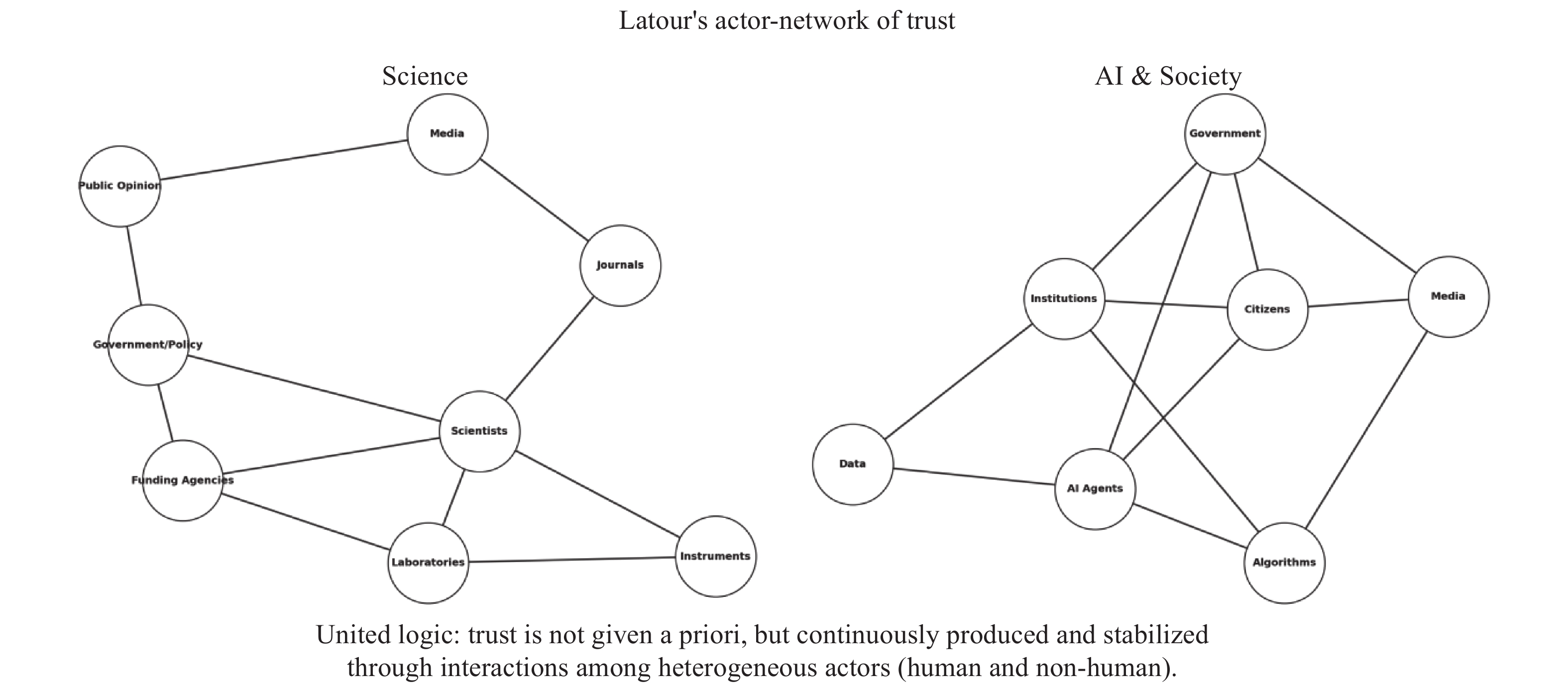
Latour, B. (1987). Science in action: How to follow scientists and engineers through society. Harvard University Press.
|
|
Levitsky, S. , & Ziblatt, D. (2018). How democracies die. Crown Publishing.
|
|
Mounk, Y. (2018). The people vs. democracy: Why our freedom is in danger and how to save it. Harvard University Press.
|
|
OpenAI. (2025). Collective alignment: Public input on our model specification. OpenAI. https://openai.com/index/collective-alignment-aug-2025-updates/.
|
|
Shao, Y. (2025年10月). Silicon-based economics: From compute as capital to an AI-shaped world order. 在2025年联合国大学人工智能大会上发表的论文.
|
|
Taylor, C. (2004). Modern social imaginaries. Duke University Press.
|
|
Tegmark, M. (2017). Life 3.0: Being human in the age of artificial intelligence. Alfred A. Knopf.
|

 中国人文社会科学核心期刊